 Heralds of the Gospel Magazine, Vol. 20, nº 227, September 2026
 Heralds of the Gospel Magazine, Vol. 20, nº 226, August 2026
 Heralds of the Gospel Magazine, Vol. 20, nº 225, July 2026
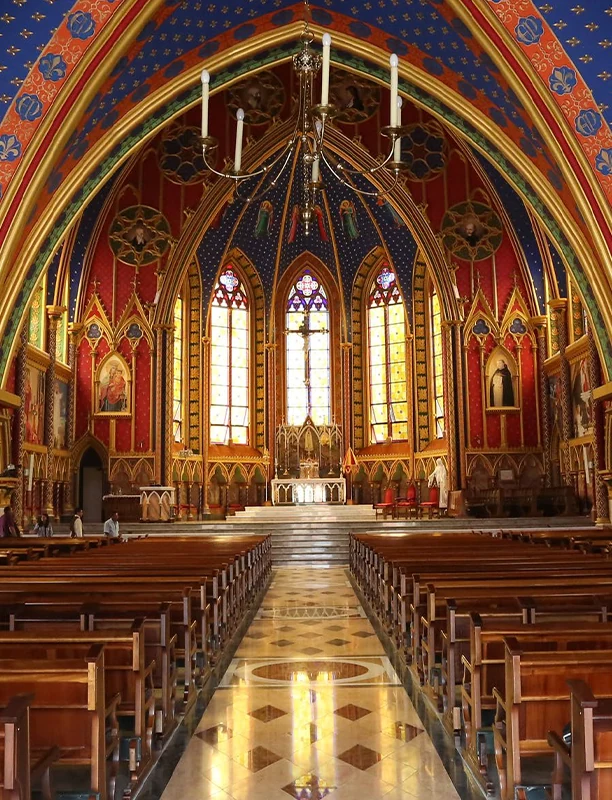 Who are the Heralds of the Gospel?
 Help of Christians
 Christmas Carols






 St. John Baptist de La Salle - St. Peter’s Basilica, Vatican
France’s Baptismal font, John Baptist’s cradle
Among the many glories that the French city of Reims can claim is the fact that it witnessed the birth of a new John the Baptist on April 30, 1651. This place, which had become the baptismal font of France when Clovis received his first of the Sacraments there around 498, and the mainstay of French faith when St. Joan of Arc saw Charles VII crowned there in 1429, also served as cradle to the man who would baptize countless French children “with the Holy Spirit” (Mk 1:8) in the troubled times that lay ahead. John Baptist, the firstborn of Louis de La Salle and Nicolasa Moët, enjoyed a childhood that unfolded in the midst of an affectionate family, piety and study. A favourite pastime of this child was to build oratories and imitate the sacred rites, in a domestic atmosphere enveloped in the tenderness of his parents and the vivacity of siblings. As a student, he displayed brilliant capacity.Canon of Rheims and theology student
The boy’s prominence in the academic world opened to him the office of canon of Reims at an early age. On Easter Sunday, 1666, he had performed masterfully at a literature competition and awards ceremony held at his school. His eloquence had drawn the attention of the elderly Peter Dozet, secretary and canon of Reims, prompting him cede his canonry to the Saint when he was only fifteen years of age, and had just received the tonsure. It was a prestigious post, but a burdensome one. As a member of the Chapter, he was obliged to participate in choir prayer: three long periods of official prayer in the name of the Church. His condition as a student exempted him from this duty on most days, but not from attending the various administrative meetings, participating in processions and filling several other duties. Cathedral of Rheims in 1722, by Pierre-Denis Martin - National Museum of the Castle of Versailles (France)
A clearly discerned call
In that historical context, much of the clergy was contaminated by a certain tepidity and laxity in their apostolic motivation. They sought favour with the nobles and well-to-do, to the neglect of the humbler classes. As a result, entire multitudes of children were lacking any religious formation whatsoever. On the other hand, a movement was now afoot in some French towns to found charity schools dedicated to these little ones, especially the poor and orphaned. The man behind this initiative, Mr. Adrian Nyel, was headed for Reims, intent on organizing a similar establishment there. Hearing rumour of the young canon’s virtue, he decided to seek his help. Fr. de La Salle allied himself to this labour, but was not long in noticing his companion’s superficial character. Nyel insisted on crisscrossing France in pursuit of new foundations without adequately securing those already begun. That nascent work resembled a seed that fell by the wayside. Nyel was the bird who took it up and brought it to the ground chosen by God but then continued in free flight across the skies… In the meantime, the Saint’s profound spirit saw the need to provide the teachers with solid religious formation before launching into ventures that could not sustain themselves. From this motion of grace, and after much prayer, Fr. de La Salle began to draw up the first outlines of the daring enterprise that he perceived to be his vocation: the founding a Religious Order. Nevertheless, Providence did not yet wish to plant the seed in fertile soil. It would first have to begin its growth in stony ground…The religious congregation is established
After a short period of community life with an emerging group of disciples, the first disagreements and dissatisfactions arose. It fell to the founder to sift through that group, realizing that many who had joined his project only sought to belong to a teaching body and had never so much as considered embracing a religious vocation. St. John Baptist de La Salle distributes his goods among the poor, by G. Gagliardi
Expansion and persecutions
Once their characteristic habit had been instituted, the name Brothers of the Christian Schools had been defined, and the first rules had been established, the work began to expand rapidly, but at the price of great suffering. In fact, on emerging from the soil, the sprout would only see the light through thorns. It would have to overcome them if the sap was to acquire vigour and stability. As word spread about the existence of free schooling, lay teachers began to feel threatened. Some families who could barely afford to keep their children in the conventional learning establishments preferred to transfer them to the charity institutions, which meant an increasing loss to mainstream teachers. The problem generated several lawsuits against the Brothers of the Christian Schools, to which the founder had to patiently respond. Meanwhile, the work advanced and developed: in 1691, two large-scale retreats were held; in 1692, the novitiate was founded; in 1694, the first profession of perpetual vows took place, and the rule was set and defined. The institution had taken the stature of an imposing religious congregation, but not everyone was pleased about it… In 1702, there were a few cases of brothers applying over overly severe punishments to transgressing novices. Some members of the clergy who harboured hostility towards St. John Baptist de La Salle pounced on this, alleging the Saint to be the one responsible for ordering such penalties to be imposed. Incited by these detractors, Cardinal Louis Antoine de Noailles made the decision to remove him from the office of superior and replace him with a priest unfamiliar with the foundational charism. The founder was informed that he was deposed, with the order to summon all the brothers of Paris to an assembly at which they would learn of the new measures. Professes the vows together with the first brothers, by G. Gagliardi
Final battles
In 1717, the second General Chapter was convened, in which the first Superior General – Br. Bartholomew – was officially nominated at the founder’s request, and the initial rule was revised. At that time, the community was reaching its maturity: “it had its own habit; it affirmed its lay state; the members professed three perpetual vows and there were suitable rules; the declared field of ecclesial apostolate was providing comprehensive education in the Christian schools; free education was considered indispensable; the community had an established hierarchy.”2 The founder would remain in recollection in Saint-Yon from then on, acting as confessor to the community and entirely obedient to the established superior. While his bodily health waned with each passing day, his soul likened him more and more to the Angels. The seed was now well set in fertile ground, the stones had crumbled and the thorns had been overcome; but for the fruit to reach full size, the seed had to die… En route to the summit of his calvary, in his debilitated physical state a few days before death, the Saint received an envoy from the local Archbishop informing him that he had been suspended from the use of holy orders and was thereby even forbidden to hear the brothers’ Confessions. It does not seem unlikely that the measure was due to old or new calumnies… St. John Baptist de La Salle drank this bitter chalice without complaint. Receiving the visit of the Archbishop of Rouen, byr G. Gagliardi
The work “post mortem”
The saint’s glorification followed shortly upon his death: in 1724 the Brothers of the Christian Schools received civil sanction and, the following year, the pontifical approval so long desired by the founder during his lifetime, from the hands of Pope Benedict XIII. In 1888, Leo XIII beatified him, canonizing him in 1900. And, in 1950, Pius XII proclaimed him Patron of Educators. Founded on firm rock and watered with the blood of its founder, the institute has produced much more than a hundredfold. After treading the most arduous paths – it was suppressed during the French Revolution, practically expelled from French territory in 1904, and lost the lives of 165 brothers to religious persecution in Spain – its members now number in the thousands, spread over five continents. But countless are the souls who have found their way to Heaven through the work of the Lasallians – a true Jordan of Grace, in whose waters a new John the Baptist glorified Christ. ◊Notes
1 GALLEGO, Saturnino. Vida y pensamiento de San Juan Bautista de La Salle. Madrid: BAC, 1986, v.I, p.362.
2 Idem, p.552.