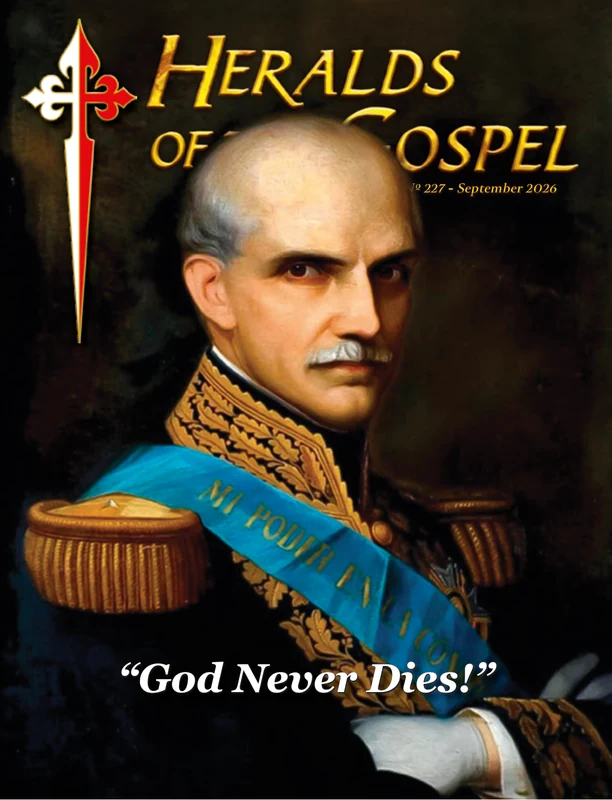
 Heralds of the Gospel Magazine, Vol. 20, nº 227, September 2026
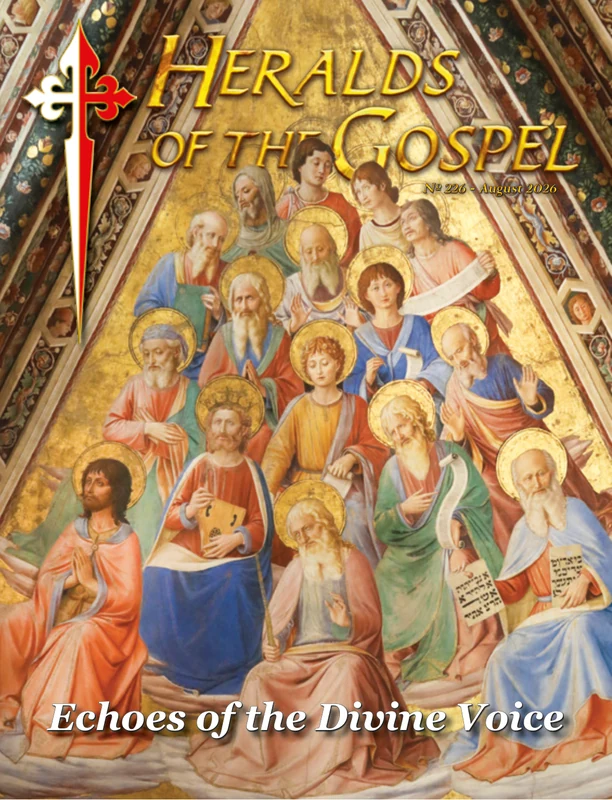 Heralds of the Gospel Magazine, Vol. 20, nº 226, August 2026
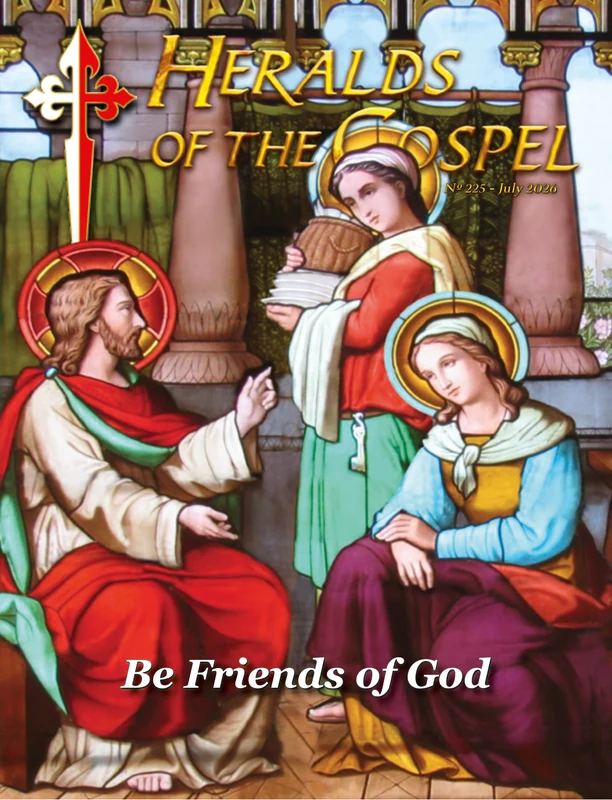 Heralds of the Gospel Magazine, Vol. 20, nº 225, July 2026
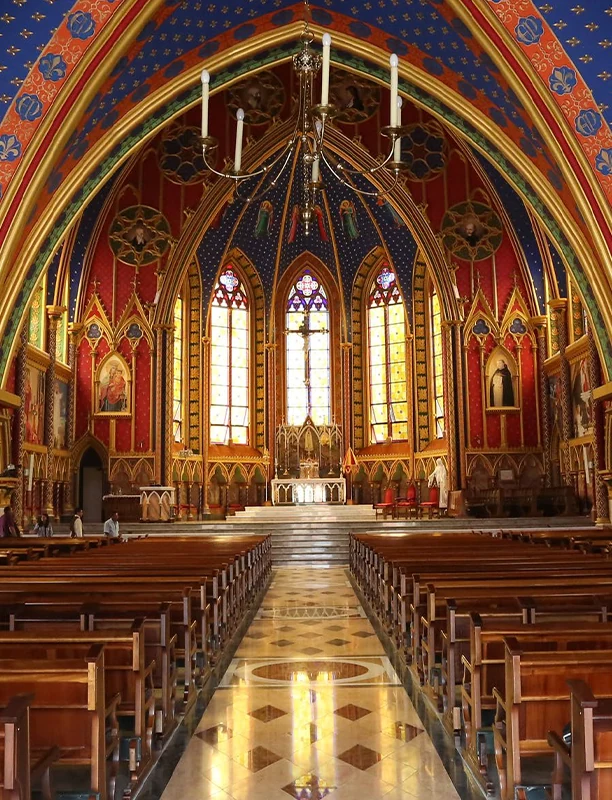 Who are the Heralds of the Gospel?
 Help of Christians
 Christmas Carols






Royal and priestly lineage
Joachim means “preparation for the Lord.”3 Like Jesus, he was born in Bethlehem, lived since childhood in Nazareth, and descended from King David. An upright and just man, Joachim had great admiration for two exemplary priests of his time: Eleazar, a venerable ancient living in Bethlehem, and the young Simeon, who carried out his duties in Jerusalem. When he had reached the age customary for marriage at that time, Joachim, aware of the seriousness of taking such a step, did not hesitate to first seek advice from these illustrious Levites. They both recommended a virtuous virgin called Anne, a name that means “grace”.4 Her father was from the priestly tribe of Levi and a native of Bethlehem, and her mother, a descendant of King David. Thus, we see united in Mary regal grandeur with priestly sacrality, which is entirely architectonic, “for She would give birth to Jesus Christ, King of kings and Supreme Priest, ‘holy, blameless, unstained, separated from sinners, exalted above the heavens’ (Heb 7:26).”5 After a certain period of time, the marriage took place, and the ceremony was officiated by the priest Simeon himself. The couple settled in Nazareth, where Joachim already lived. He was twenty-five years of age and Anne was approaching twenty. From the beginning, they endeavoured to ensure that their marriage was completely holy and pure, causing admiration among all those who knew them. In fact, God blessed them and they had – due to St. Joachim’s inheritance – a great deal of property.6 However, a terrible ordeal would befall their home.
The ordeal of unfruitfulness
As the years went by, the marriage proved fruitless in terms of offspring. In those days, this was often interpreted as a tremendous curse from God, because everyone married in order to have children, with the objective of achieving the honour of being ancestors of the Messiah. Because of this, it was not long before the holy couple began to suffer the worst insults, even coming from those closest to them. Twenty long years passed amid unspeakable humiliations. One day in particular, St. Joachim went, as usual, to make generous offerings at the Temple.7When he arrived, he was publicly rejected by a priest called Reuben, who declared that the offering of a man without offspring was not pleasing to the Lord.8 Msgr. João observes9 that, faced with such words, St. Joachim must have felt as though they were the confirmation, from the lips of a sacred minister, of his most grievous perplexity: “What have I done to God for Him to chastise me in this way?” Thus he returned home and described to his wife the humiliation he had suffered. Then, with her consent, he decided to retire to the mountains for a few weeks to pray and fast. They both sent requests to the venerable priest Simeon to make offerings to God in the Temple, asking Him to grant them offspring. But the darkness continued as the days passed, for the silence from on high prevailed. After some time, St. Joachim returned from his sorrowful retreat. However, in the midst of such trials, God’s hand can be glimpsed. Through the powerlessness of nature, He was preparing the way for His intervention, as St. John Damascene explains: “Nature had been overcome by grace and stood trembling, no longer ready to take the lead. Therefore when the Virgin Mother of God was to be born of Anne, nature did not dare to anticipate the fruit of grace; instead it remained without fruit until grace came forth with its own.”10Without offspring, Joachim and Anne endured twenty years of unspeakable humiliation before the Lord sent them the consolation of a promise
St. Gabriel and the Golden Gate
A year later, the Archangel St. Gabriel appeared to Anne, announcing to her in mysterious terms that she would give birth to a Girl: “The Daughter to be born of you will be the dawn of salvation and the door through which the promised Messiah will enter. She will be the ark of your victory, and will draw God to this earth.”11 The same Archangel, appeared to Joachim in a dream, telling him of the heavenly visit that Anne had received and revealing that a Daughter would be born to them, whom he was to name Mary. The next day, they discussed these supernatural events and decided to go to the Temple in Jerusalem to thank the Lord. By mutual agreement, they promised to consecrate the Child entirely to the service of God as soon as her age permitted. When they arrived in Jerusalem, they entered through the Golden Gate, the only gate with direct access to the Temple from the surrounding areas. This site would later become known in the Christian iconography of the first centuries as symbolic of Our Lady. Joachim and Anne surely realized something of the significance of the place: their Daughter would be the “Golden Gate par excellence, through which God Himself would enter the world, inaugurating a new regime of grace for humanity.”12 Advised by angelic illumination of the couple’s visit, Simeon the priest also went there to accompany and bless them.“The Daughter to be born of you will be the dawn of salvation, the door through which the Messiah will enter. She will be the ark of your victory”
The birth of Our Lady

The Presentation of Our Lady
When Mary had reached the age of three, Joachim and Anne set out to fulfil their promise to give her to God’s service in the Temple, and to this end the three of them set off for Jerusalem. Once they had settled in the Holy City after their arduous journey, as the sun was setting, St. Joachim announced to Mary that they would be going to the Temple the following day, which filled her with joy. Arriving at the Temple, the couple proceeded with the Child to a room where Simeon was. After proclaiming a beautiful prayer composed that very moment, St. Joachim gave his daughter to the priest, saying: “My daughter, I commend You to this son of Levi to be offered to the Lord, that You may serve Him all the days of your life. Be an immaculate offering to the God of our people, and may He visit us with the coming of the awaited Messiah.”16 After mutual thanks, Our Lady was entrusted to one of the maidens’ teachers and her parents withdrew.When Mary had reached age three, Joachim and Anne set out to fulfil their promise to give her to God’s service in the Temple
Last contacts on earth
St. Joachim and St. Anne frequently visited the Temple, of course, to be with their Daughter. On his last visit, St. Joachim was particularly feeble, and seeing this, Mary undertook, discreetly and maternally, to prepare him to cross the threshold of eternity. It is said that, on this occasion, he saw a beautiful halo shining on his daughter’s forehead and a legion of Angels standing guard around her. At this moment some aspect of Our Lady’s vocation was revealed to him.17
A mission that continues in eternity
Shortly after St. Anne’s death, Our Lady’s marriage to St. Joseph and the Incarnation of the Word took place. If St. Anne and St. Joachim had lived a few more years, they would have beheld God made Man with their own eyes. However, we can see that this was not intended for them. Their mission on this earth – to bring forth and protect the Treasure of the Most High, Mary – had already been fulfilled and so the Lord called them to Himself. However, in some way this mission continues in Heaven, and in a very special manner. It is evident that both of them are eager to intercede with their Daughter for each one of us and, above all, for the Holy Church. If it is true that the tree is known by its fruit (cf. Mt 7:16-20), what can we say about the blessed tree from which the Blessed Virgin was born?18 For our part, we should always take shelter under its shade because, through the intercession of this holy couple, our supplications to Our Lady will never fail to be answered. ◊The mission of protecting the Treasure of the Most High is prolonged in Heaven: both are eager to intercede with their Daughter for the Church
Notes
1 ST. JOHN DAMASCENE. Homélie sur la nativité, n.2: SC 80, 49.
2 Cf. ALASTRUEY, Gregorio. Tratado de la Virgen Santísima. 2.ed. Madrid: BAC, 1947, p.16.
3 Idem, ibidem.
4 BUTLER, Alban. Vidas de los Santos. Ciudad de México: John W. Clute, 1965, v.III, p.192.
5 CLÁ DIAS, EP, João Scognamiglio. Mary Most Holy: The Paradise of God Revealed to Men. Houston: Heralds of the Gospel, 2022, v.II, p.59; cf. ALASTRUEY, op. cit., p.11-14.
6 Cf. PROTOEVANGELIUM OF ST. JAMES. I, 1. In: SANTOS OTERO, Aurelio de (Ed.). Los evangelios apócrifos. Madrid: BAC, 2006, p.130.
7 Cf. GÜEL, Dolores. Santa Ana. In: ECHEVERRÍA, Lamberto de; LLORCA, SJ, Bernardino; REPETTO BETES, José Luis (Org.). Año Cristiano. Madrid: BAC, 2005, v.VII, p.787.
8 Cf. PROTOEVANGELIUM OF ST. JAMES, op. cit., I, 2, p.131.
9 Cf. CLÁ DIAS, op. cit., p.63.
10 ST. JOHN DAMASCENE, op. cit., n.2, 49.
11 CLÁ DIAS, op. cit., p.65.
12 Idem, p.66.
13 Cf. ALASTRUEY, op. cit., p.25; CLÁ DIAS, op. cit., p.77.
14 CLÁ DIAS, op. cit., p.81.
15 CADOUDAL, Georges. Sainte Anne. In: VIES DES SAINTS. 2.ed. Paris: Garnier Frères, 1854, v.III, p.116; cf. PROTOEVANGELIUM OF ST. JAMES, op. cit., VI, 2, p.140.
16 CLÁ DIAS, op. cit., p.132.
17 Cf. CADOUDAL, op. cit., p.116.
18 Cf. ST. JOHN DAMASCENE, op. cit., n.5, 57.