 Heralds of the Gospel Magazine, Vol. 20, nº 227, September 2026
 Heralds of the Gospel Magazine, Vol. 20, nº 226, August 2026
 Heralds of the Gospel Magazine, Vol. 20, nº 225, July 2026
 Who are the Heralds of the Gospel?
 Help of Christians
 Christmas Carols
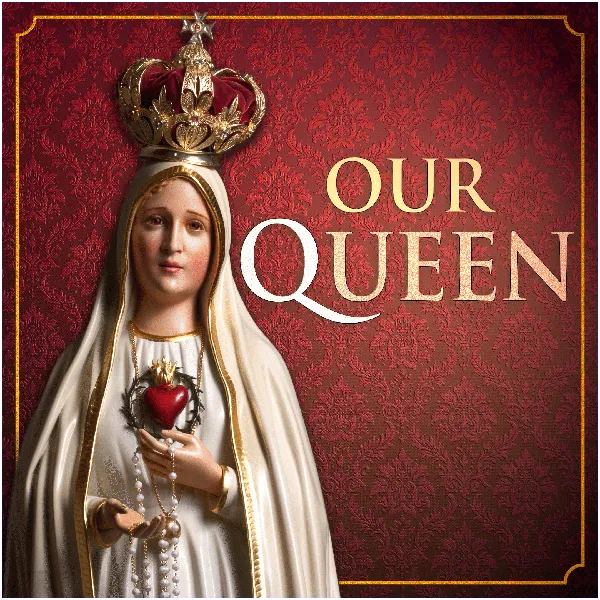








From eternity, St. Jane de Chantal continues the mission begun on this earth together with St. Francis de Sales: to prevent the bonds of love that unite chosen souls to Heaven from being broken.
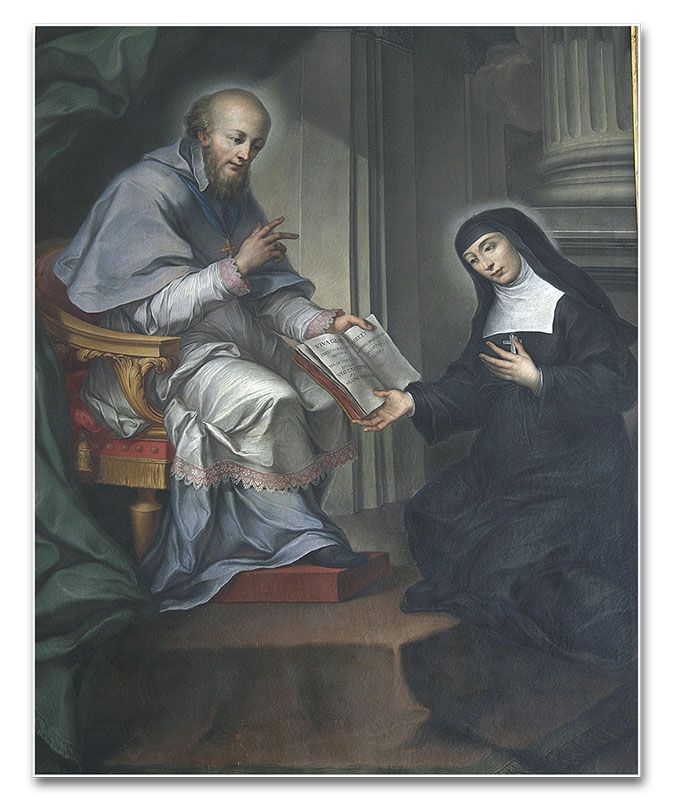 St. Francis gives the Rules to St. Jane de Chantal
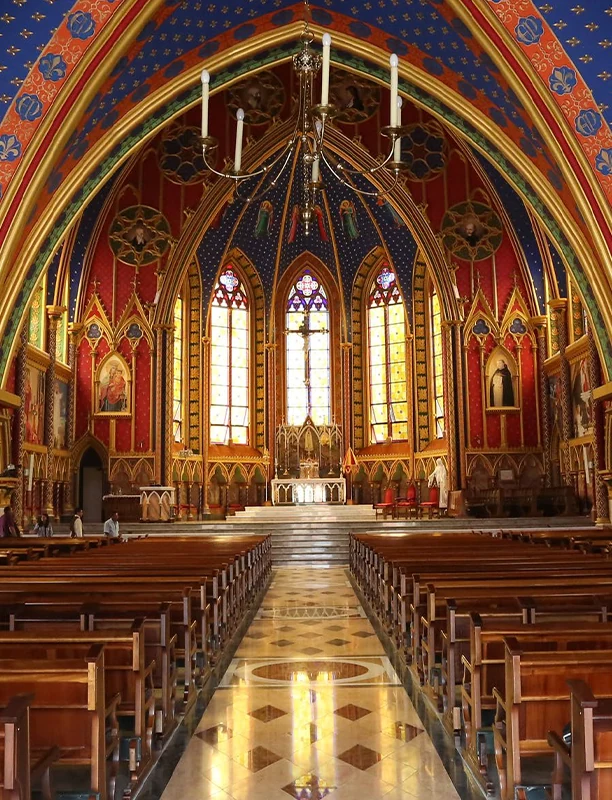
 Visitation Monastery, Genoa (Italy)
A girl with a strong and lively spirit
Jeanne-Françoise Frémyot de Chantal was born in Dijon, on January 23, 1572, during the pontificate of St. Pius V. Her father was the magistrate Bénigne Frémyot and her mother, Marguerite de Berbisey, died when the girl was only eighteen months of age, leaving behind three children to the care of her spouse. A few hours after coming into the world, the infant girl was baptized with the name of Jane, in honour of the Blessed commemorated on that day, St. John the Almoner. Years later, when anointed with the holy oil of Confirmation, she was given the name Frances, in homage to the sweet Poverello of Assisi. Unlike her sister Margaret, two years older, Jane was an extremely vivacious child. Just when her father thought she was busy with her daily duties under the eye of her governess, he might be surprised to find her running after chickens in the barn, while her little three-year-old brother Andrew cried, startled by the tremendous commotion created by Jane’s mischief. While the firstborn took pleasure in sewing, embroidery, and music, and Andrew in reading, Jane preferred horseback riding and asking her father questions, drawing him into filial debates. Her relatives even commented on the lack of femininity they felt she displayed, thinking it was due to her mother’s absence. However, the father sensed something deeper in his daughter’s way of being, and so he defended her and reinforced the strength of spirit that she showed in little everyday actions. Her modesty, for example, stood out when she was among girls her age. To her humility were united a combative purity and vigilance, which gave her a horror of everything that might separate her from God, especially people of bad character. She had such an aversion to heretics that when such persons took the little child into their arms to carry her, she would begin to scream until they let her go!“This is how they will burn in hell...”
Among the episodes that marked her childhood, one draws special attention for revealing to what degree her external attitudes were a reflection of an innocence that was never tolerant towards evil. One day, when Jane was only five years old, her father was at home arguing with a Calvinist pastor, who explicitly denied the Real Presence of Our Lord in the Eucharist. Upon hearing this, the girl – who was following the conversation from a distance – declared to the heretic, without human respect and with the determination of a preacher: “Our Lord Jesus Christ is present in the Blessed Sacrament, because He himself said it. If you wish to deny what He has said, you make a liar of Him.” Seeking to earn the good graces of the little one, the Calvinist gave her some caramel candies. But Jane immediately threw them into the fire, declaring: “This is how the heretics, who do not believe what Jesus Christ said, will burn in hell.”1 Baronness de Chantal attending the preaching of St. Francis de Sales -
 Church of Notre-Dame, Dijon (France)
“Virtus vulnere virescit”
In her adolescent years, Jane’s golden innocence took on the crimson hue of trial, as she witnessed the devastation resulting from the religious wars in her homeland. Churches were destroyed, and crosses could be seen cast into the streets. Quite often the girl showed how much she suffered contemplating this scenario, shedding discreet tears. When Bénigne Frémyot decided that the time had come for his daughter to start a family, he recommend Christophe de Rabutin, the Baron of Chantal, as a spouse. She serenely assented, trusting in her father’s discernment. “Virtus vulnere virescit – courage grows stronger with a wound.” This motto, which the Baron of Chantal displayed on his coat of arms, reached perhaps its maximum form of expression when the bonds of marriage united Jane to this noble family. The couple had four children, but when these were still very young, a painful trial ensued: Christophe was accidentally shot during a hunt and died a few days later. With manly courage and peace of mind, Jane faced this harsh blow that left her a widow at twenty-eight years of age.Maternal affection and purity of heart
It did not take long for her to make up her mind not to marry again, like the strong Judith praised in Sacred Scripture: “And chastity was joined to her virtue, so that she knew no man all the days of her life, after the death of Manasses her husband” (Jdt 16:26). She then made a vow of chastity, taking Our Lord Jesus Christ as her Spouse. Jane disposed of numerous belongings and donated a great part of her wealth to the poor, beginning to live almost like a nun inside the castle. Instead of taking part in the social festivities that her noble condition offered her, she spent her time caring for her children and seeing to the needs of the servants and field workers. All the pleasures that filled the daily life of a French lady of the early seventeenth century were rejected by her and replaced by prayer and the practice of charity. The young widow’s physical beauty was no longer set off with adornments and jewels, but with maternal affection united to purity of heart. Her countenance had become a clear mirror of her interior. Nevertheless, to her affliction, this prompted her father’s zeal to search for another suitor. However, from all eternity Providence had reserved for Jane de Chantal a very different partner from that imagined by Bénigne Frémyot. It was not at court that she would find him, but in the pulpit... The baroness’ father had not been able to understand the longings of his daughter, who faithfully let herself be guided by the breath of the Holy Spirit. St. Francis de Sales receives s St. Jane Frances de Chantal - Church of Notre-Dame in Beaune, (France)
New type of alliance between the children of light
The holy friendship that was thus established between the two evokes the sublime union existing among the Saints in Heaven, entirely characterized by the most pure and heartfelt affection. This is how St. Francis de Sales wrote to St. Jane in a note: “It seems that it was God who gave me to you. I am more and more convinced of this. At the moment all I can say to you is: recommend me to your Guardian Angel.”3 Later, he pondered in another letter the precious quality of this spiritual relationship: “This friendship is whiter than snow, purer than the sun; that is why I did not rein it in... allowing it freely follow its course.”4 St. Francis de Sales “felt so united to his correspondent that he dropped from his language all words that indicated any distinction. He even spoke of ‘our heart’, which he saw and perceived as ‘being one’. Only ‘He who is unity by essence’ could ‘merge two spirits so perfectly that they were no longer but one spirit, indivisible and inseparable.’ The tone of their correspondence sometimes ran the risk of causing surprise. For example, the affectionate good nights which he wished her: ‘Good night, my dearest daughter, but a million good nights. Remain as you are, always sweet, and take the rest required by our body.’”5 More than a noble sentiment, the love between the two reflected a new type of alliance between the children of light, by which the grace that dwells in the soul of one communicates to the soul of the other and leads to a love for God that each would never attain alone. St. Jane Frances de Chantal - Cathedral of Saint-Gatien, Tours (France)