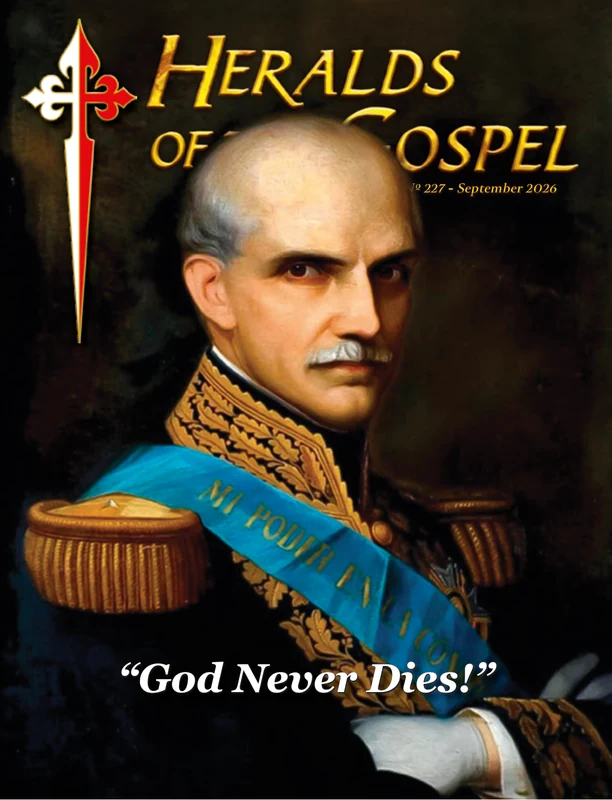
 Heralds of the Gospel Magazine, Vol. 20, nº 227, September 2026
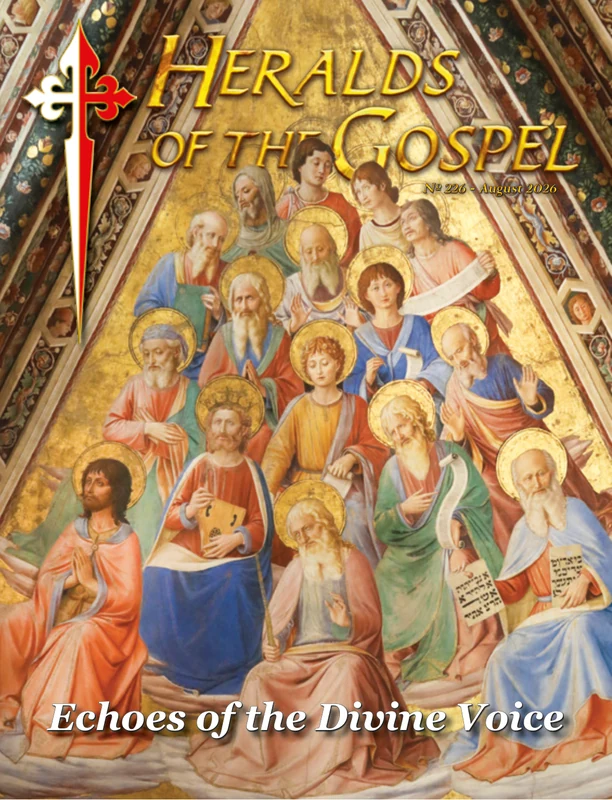 Heralds of the Gospel Magazine, Vol. 20, nº 226, August 2026
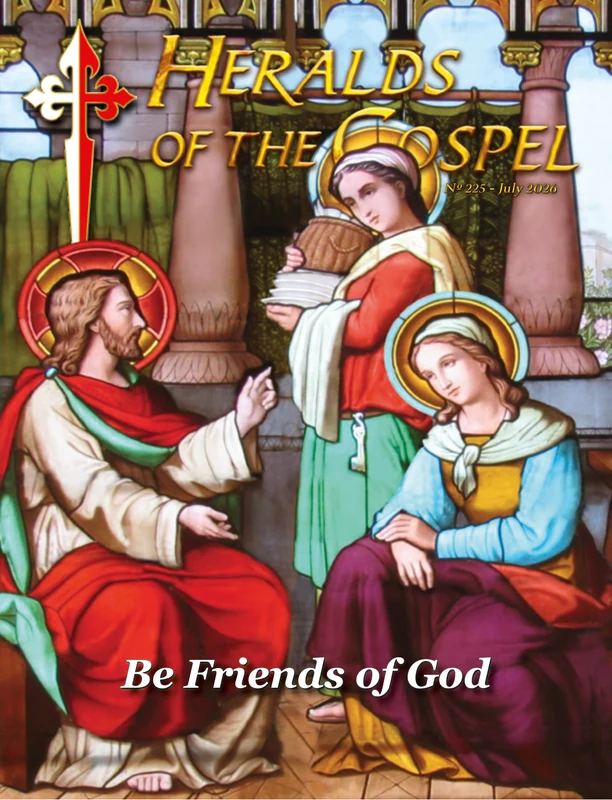 Heralds of the Gospel Magazine, Vol. 20, nº 225, July 2026
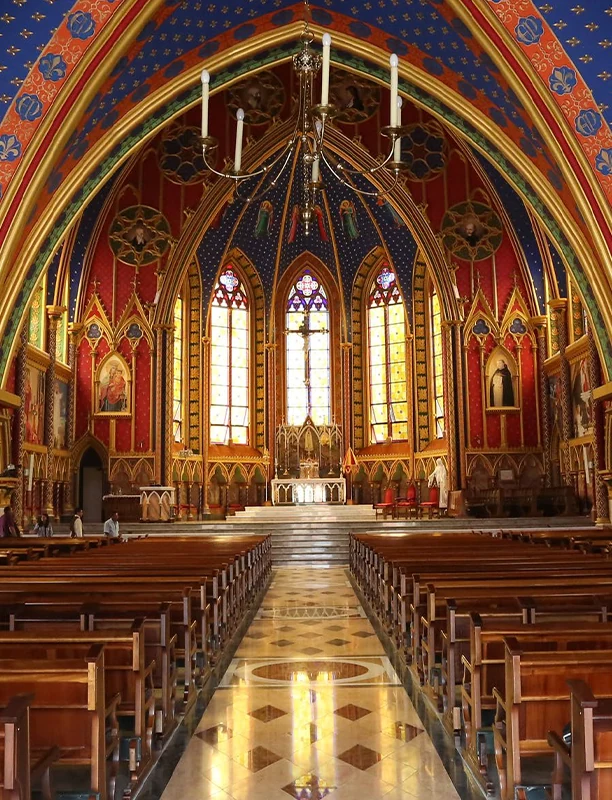 Who are the Heralds of the Gospel?
 Help of Christians
 Christmas Carols







Rewarded for their love and submission
Theology tells us that the heavenly spirits received from God a mysterious revelation concerning the plan of creation, whose acceptance or rejection divided them and provoked a great battle in Heaven, in which the rebellious angels were cast into Hell (cf. Rv 12:7-9). Some authors affirm that in this trial of the Angels, “God gave them a foreknowledge of the Incarnation, and asked them to worship the God-Man. However, the Divine Word would have been presented to them, not in all His glory and power, but wrapped in the human veils of poverty, suffering and humiliation. Another theological current, supported by numerous Saints and Doctors, affirms that this was not the only trial. They add to the adoration of Christ the acceptance of Mary Most Holy as Mother of God, and Queen of Angels and of the whole universe.”1 With each act of submission to the designs of the Most High, the faithful spirits contemplated a new aspect of their missions, until, from light to light, they reached the height of the splendour for which they had been created. In the great heavenly combat, St. Gabriel must have shone like no other for his enthusiastic and unconditional love for the revelation about the Blessed Virgin, for he received as a reward a role of incomparable importance in relation to Her: he was to represent God Himself before the Queen of the universe – therefore also his Sovereign – and to beseech her consent to be the Mother of the Messiah. “To reveal Mary to Mary, to render Her, therefore, this eminent service, is an act of supreme nobility, which established an altogether special bond between the Archangel and Our Lady. He became a kind of prophet, who indicated to the Blessed Virgin how her whole life and mission was to be.”2Intimate relationship with the Queen of Angels
While all the Angels were asking themselves “Quæ est ista?” (Cant 6:10), St. Gabriel knew God’s plan for Our Lady and had a burning desire to communicate with Her, in order to convey to Her in some way that divine love which hovered over Her and which he had contemplated at the very beginning of Creation. Moreover, the Archangel’s mission required him to closely accompany Mary from the very first moments of her existence. It was necessary for him to analyse her attitudes, her way of thinking, her inner movements, so that when the great hour came for him to represent the Divine Holy Spirit before His Spouse, he could present the message in a beautiful and amenable manner, with holy diplomacy, so as to move Mary’s heart, in its most perfect humility, to say “yes”. A relationship must have been established between the two, similar to that between a Guardian Angel and his ward.3 We can imagine him at the birth of Our Lady, taking Her in his arms, covering Her with his wings and showing Her the care of a true father. He must have exercised this attentiveness especially in the period when She was in the Temple without the presence of her parents, St. Joachim and St. Anne. At times, too, when the Virgin, being a most sublime creature, found herself rejected by those around Her, or when She felt mystified by her very self because She did not comprehend her own grandeur, St. Gabriel must have come to Her, enlightening and comforting Her. In short, the Archangel was for Our Lady the very presence of God and of His infinite love for Her. On the other hand, while he had a protective affection for Mary owing to his superior nature, he also had a filial love for Her, for it was through the Mother and Mediatrix of Divine Grace that he had received, ante previsa merita, the gift of being faithful in his trials. For this reason, in addition to being his Queen, the Blessed Virgin was also the Mother who had granted him a share in the divine life.Receptacle of the “fiat” that changed history…
 St. Gabriel received as a reward the mission of representing God Himself before
 the Queen of the universe
St. Gabriel - Church of St. Margaret, Munich (Germany)
…and of the sorrows that co-redeemed humanity
The Annunciation was probably the climax of St. Gabriel’s mission, but not his last involvement with Our Lady. As we know, it is the Angels who present our prayers to God, and it is they who guard us on our way to eternity. Therefore, even after the Incarnation, St. Gabriel “must have continued his Marian ministry, acting as an intermediary between God and the Blessed Virgin.”5 We can imagine him contemplating Mary and the little Jesus, filled with awe and veneration. He who in imitation of his Lady analysed all these things and kept them in his heart (cf. Lk 2:19), carefully collected every act of love, devotion and respect that he had the privilege of witnessing. In his tireless dedication, what was St. Gabriel’s mode of action during the most dreaded and decisive moment of his charge’s life, the Passion? It seems fair to think that in those hours of unspeakable suffering, he sought more than ever to support, comfort and protect Her. Indeed, were it not for a special angelic protection, it would be difficult to understand how, in the midst of the violent and satanic chaos that surrounded the tragedy of the Crucifixion, no one attacked Our Lady’s physical integrity. Unwilling to allow His most loving Mother to be so much as touched by the infernal powers, Jesus wanted this powerful Archangel to be constantly at her side as an invincible defender. Nevertheless, “because of the insight into Mary’s immaculate soul that the Blessed Trinity had given him, the Archangel knew that although he guarded Her from external attacks, he would not be able to ward off the interior sufferings that came from her direct relationship with God.”6 He was, therefore, the receptacle not only of her fiat, but also of her incomparable inner sufferings, of her tears and of her sighs, to present them to the Father as a sacrifice of pleasing fragrance, and to the most afflicted Heart of Jesus as a sweet consolation. We do not know how painful it must have been for St. Gabriel, in those august hours, to see his beloved Queen suffer so much. Everything indicates that “if an Angel were to weep, there would be no ocean capable of containing his tears…”7 Paradoxically, however, he drew his strength from the very determination, composure and seriousness that emanated from Our Lady.Champion of devotion to Mary
 St. Gabriel was the receptacle not only of her “fiat”, but also of her inmost sufferings, of her tears and of her sighs, to present them to the Father
Virgin and Angel of the Annunciation, by Nardo di Cione -
Alana Collection, Newark (Delaware)
Notes
1 MORAZZANI ARRÁIZ, EP, Pedro Rafael (Org.). A criação e os Anjos [Creation and the Angels]. São Paulo: Lumen Sapientiæ, 2015, p.147.
2 CORRÊA DE OLIVEIRA, Plinio. Conference. São Paulo, 24/3/1972.
3 Cf. MORAZZANI ARRÁIZ, op. cit., p.184.
4 CORRÊA DE OLIVEIRA, op. cit.
5 MORAZZANI ARRÁIZ, op. cit., p.184.
6 CLÁ DIAS, EP, João Scognamiglio. Maria Santíssima! O Paraíso de Deus revelado aos homens [Mary Most Holy! God’s Paradise Revealed to Men]. São Paulo: Arautos do Evangelho, 2020, v.II, p.460-461.
7 Idem, p.461.