 Heralds of the Gospel Magazine, Vol. 20, nº 227, September 2026
 Heralds of the Gospel Magazine, Vol. 20, nº 226, August 2026
 Heralds of the Gospel Magazine, Vol. 20, nº 225, July 2026
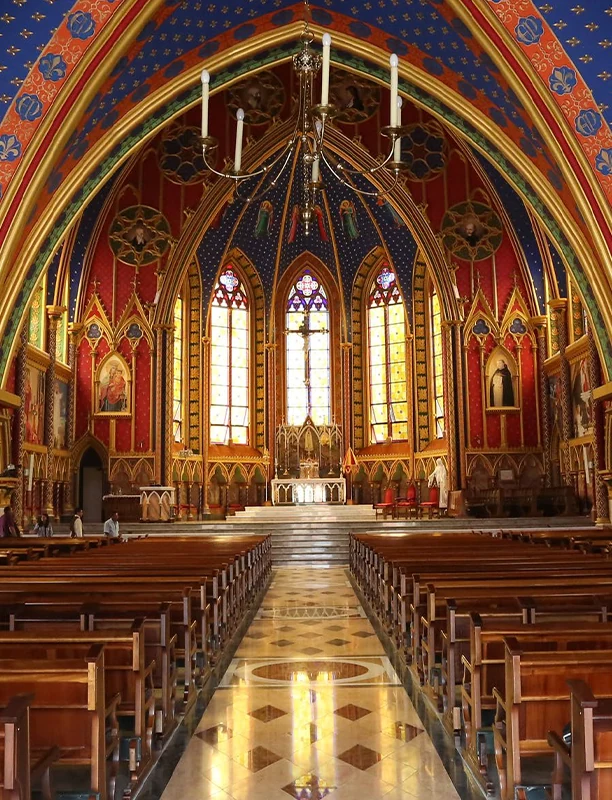 Who are the Heralds of the Gospel?
 Help of Christians
 Christmas Carols







A unique vocation arises amidst the moral decadence of the 15th century: a solitary who gathers crowds, a penitent who lives for twenty-four years in the courts, a prophet and wonder-worker who chooses to call himself “Minimo”.
The dawn of a great vocation
Fifteen years had passed since Giacomo D’Alessio had married Vienna di Fuscaldo, but Providence was requiring that they endure the harsh trial of childlessness. The couple decided to do violence to Heaven. They went on pilgrimage to Assisi, where the Poverello had been working miracles for two centuries, and begged St. Francis to grant them a child. Shortly after their return to Paola, the enigmatic portent described above occurred. Finally, on March 27, 1416, Giacomo’s home again became the talk of the town: friends and relatives flocked there to meet the couple’s newborn son, who was given the name of Francis in honour of the Saint of Assisi. Giacomo and Vienna, recalling the phenomenon that had presaged his birth, understood that God had given them an unusual heir. To confirm the predilection of Providence for the child, he was soon marked with the glory of suffering. When he was still very young, an abscess in his eye threatened to leave him blind. Once again, his pious mother hastened to the feet of the Stigmatist of Assisi and promised to offer her son as an oblate for a year, as soon as he was old enough. Mysteriously, on her return to Paola, she felt herself filled with great peace of mind and the certainty that she had been heard. From that moment on, the child began to recover until only a small scar was left, which would remain until the end of his life as testimony to the fact.A unique way of living
When Francis was about thirteen years old, Vienna judged him ready to be given over to God’s service and presented him to the Franciscan friary of San Marco Argentano. Already advanced in the practice of prayer and penance, due to the formation received from his pious parents, the boy would discover with the Friars Minor the first glimpses of his extraordinary vocation. The Franciscans believed he would make an excellent member of their Order; however, God was calling him to fight on other fronts. When his year as an oblate was over, Francis returned to the home of his childhood, but shortly afterwards set out again, accompanied by his parents, for a long pilgrimage which would pass through Rome, Assisi, Loreto, Monteluco and Montecassino. It was on this journey that he finally discerned his special mission. He would return to Paola, but not to his family home; his abode would be in the nearby caves, where he would live as a hermit. Clad in sackcloth and girded with a rough rope, the young anchorite thus began the period of retreat in which God would forge his soul for future battles. It was not long before his example attracted other vocations: after only five years, numerous huts had sprung up around Paola, inhabited by ascetics who conformed to the rule of life established by the virtuous man of God and followed his counsels. In short order, the “hermits of Friar Francis” – as they were called by the people – inspired the creation of new communities in the then Kingdom of Naples, and the fame of the hermit began to spread throughout Europe. Nevertheless, the constitution of the Order of the Minims was not to be achieved without obstacles. In 1467, learning of the curious lifestyle led by these religious, Pope Paul II sent Monsignor Baldassare de Gutrossis to Calabria as his legate. Arriving at the rustic locale where the Saint lived, the prelate asked to meet with him, and was promptly attended. He then informed the monk that the way of life he had imposed on his disciples “was not compatible with the weakness of our nature” and was therefore “disapproved of by the most prudent people”1 of the time. He concluded his exposition by stating that Francis should modify the practices of his followers. Hearing this, the monk said nothing, but went to the brazier beside which they were both warming themselves and, taking some burning coals into his bare hands, said to his visitor: “Look, Monsignor: for those who love God, anything is possible!” The astonished prelate took his leave, kissing the tunic of the miracle-worker. Before returning to Rome, he sought out some persons who had long been closely acquainted with St. Francis and his confreres, to hear what they had to say. Their testimonies yielded abundant documentation in favour of the religious, which satisfied the Pontiff and allayed his concerns. However, since Paul II died a few years later, it fell to his successor, Sixtus IV, to grant approval to the congregation in 1474. Years later, the holy founder undertook to draw up a rule that would govern his Order throughout the centuries. He wrote it amidst much prayer and penance, clearly outlining the “perpetual Lenten” lifestyle that defines the charism of the Minims. It was definitively approved in 1506 by Pope Julius II. The growing expansion of the Order soon made it necessary to establish both a female and tertiary branch.Extraordinary wonder-worker and example of humility
As if Francis’ shining virtue were not enough to attract the crowds, God had endowed him with the gift of working miracles. Scenes from the life of St. Francis of Paola: at left, he is saved from the fire that broke out during the construction of the monastery;
 at right, the crossing of the Strait of Messina on the Saint’s mantle – Vatican Museums
God’s voice resounds in the courts
Unlike so many others, he would not allow himself to be tarnished in any way by the worldly atmosphere of the palaces; on the contrary, like a new John the Baptist, he would be the very voice of God crying out in consciences. When Francis arrived at the court of King Ferrante of Naples in 1482, the monarch immediately tried to mitigate his reproaches by showering him with gifts. One day he offered the man of God a silver tray filled with gold coins with which to build a monastery, to which the saint replied: “Your Majesty, your people are oppressed; there is widespread discontent; the adulation of the courtiers prevents the cries of so many misfortunes from reaching your august throne. Remember, Your Majesty, that God placed the sceptre in your hand, not to satisfy your inordinate cravings for pride and vanity, but so that you would seek the happiness and well-being of your vassals. Do you believe that there is no hell for those who rule?”3 And he sternly exhorted him: “I adjure you, Majesty, to amend your conduct immediately and improve your government. If you do not re-establish order, peace and justice among your people – I must transmit to you on behalf of God – your throne will collapse and your lineage will soon become extinct!”4 To reinforce his words, the Saint took a coin and, squeezing it, made blood flow from it. Then he continued, “Behold, Your Majesty: the blood of your subjects cries out for vengeance before God!”5 Apparently, the fact was not enough to change the wicked heart of the king, whose lineage was extinguished while St. Francis was still alive.The miracle that no one expected
Another sovereign, Louis XI of France, reacted differently. Despairing at the prospect of death, he begged the holy man to come and cure him. On the Pope’s mandate, Francis made the journey in 1483. An extravagant reception cortege was prepared for him, but the hermit entered the country with his eyes downcast and, on reaching the royal castle, chose a nearby hut as his quarters. “Prolong my life, O priest!” the king pleaded with emotion. “The life of kings, Your Majesty,” replied St. Francis, “like that of all his subjects, is in God’s hands. Put your conscience and your State in order.” A great miracle began to take place, greater than a cure – greater even than a resurrection. The monarch, who for long years had lived far removed from the fear of God, was reconciled with his Creator and gave up his soul to Him on August 30, 1483, imploring: “Our Lady, my good Mother, help me!” His death occurred on a Saturday, as the Saint had prophesied, as an assurance that he would be protected by the Blessed Virgin.Sustaining the fidelity of St. Joan of Valois
The Hermit of Paola remained in France as an influential counsellor during the regency of Anne, daughter of Louis XI, and during the reign of Charles VIII. He also guided the King of Spain, Ferdinand the Catholic, in some matters, especially regarding the wars of the Reconquest and the expansion of the Faith in the New World. However, he was still to accomplish one last and glorious work in the lands of the Church’s firstborn daughter: to sustain the fidelity of Princess Joan of Valois, “the unloved daughter of Louis XI and the scorned wife of Louis XII, foundress of the Order of the Annunciation.”6 St. Francis of Paola was an “enlightened counsellor, a faithful friend and an angel of consolation”7 for this soul, tempered from childhood by trial, and whose merits before God were to become evident on Pentecost Sunday 1950, upon being proclaimed by Pius XII as St. Joan of France. St. Francis of Paola - Shrine of Our Lady of Victory, Malaga, (Spain)