 Heralds of the Gospel Magazine, Vol. 20, nº 227, September 2026
 Heralds of the Gospel Magazine, Vol. 20, nº 226, August 2026
 Heralds of the Gospel Magazine, Vol. 20, nº 225, July 2026
 Who are the Heralds of the Gospel?
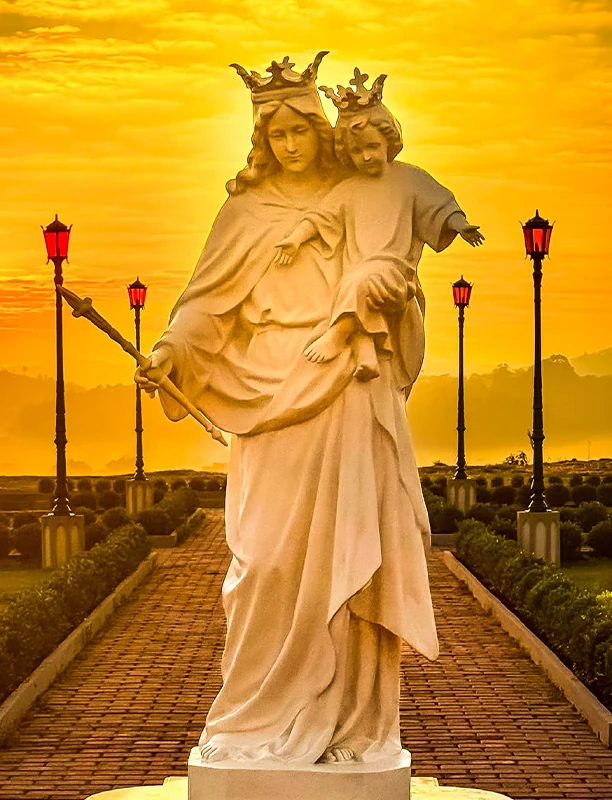 Help of Christians
 Christmas Carols







The King of kings marries a princess in Egypt
A native of Alexandria, in Egypt, Catherine was the daughter of a pagan king, Costus of Cyprus.1 Her beauty, majestic bearing, and erudition made her known to all. From childhood, she devoted herself diligently to her studies and was “well instructed in the art of rhetoric, philosophy, geometry, and other sciences.”2 But none of this satisfied her. Her penetrating spirit discerned the emptiness of this knowledge and perceived the lack of a “cornerstone” that would give it all meaning. One day, she had a vision: a Lady carrying a beautiful Child in her arms begged Him to accept Catherine among His servants. The Infant, however, refused. Despite the strong impression it made on her, Catherine was unable to grasp the deeper meaning of the scene. She continued her studies and later encountered the doctrine of the disciples of Jesus Christ, which completely captivated her heart. Everything enchanted her, and with each new discovery, her thirst for learning grew, always accompanied by celestial satisfaction. “Catherine is a Christian at heart, even before receiving baptism.”3 The vision she had seen then gained meaning, and she understood that all the wealth and knowledge in the world are worthless if one does not enjoy the Divine Child’s favour. After some time, the apparition repeats itself; this time, however, the Infant Jesus is holding a wedding ring and, with great affection, espouses the maiden in the presence of the celestial court.Instructed since childhood in the sciences of her time, she discerned their emptiness, and the lack of a “cornerstone” that would give them meaning
A great polemicist and invincible lady
 St. Catherine argues with the philosophers - Bavarian National Museum, Munich (Germany)
Strengthened by the heavenly messenger, Catherine presented herself before the renowned scholars and the governor, who was there, aroused by curiosity. Seated among them, she refuted all of their subtle and fallacious arguments, one by one. More than on her own erudition, she relied on the Saviour’s promise: “you will be dragged before governors and kings for my sake, to bear testimony before them and the Gentiles. When they deliver you up, do not be anxious how you are to speak or what you are to say; for what you are to say will be given to you in that hour; for it is not you who speak, but the Spirit of your Father speaking through you” (Mt 10:18-20). Maximinus was, at first, paralyzed with astonishment. Then he ordered the wise men to present more compelling arguments, but they were overcome by Catherine and finally came to recognize the existence of the one true God, saying: “We will sign this truth with our blood, if necessary.”7 So they themselves ultimately met their end by being cast into the fire, thus conquering, through martyrdom, the Kingdom of Heaven.Much more than on her own erudition, she relied rather on the Saviour’s promise: “what you are to say will be given to you in that hour”
Weakness meets confidence
But the princess’ epic was not ended. The Acts of the Martyrs record that she was then cast into a dungeon.8 Her resistance, serenity, and ardour were more eloquent than any words spoken by her lips. In this final period of her life, she converted many people to the Church, among them the empress herself, and the leader of a legion with two hundred soldiers, named Porphyry.Enraged after trying every means to persuade this noblewoman to apostatize from her belief in the true God, and to test her unyielding conviction, Maximinus condemned her to torture on an apparatus consisting of four wheels with iron teeth, designed to tear the victim to pieces. We can conjecture that the Lord once again allowed His servant to fear, upon hearing the sentence. It is plausible to imagine Catherine on her knees, begging for strength in that situation. Undoubtedly, her greatest fear was that, witnessing this torture, many Christians would become terrified and waver.Enraged at his failure to persuade the noblewoman to deny her belief in the true God, Maximinus found himself defeated once again by a miracle
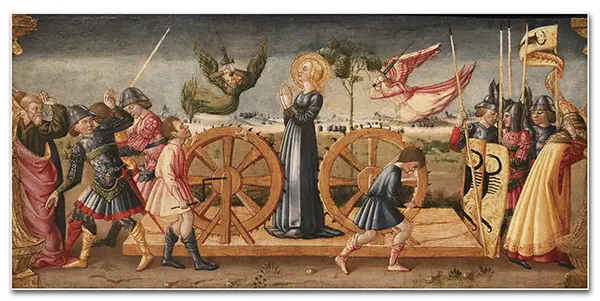 “Martyrdom of St. Catherine of Alexandria”, by Neri di Bicci - Art Museum of Catalonia, Barcelona (Spain)
A chaste body protected by Angels
The chronicles relate that instead of blood, milk flowed forth from her severed neck, which many interpret as a sign of her fertile virginity, that is, the spiritual motherhood that St. Catherine carries out in relation to a great number of souls.Tradition narrates to this day that it was the Angels who came and carried her body away, transporting it to Mount Sinai, and burying it there. Indeed, that chaste body was not to be touched by hands stained by sin. Only the heavenly spirits, with whom St. Catherine was in complete harmony by virtue of her purity, would bear it. Although these two episodes are not historically proven facts, our devotion can accept them wholeheartedly. It is certain that, if God did not perform these particular wonders to authenticate the fidelity of His servant, He must have performed greater ones, since He always surpasses all human imagination. In the 11th century, her remains were transferred to Rouen, France, and to this day, her relics exude a sweet fragrance. Why would the Princess of Alexandria have “gone” to that nation, the first-born daughter of the Church? Perhaps because, upon arriving in eternity, her mission had only just begun…The Angels came to carry her body away, and buried it at Mount Sinai. In this manner, that chaste body was not to be touched by hands stained by sin
 “The decapitation of St. Catherine of Alexandria”, by Lorenzo Monaco - Gemäldegalerie, Berlin
St. Catherine’s heavenly mission
Renouncing temporal titles in favour of those eternal, St. Catherine confronted the enemies of the Faith, resisted in disputes, suffered imprisonment, preserved her virginity, and remained steadfast in her convictions. Our Lord wished to grant her rewards for the victory she won, and one of them was to appoint her as the helper of virginal and heroic souls who would have to face similar situations. It is worth recalling, at least in passing, the role she played in the life of St. Joan of Arc. Accompanying St. Michael the Archangel and St. Margaret, the martyr of Alexandria appeared and instructed the Maid of Domrémy regarding the fulfilment of her lofty mission to save France. It was St. Catherine who showed the French heroine the hidden sword she was to use in battle. It was also she who revealed to her how she would be wounded and would be captured by the English; and on several occasions, St. Catherine encouraged her in her tribulations, especially in the episode when Joan threw herself from the tower where she was imprisoned. St. Joan of Arc kept a ring as a memento of her father. Her glorious protector kissed it, and from then on, the Pucelle preserved it as a precious relic. This same ring is venerated in France to this day.What has she yet to do?
Eternity, as the word indicates, is eternal: Thus, although St. Catherine of Alexandria has been in Heaven for centuries, her story and mission have only just begun… If the deeds she has already accomplished on behalf of her devotees and the great liberator of France are so extraordinary, what does God still have in store for her from now on? Her graces have not run dry; her power of intercession has not waned! Let us not hesitate to invoke her in times of difficulty, especially if we are defending goodness and truth, virtue and the name of God and His Church. There is no doubt that St. Catherine of Alexandria will come to our aid with the brilliance and power that have always characterized her. ◊Notes
1 Cf. PEREIRA, Ney Brasil. Santa Catarina de Alexandria. 2.ed. Florianópolis: [s.n.], 2015, p.20.
2 SYMEON METAPHRASTES. Martyrium Sanctæ Catharinæ, n.5: PG 116, 279-282.
3 GONZÁLEZ VILLANUEVA, Joaquín. Santa Catalina de Alejandría. In: ECHEVERRÍA, Lamberto de; LLORCA, SJ, Bernardino; REPETTO BETES, José Luis (Org.). Año Cristiano. Madrid: BAC, 2006, v.XI, p.606.
4 Cf. Idem, p.608.
5 Cf. Idem, p.608-609.
6 ROHRBACHER. Vida dos Santos. São Paulo: Américas, 1961, v.XX, p.241.
7 Idem, p.242.
8 Cf. GONZÁLEZ VILLANUEVA, op. cit., p.610.