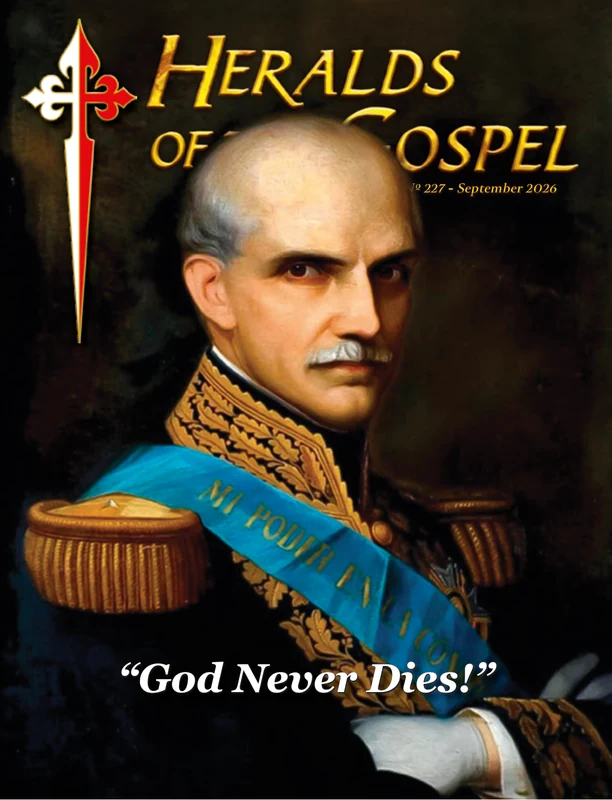
 Heralds of the Gospel Magazine, Vol. 20, nº 227, September 2026
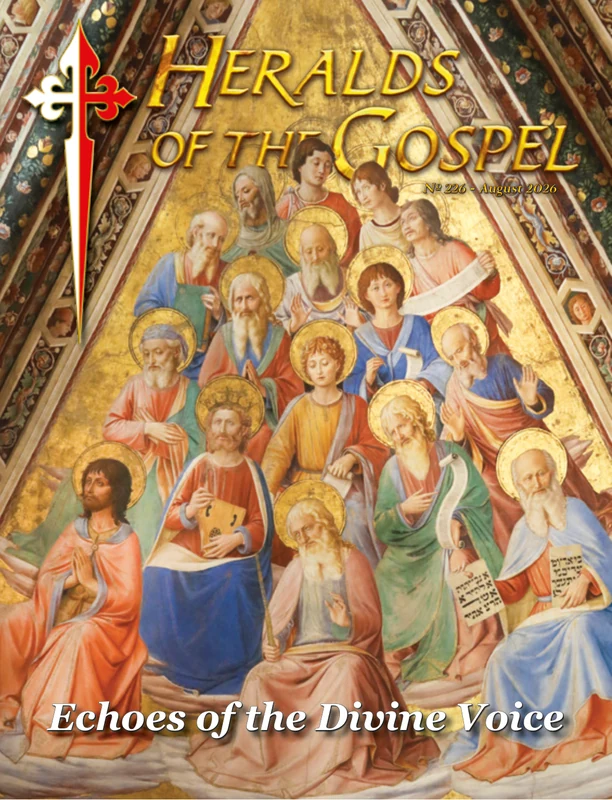 Heralds of the Gospel Magazine, Vol. 20, nº 226, August 2026
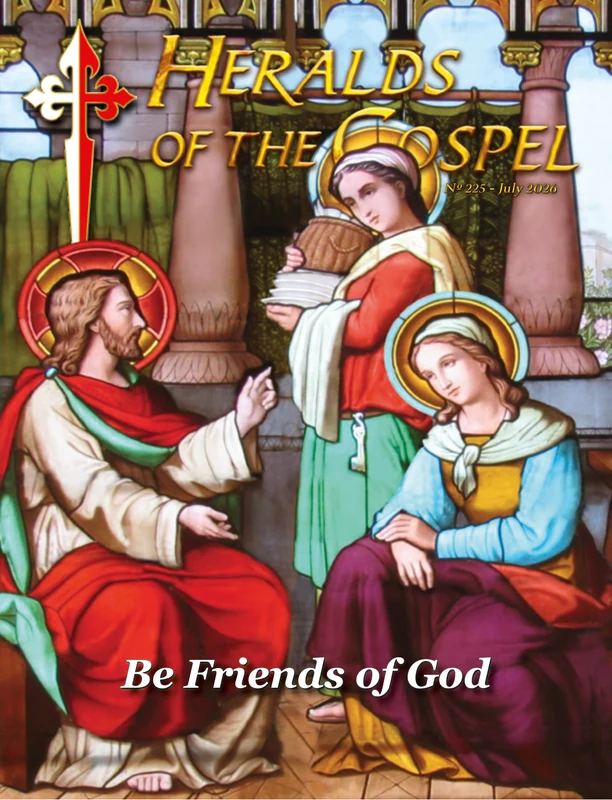 Heralds of the Gospel Magazine, Vol. 20, nº 225, July 2026
 Who are the Heralds of the Gospel?
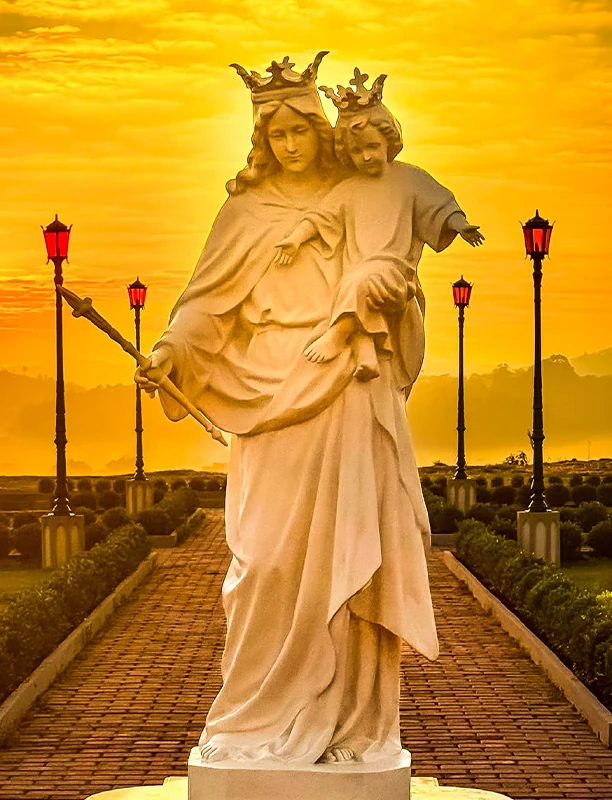 Help of Christians
 Christmas Carols







Gospel of the Twenty-Sixth Sunday in Ordinary Time
Jesus said to the Pharisees: 19 “There was a rich man who dressed in purple garments and fine linen and dined sumptuously each day. 20 And lying at his door was a poor man named Lazarus, covered with sores, 21 who would gladly have eaten his fill of the scraps that fell from the rich man’s table. Dogs even used to come and lick his sores. 22 When the poor man died, he was carried away by Angels to the bosom of Abraham. The rich man also died and was buried, 23 and from the netherworld, where he was in torment, he raised his eyes and saw Abraham far off and Lazarus at his side. 24 And he cried out, ‘Father Abraham, have pity on me. Send Lazarus to dip the tip of his finger in water and cool my tongue, for I am suffering torment in these flames.’ 25 Abraham replied, ‘My child, remember that you received what was good during your lifetime while Lazarus likewise received what was bad; but now he is comforted here, whereas you are tormented. 26 Moreover, between us and you a great chasm is established to prevent anyone from crossing who might wish to go from our side to yours or from your side to ours.’ 27 He said, ‘Then I beg you, father, send him to my father’s house, 28 for I have five brothers, so that he may warn them, lest they too come to this place of torment.’ 29 But Abraham replied, ‘They have Moses and the prophets. Let them listen to them.’ 30 He said, ‘Oh no, father Abraham, but if someone from the dead goes to them, they will repent.’ 31 Then Abraham said, ‘If they will not listen to Moses and the prophets, neither will they be persuaded if someone should rise from the dead’” (Lk 16:19-31).
I – The Root of Attachment to Money
As children come into contact with the reality surrounding them, at the dawning of the light of reason, they feel small and powerless before a universe that seems immense and unfathomable. Accordingly, children readily believe that other beings are superior to them, assume a position of dependency towards older people, and have complete trust in the protection of their parents. This attitude of innocence allows children to accept without difficulty the existence of a world beyond the reach of their senses, which can be neither seen nor touched. Thus, they are predisposed to live in openness to the supernatural. With the passing of the years, however, a strong tendency to be self-sufficient shows itself in the human soul. Then, especially when virtue is lacking, the soul becomes impenetrable to all that is beyond its nature and which it cannot control, such as the principles of the Faith. As a result, people will prefer to deal with concrete things that call for management skills, such as money, work, studies and family. They imagine themselves secure by being able to dominate in these areas. Thus, as the heart distances itself from God and follows the path of pride, giving vent to this tendency to control everything, a “religion” begins to emerge, in which the five senses are considered absolute: it is the worship of the palpable, of the sensible, of the material, of that which provides a person with apparent stability. From this perspective, in every age, ever since the first monetary trade in history was established, no other good has been coveted as much as money. It is seen as the chief means for navigating life with security. Everyone dreams of winning the lottery, finding treasure, receiving a large inheritance or some other way of having fortune suddenly knock at their door. However, while it is true that the abundance of possessions favours a carefree life, “he who loves money will not be satisfied with money” (Eccl 5:10), and will never obtain inner peace. This problem is the backdrop against which the eloquent parable of the rich man and the poor Lazarus unfolds. St. Luke presents it as the culmination of a sequence of teachings given by Our Lord on the use of wealth. Left, Return of the Prodigal Son - St. Francis Xavier Cathedral (Green Bay, Wis.), centre, the Good Samaritan - St. Patrick’s Church, New Orleans; at right, the Good Shepherd - Church of Our Lady of Mercy, Salta (Argentina)
II – A Parable for the Pharisees
The Gospel for this Twenty-Sixth Sunday in Ordinary Time features one of the sermons Jesus delivered while on His way to Jerusalem during the third year of His public life. Just prior, He had narrated the three parables of mercy to illustrate how entirely ready God is to receive everyone. Immediately following this, the Evangelist records the parable of the unfaithful administrator, which was addressed to the disciples in a discourse that concluded with the categorical statement: “You cannot serve God and mammon” (Lk 16:13). Among the listeners present were “the Pharisees, who were lovers of money […] and they scoffed at Him” (Lk 16:14). Much put out by these considerations on dishonest money, they doubtless murmured against Jesus and labelled His doctrine as insane and absurd. The Saviour then turned to them and, after rebuking them for their falseness, went on to paint a scene in vivid colours that focused in a very specific way on human pride and greed. He most likely would have told it with a wealth of detail not found in the text of St. Luke. Perhaps He took as much as half an hour to build up such a well-knit, formative and convincing plot.God forgets the proud
Jesus said to the Pharisees: 19 “There was a rich man who dressed in purple garments and fine linen and dined sumptuously each day. 20 And lying at his door was a poor man named Lazarus, covered with sores, …”
 Poor Lazurus - Church of St. Lazarus, Palencia (Spain)
A poor man assisted by grace
21 “…who would gladly have eaten his fill of the scraps that fell from the rich man’s table. Dogs even used to come and lick his sores.”
The reward of the humble and the burial of the egoistic
22 “When the poor man died, he was carried away by Angels to the bosom of Abraham. The rich man also died and was buried, …”
A pale idea of the humiliation of the condemned
23 “…and from the netherworld, where he was in torment, he raised his eyes and saw Abraham far off and Lazarus at his side. 24 And he cried out, ‘Father Abraham, have pity on me. Send Lazarus to dip the tip of his finger in water and cool my tongue, for I am suffering torment in these flames.’”
 The Patriarch Abraham - St. Andrew’s Cathedral, Bordeaux, France
The impassable separation between the just and the condemned
25 “Abraham replied, ‘My child, remember that you received what was good during your lifetime while Lazarus likewise received what was bad; but now he is comforted here, whereas you are tormented. 26 Moreover, between us and you a great chasm is established to prevent anyone from crossing who might wish to go from our side to yours or from your side to ours.’”
27 “He said, ‘Then I beg you, father, send him to my father’s house, 28 for I have five brothers, so that he may warn them, lest they too come to this place of torment.’”
Nothing convinces an egoist
29 “But Abraham replied, ‘They have Moses and the prophets. Let them listen to them.’ 30 He said, ‘Oh no, father Abraham, but if someone from the dead goes to them, they will repent.’”
 Lazarus in the bosom of Abraham and the rich man in hades, by Rudolf Kuhn - Summer refectory of the Imperial Abbey of Salem (Germany)
31 “Then Abraham said, ‘If they will not listen to Moses and the prophets, neither will they be persuaded if someone should rise from the dead.’”
III – What I Most Value Is What Will Decide My Eternity
Much more than two contrasting pecuniary situations, this parable clearly points out two different states of soul: one of humility, the other of pride. Both rich and poor will be judged after death on the basis of their love for God or for self – of the detachment or the attachment that they displayed in relation to their life situation. Msgr. João Scognamiglio Clá Dias during benediction with the Blessed Sacrament on the Solemnity of Corpus Christi, 20/6/2019
The value of daily Communion
To attain this eternal joy, we must prepare ourselves by seeking not the satisfaction of fleeting pleasures, but the joys that unite us with God. Above all, we must value something that poor Lazarus and the rich man did not have: daily Communion. Our Lord said, “He who eats My flesh and drinks My blood has eternal life” (Jn 6:54). We have been given the opportunity to approach the Eucharist every day, a pledge of salvation, a feast envied by the very Angels! We, the baptized, are called to do good to others. To this end, it is indispensable for us to first enrich ourselves by drawing graces from our intimacy with the most Blessed Sacrament, by practising virtue with His help and by seeking to deepen our knowledge of our Faith. Only after we have reaped these treasures will we be enabled to teach, to help, and to counsel others. The Church has, for centuries, repeated a request which is highly relevant to the Catholics of our time: “Send forth Thy Spirit, and renew the face of the earth.” If we want to convert as many people as possible and bring about the triumph of Our Lady over hearts that She promised in Fatima, we must first seek our personal sanctification.“Those who pray are sure to be saved”
Moreover, if we are to walk the path of complete detachment, we will need much grace and therefore much prayer. To be so absorbed with material things that one has no time left to pray can endanger the salvation of our souls. After all, it is in this contact with God that we obtain special graces to persevere in our commitment to the good and avoid hell. As St. Alphonsus Maria de Liguori taught, “He who prays is certain to be saved, while he who prays not is certain to be damned.”3 In this vein, it is fitting to recall the words of Pope Benedict XVI to a group of recently appointed Bishops: “the Apostles understood well that prayerful listening and the proclamation of what they had heard were to take priority over the many things to be done, so they decided: ‘We will devote ourselves to prayer and to the ministry of the word’ (Acts 6:4). This apostolic programme is more timely than ever. In a Bishop’s ministry today, the organizational aspects are absorbing, the commitments many and the needs always numerous, but the first place in the life of a successor of the Apostles must be kept for God. Especially in this way will we help our faithful.” 4 Sunset at the house of the Heralds of the Gospel in Quito
Notes
1 Cf. FILLION, Louis-Claude. Vida de Nuestro Señor Jesucristo. Vida pública. Madrid: Rialp, 2000, v.II, p.412.
2 Cf. ST. THOMAS AQUINAS. Summa Theologiæ. Suppl., q.69, a.4.
3 ST. ALPHONSUS MARIA DE LIGUORI. A oração, o grande meio para alcançarmos de Deus a salvação e todas as graças que desejamos. Aparecida: Santuário, 1987, p.42.
4 BENEDICT XVI. Address to the participants in the meeting for Bishops ordained during the past year, 22/9/2007.