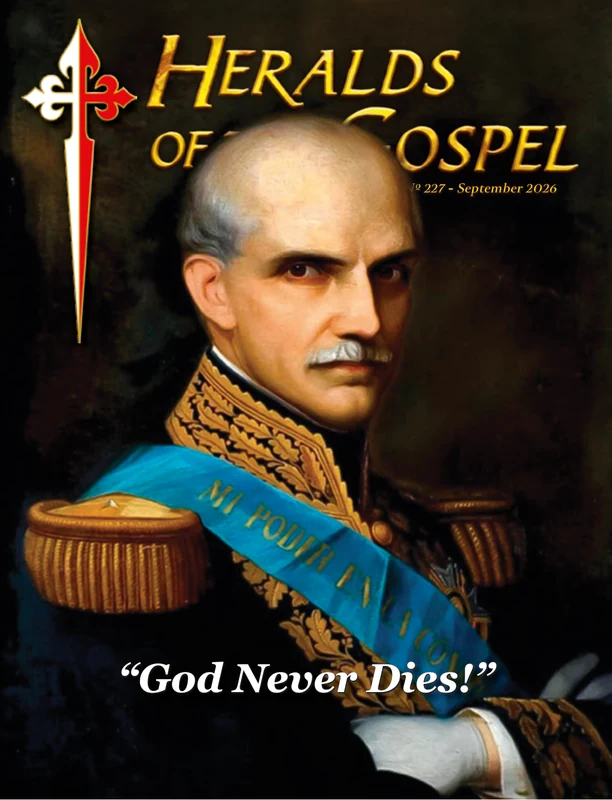
 Heralds of the Gospel Magazine, Vol. 20, nº 227, September 2026
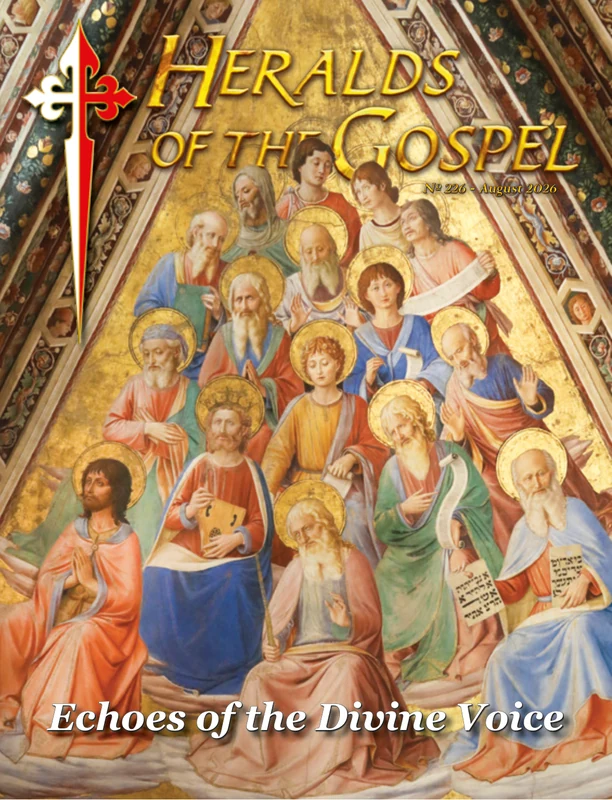 Heralds of the Gospel Magazine, Vol. 20, nº 226, August 2026
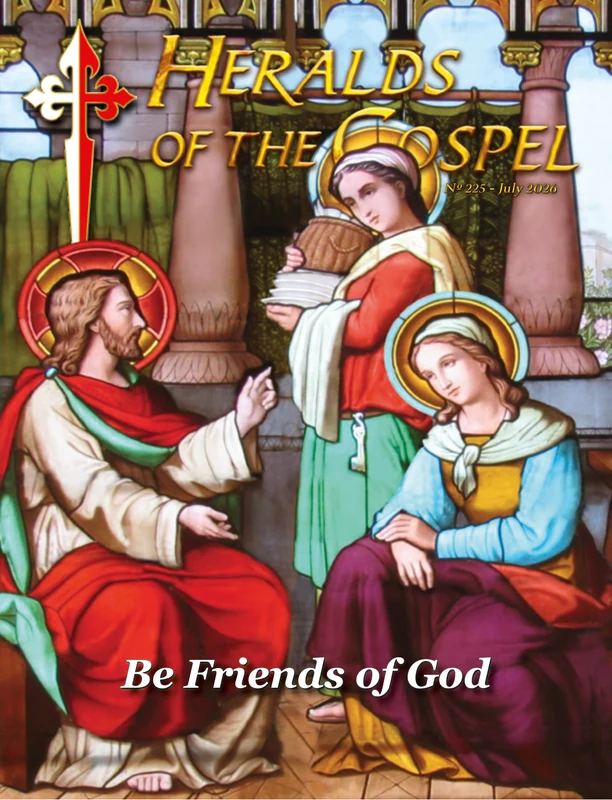 Heralds of the Gospel Magazine, Vol. 20, nº 225, July 2026
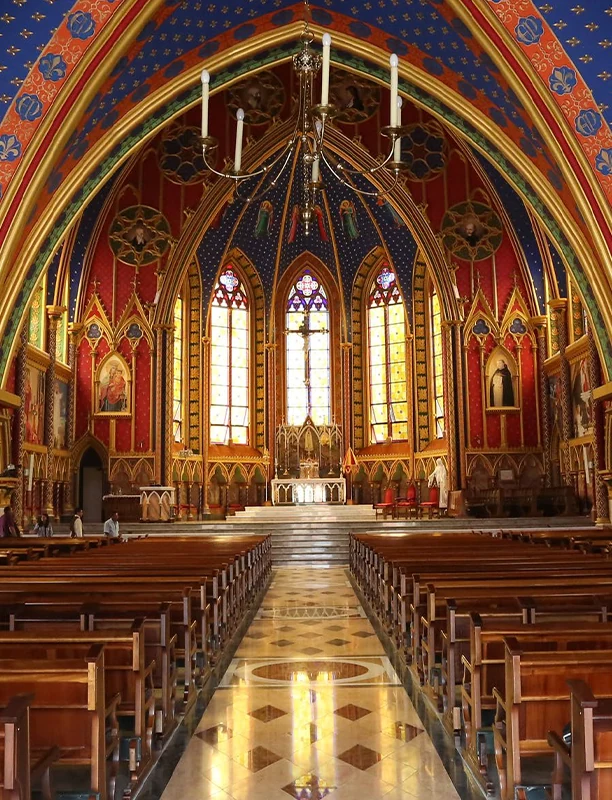 Who are the Heralds of the Gospel?
 Help of Christians
 Christmas Carols






Gospel – 24th Sunday in Ordinary Time
27 Jesus and His disciples set out for the villages of Caesarea Philippi. Along the way He asked His disciples, “Who do people say that I am?” 28 They said in reply, “John the Baptist, others Elijah, still others one of the prophets.” 29 And He asked them, “But who do you say that I am?” Peter said to Him in reply, “You are the Christ.” 30 Then He warned them not to tell anyone about Him. 31 He began to teach them that the Son of Man must suffer greatly and be rejected by the elders, the chief priests, and the scribes, and be killed, and rise after three days. 32 He spoke this openly. Then Peter took Him aside and began to rebuke Him. 33 At this He turned around and, looking at His disciples, rebuked Peter and said, “Get behind Me, Satan. You are thinking not as God does, but as human beings do.” 34 He summoned the crowd with His disciples and said to them, “Whoever wishes to come after Me must deny himself, take up his cross, and follow Me. 35 For whoever wishes to save his life will lose it, but whoever loses his life for my sake and that of the Gospel will save it” (Mk 8:27-35).
I – A Mysterious Logic
The fact that God introduced man into the paradise of delights after his creation, as described in Genesis (cf. Gn 2:8), opens up at first sight a panorama of happiness that is both earthly and supernatural, idyllic from every standpoint. Adam and Eve, completely innocent, enjoyed a marvellous garden where harmony reigned, with absolute and immediate dominion over nature and, above all, frequent visits from the Heavenly Father (cf. Gn 3:8). However, this idea of a little Heaven on earth is suddenly and unexpectedly dispelled when we read the story of the temptation of the first woman and her irrational fall, in which she dragged her husband along without any resistance. And the realization of the consequences of original sin for the entire human race leads us to lament, as the most tragic fate, the situation into which Eve’s degraded children fell.But there seems to be something missing to explain this debacle. How could the first two human creatures, born from the hands of the Father of Lights himself, have fallen into such an appalling abyss? We are undoubtedly facing a mystery: “Delicta quis intellegit?” (Ps 19:12). We must take into account an indispensable element in creation, which goes a long way towards explaining this drama: it is the trial. Yes, God created us for Heaven, but in His lordship, He demands of us the precept of fidelity, obedience and love. Made in the image and likeness of the Creator and capable of choosing good and rejecting evil on our own, the trial was the only way we could exercise our freedom in an upright manner, choosing God above other things and thereby showing Him our love. And it was because Eve forgot this fundamental and arduous aspect of life, preferring a comfortable and optimistic position, not without a sense of self-sufficiency, that she ended up abusing her free will and sliding down the slope of sin.Eve preferred a comfortable and optimistic position in the face of the trial, and ended up abusing her free will and sliding down the slope of sin
Loving acceptance of suffering: the origin of all good
God, who showed himself to be such a friend, by coming down in the afternoon breeze to talk to Adam, also showed himself to be a Lord worthy of being feared and obeyed by forbidding the first couple to eat from the tree that was in the centre of Paradise (cf. Gn 2:16-17). It was the diminished respect for the absolute supremacy of the Creator and the neglect of the duty to be faithful to Him in the trial that introduced evil to the face of the earth.
II – The Only Way to the Kingdom of Heaven
Set at the end of St. Mark’s chapter 8, the Gospel for this 24th Sunday in Ordinary Time is preceded by the narration of various miracles, such as the second multiplication of the loaves (cf. Mk 8:1-9) and the healing of a blind man near Bethsaida (cf. Mk 8:22-26), during which time Jesus is surrounded by the Pharisees, who ask Him in vain for a sign (cf. Mk 8:11-12). He then moves away from the crowd and sets off, accompanied by His disciples, towards Caesarea Philippi, a rocky area where He begins the conversations on which we will reflect in this commentary. Once these are over, He ascends Mount Tabor and the Transfiguration takes place. In the passage we are presently analysing, the Divine Master wishes, after having attracted the crowds with dazzling success, to have a more peaceful moment in which to form His disciples with a view to the future glorification of Golgotha. His path, contrary to what one might think, was one of humiliation and obedience until death, and death on a Cross. And His followers needed to have this in mind. Peter’s reaction, however, shows how much they did not expect this outcome for the life of the Saviour, whom they considered a successful and extremely popular leader, due to His thaumaturgical powers.The example given by the Saviour and His Holy Mother established forever that sacrifice accepted with love is the source of all good, and it is the only way to glory
Alone with the Master
27 Jesus and His disciples set out for the villages of Caesarea Philippi. Along the way He asked His disciples, “Who do people say that I am?”

The distorted outlook of the Jewish people
28 They said in reply, “John the Baptist, others Elijah, still others one of the prophets.”
Set apart from the world
29 And He asked them, “But who do you say that I am?” Peter said to Him in reply, “You are the Christ.”
The Apostles needed to realize that they had been set apart from the society in which they lived. They were in the midst of it, but they were not to be confounded with it, because, by inspiration of the Heavenly Father, they discerned in Our Lord the true Light that had come into the world. This visualization of Jesus was characteristic of them. Today, too, it is a challenge to believe in the divinity of the Saviour. In an age submerged in the darkness of apostasy to the very extremes of prevarication, the courage to keep the faith and live in coherence with it separates us from the world. However, far from feeling afraid or insecure, we must proclaim our Catholic convictions with intelligence and boldness, so as to attract souls who can be saved and combat the enemies of truth, goodness and beauty.The Apostles discerned in Our Lord the true Light that had come to the world, but they were horrified by the dark shadow of trial that He showed them

O mais duro castigo
30 Then He warned them not to tell anyone about Him.
The prospect of the trial
31 He began to teach them that the Son of Man must suffer greatly and be rejected by the elders, the chief priests, and the scribes, and be killed, and rise after three days. 32a He spoke this openly.
How difficult it is to accept this prospect! However, being willing to face adversity for the love of truth and goodness is at the heart of our existence on earth. In the eyes of faith, it is an honour to be able to fight for God in the struggle against the evil that is in and around us. But for the worldly, who prefer an easy and pleasurable life, this visualization causes annoyance, incomprehension and, ultimately, revolt.The prediction of what is unpleasant, what is arduous and what goes against personal criteria repels the creature who imagines himself independent and deserving of ease and comfort

The “leaven of Eve”
32b Then Peter took Him aside and began to rebuke Him.
Rock of the Church or Satan?
33 At this He turned around and, looking at His disciples, rebuked Peter and said, “Get behind Me, Satan. You are thinking not as God does, but as human beings do.”
The history of the Papacy itself seems to give us the key to interpretation. When the Pontiffs are true followers of Our Lord Jesus Christ, they are ready to face the most terrible adversaries and even shed their blood for the Church with admirable valour. When, however, they try to win the admiration of the world, they become capable of the worst betrayals, making themselves worthy of the atrocious rebuke inflicted on Peter. The judgement of the Popes will therefore be implacable: before God, they will either be a rock or Satan. There will be no middle ground. We will be judged in a similar way. If we, attracted by the comforts of a mediocre existence, flee from the cross and build a pleasurable life in pact with the maxims of perdition propagated by the world, we will also hear from the Lord’s lips the condemnatory sentence: “Get behind Me, Satan.” But if we want to conquer Paradise, we must keep the faith of the Prince of the Apostles in order to be living stones of the Church in the midst of the storm.Only those who persevere to the end in this hard struggle of earthly life, willing to bring out the best in themselves, will truly win the honours of Paradise
There is only one way
34 He summoned the crowd with His disciples and said to them, “Whoever wishes to come after Me must deny himself, take up his cross, and follow Me.35 For whoever wishes to save his life will lose it, but whoever loses his life for my sake and that of the Gospel will save it.”
