 Heralds of the Gospel Magazine, Vol. 20, nº 227, September 2026
 Heralds of the Gospel Magazine, Vol. 20, nº 226, August 2026
 Heralds of the Gospel Magazine, Vol. 20, nº 225, July 2026
 Who are the Heralds of the Gospel?
 Help of Christians
 Christmas Carols








Orphanhood is one of the most terrible sufferings a man can endure. Something similar to this excruciating hardship undoubtedly assailed the Apostles when Our Lord ascended to Heaven.
He whom they considered their Master, Model, Father, Friend, and Redeemer had departed… A cloud had enveloped Him during the Ascension, and then it became clear to all that Jesus would forever be irreplaceable!
We can imagine the Apostles gathered with Our Lady on that first day when the universe seemed empty without the physical presence of the Saviour, an absence perhaps more terrible than that felt at the burial itself, for now, instead of a stone, eternity separated them from the Beloved.
It is likely that they wanted to remember the last moments with the Divine Master by celebrating a Holy Mass. The first after the Ascension! But who would preside over such a solemn act?
Some opted for Peter, who held primacy among all; others for John, the Beloved Disciple, keeper of the secrets of the Heart of Jesus.
The doubt vanished when, exchanging glances, they noticed James, called “the brother of the Lord, surnamed the Just,”1 whose features were so similar to those of the Master that it led Judas to give the infamous kiss to the Redeemer so that the soldiers would not confuse Him with this Apostle.
There was no doubt: he should celebrate the Holy Sacrifice, so that all might remember the face of the Saviour! What an honour and what glory for this Apostle to resemble his model, even physically!
First fruits for Our Lord Jesus Christ
Son of Cleophas Alphaeus and Mary – mentioned in the Gospels as Mary of Cleophas – St. James had family ties with Jesus: his mother was a first cousin of Our Lady.
In the institution of the twelve, he is distinguished from St. James the Greater by the epithet “son of Alphaeus” (Mk 3:18).
Although the Apostle – according to the opinion of some historians – was at least ten years older than the Redeemer, it is believed, due to their close relationship, that they spent time together since childhood.
Furthermore, it would be natural for James to follow with admiration the growth of Jesus in wisdom and grace (cf. Lk 2:40), which is why we find him at His side from the first announcements of the Good News.
However, transcending the bonds of consanguinity, his vocation had a divinely mysterious origin, for, by heavenly inspiration his mother had offered him as a Nazarene before his birth, that is, consecrated to the Lord from his mother’s womb.
James would be at the same time a cousin of the Incarnate Word and consecrated to Him from conception. And how much he knew he was freely loved by God, the Apostle would later make clear in his epistle:
Every good endowment and every perfect gift is from above, coming down from the Father of lights. […] Of His own will He brought us forth by the word of truth that we should be a kind of first fruits of His creatures (Jas 1:17-18).
The providential design that hovered over his family became evident throughout Jesus’ public life.
His father was one of the disciples to whom the Divine Master appeared in Emmaus after the Resurrection; his mother, inseparable companion of the Blessed Virgin Mary and one of the Holy Women, stood at the foot of the Cross on Calvary.
One of his brothers, Joseph, called “Justus,” was among the seventy-two disciples; another, Jude Thaddeus, was an Apostle like James; and a third, Simeon, became the second Bishop of Jerusalem…
However, James would have a primary role, some aspects of which we will consider.
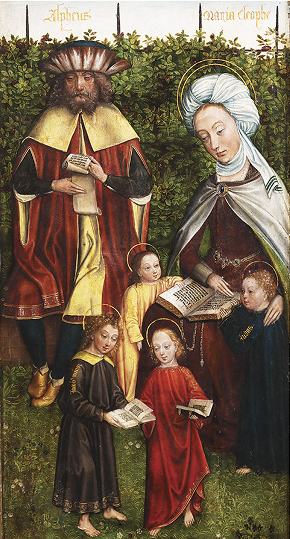
children” - Fine Arts Museum of Ghent (Belgium)
Awaiting the glorious dawn of the Resurrection
Little is mentioned in the Gospels about the biography and deeds of this cousin of the Lord during the absorbing years with Him before the Passion.
According to ancient Church traditions, James cherished such a particular affection for Jesus that his grief at His Death led him to promise to fast until the prophecy of the Resurrection was fulfilled.
Thus, on Easter Sunday, Christ appeared to him even before communicating with the others.
Indeed, St. Jerome endorses a tradition according to which the Lord, after the opening of the stone of the tomb, came to meet him and, taking a loaf of bread in His glorious hands, blessed it, broke it, and presented it to James: “My brother eat your bread, for the Son of Man is risen from among those that sleep.”2
The familiarity shown in this apparition confirms our impression that they loved each other as brothers and also offers us a striking detail: despite the tragic moments of the Passion, St. James had revered the Master’s words and believed in them, for confidence in the Resurrection confirmed him in faith.
Thus, he would later say: “Blessed is the man who endures trial, for when he has stood the test he will receive the crown of life which God has promised to those who love Him” (Jas 1:12).
In the same vein, he would advise the faithful of the whole Church to have patience “until the coming of the Lord” (Jas 5:7), and to nurture an integral faith, for “he who doubts is like a wave of the sea that is driven and tossed by the wind. For that person must not suppose that […] [he] will receive anything from the Lord.” (Jas 1:6-8).
To today’s relativistic standards, such words sound rather harsh, excessively “radical”...
But James could be demanding of his listeners because his own conduct was irreproachable, a model of faithful fulfilment of the Lord’s words (cf. Jas 1:22), a man who always demonstrated his faith through works (cf. Jas 2:18), as the leitmotif of his entire life.
This impeccable conduct had crowned him with the respect and esteem of his brothers in Christ, and even of the Jews, among whom he held considerable prestige.
The plume of the Apostle of the Gentiles describes a second visit by the Divine Master to James in the days following the Resurrection. Writing to the Corinthians, St. Paul recounts that the Lord “appeared to Cephas, then to the twelve.
Then he appeared to more than five hundred brethren at one time, most of whom are still alive, though some have fallen asleep. Then he appeared to James, then to all the apostles” (1 Cor 15:5-7).
By manifesting Himself in such a particular way to James, Our Lord wished to confirm him in his mission, giving him a prominent role among the faithful of the early Church, for which he should be, in some way, His very image.
The heir of Jerusalem
The Church of Jerusalem, firstborn of the Churches of Asia and the whole world, was established by Jesus Christ who, shortly before the Ascension, entrusted it to St. James.
This was a highly fraternal and symbolic gesture, for Our Lord bequeathed to Peter, Prince of the Apostles, the throne of the world, the City of Rome; but to James He left His own inheritance, the City of the Son of David.3
This privilege conferred upon him a certain preeminence in the Apostolic College; all respected his office and admired his virtue.
The testimony left by St. Paul in mentioning the name of James first among those “reputed to be pillars” (Gal 2:9) of the Church shows how much his authority was considered from the earliest times, as a symbol of union and fidelity to the Saviour.
The canon of the New Testament preserved other allusions to this authority. We find, for example, in the last of the Catholic epistles: “Jude, a servant of Jesus Christ and brother of James, to those who are called, beloved in God the Father and kept for Jesus Christ” (Jude 1:1).
Similarly, the Acts of the Apostles recounts that, imprisoned by order of Herod, Peter was freed by an Angel and, before fleeing the city in search of safety, recommended that the faithful tell everything “to James and to the brethren” (Acts 12:17), thus indicating the deference he had toward the Bishop of Jerusalem.
Indeed, at the Council of Jerusalem, around the year 50 A.D., which addressed the controversies presented by Paul and Barnabas regarding the obstacles created in the evangelization of the Gentiles by certain Jewish customs, it was St. James who, listening to both of them, dictated the general rule that the Church would adopt henceforth:
“Therefore my judgment is that we should not trouble those of the Gentiles who turn to God” (Acts 15:19).
An epistle-testament
The fame of St. James had spread to such a degree throughout the regions of Asia Minor that many Christians travelled to Jerusalem just to see him.
St. Ignatius of Antioch, in a letter to the Apostle St. John, expresses his desire to meet the “venerable James, who is surnamed Just, whom they relate to be very like Christ Jesus in appearance, in life, and in method of conduct, as if he were a twin-brother.”4
The martyr of Antioch further adds that he had heard that whoever looked at James would find Jesus Himself and all the characteristics of His physiognomy.5
The grace of contemplating him was not granted to us, but we can glimpse the personality of this Apostle in the only epistle of his authorship that tradition has bequeathed to us.
There we find a meditation and an application of the words of the Divine Master to the daily life of the faithful in the early days, but which echoes to this day, with as much relevance as then.
In most of these early Christians who came from Judaism, there was a veiled dichotomy between what they believed and how they lived.
For St. James, only integrity can meet the challenge of holiness: “let your yes be yes and your no be no” (Jas 5:12), he will say, following the example of Jesus.
“Draw near to God and He will draw near to you. Cleanse your hands, you sinners, and purify your hearts, you men of double mind” (4:8)…
Let us recall that hypocrisy had already claimed some victims in his community, such as Ananias and Sapphira (cf. Acts 5:1-11), so it was necessary to uproot it. To the upright, on the contrary, the Saint promises that even the devil “will flee” (4:7) from them.
His words reveal a person of principle, coherence, and sincerity: “Whoever knows what is right to do and fails to do it, for him it is sin” (4:17), for “as the body apart from the spirit is dead, so faith apart from works is dead” (2:26).
And also “by his good life let him show his works in the meekness of wisdom” (3:13). The Apostle pleads: “Do not speak evil against one another, brethren” (4:11), for “judgment is without mercy to one who has shown no mercy” (2:13).
Thus, uniting radicality and gentleness, St. James does not abandon evangelical simplicity: “Is any one among you suffering? Let him pray. Is any cheerful? Let him sing praise” (5:13).
And, like a good shepherd, he desires once again to gather the stray sheep of his flock: “whoever brings back a sinner from the error of his way will save his soul from death and will cover a multitude of sins” (5:20).
The Epistle of St. James also contains, in detail, the doctrine of the Sacrament of the Anointing of the Sick:
Is any among you sick? Let him call for the elders of the Church, and let them pray over him, anointing him with oil in the name of the Lord; and the prayer of faith will save the sick man, and the Lord will raise him up; and if he has committed sins, he will be forgiven (5:14-15).
In short, his letter, full of fidelity and love for Jesus, can be considered his best testament, for St. James would be called upon to seal his words with the testimony of his own blood.
The holy end of a holy life
After the first persecution of Christians in Israel, which claimed the lives of Stephen and James the Greater, leading them to inaugurate the illustrious procession of martyrs, the faithful dispersed to the four corners of the earth.
In Jerusalem, only three Apostles remained: Peter, James the Less, and John. Twenty years of peace and expansion followed, a period that led Peter and John to leave to assume other episcopal sees of the nascent Church.
Around the year 60, another persecution broke out against the Church of Jerusalem.
Paul, who was fortuitously visiting, was arrested and transferred to Rome, which ended up concentrating the hatred of the Sanhedrin against James, who remained at the head of the faithful of the Holy City.
The account of the historian Flavius Josephus6, an eyewitness to the events, reveal the details of the occurrence.
He narrates that the high priest arrested James, taking advantage of the interval between the death of Governor Festus and the arrival of Albinus, appointed in his place, and brought him before the Sanhedrin, condemning him to stoning.
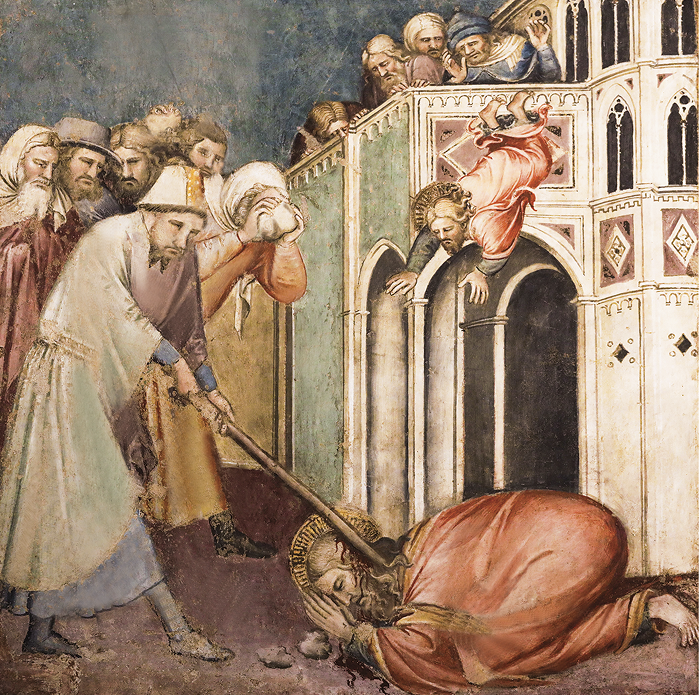
Hegesippus, a Jewish convert of those times, in transmitting the tradition that the first communities preserved of the martyrdom of their pastor, adds that the Sanhedrin forced the Apostle to climb to the pinnacle of the Temple and, while he was declaring the divinity of Jesus, they threw the Just One down from there.7
As he survived the fall, the Pharisees threw themselves upon him to stone him, and one of those present struck his head with a fuller’s club, thus ending his life and his martyrdom.
The Christians reverently bore the Apostle’s body to be buried near the Temple.
And many Jews who disapproved of the act saw in this wicked murder one of the causes of the destruction of the Holy City, of that Jerusalem which had killed the Redeemer and the prophets, and which had once again become guilty of the blood of the innocent.8
He completed in himself the countenance of Christ
“Remember your leaders, those who spoke to you the word of God; consider the outcome of their life, and imitate their faith” (Heb 13:7).
This is the advice given in the Letter to the Hebrews, possibly referring to the martyrdom of James, “the Lord’s brother,” he who, by an exalted design, had displayed in his countenance, as in the purest mirror, the sacred face of the Saviour.
However, the greatness of this Apostle lies not only in his physical resemblance to Jesus, but above all in having conformed his soul to that of Christ, assuming in himself the traits of the Master’s personality, with his virtues and sufferings.
The martyrdom so heroically faced sealed in James’ soul the countenance of the suffering Christ, completing in him what he lacked to follow in the footsteps of the Lamb once slain.
St. James is, therefore, an example for our times: let us complete in our souls the image of Christ, like a shining mirror, by imitating with integrity Our Lord on the way of the cross!