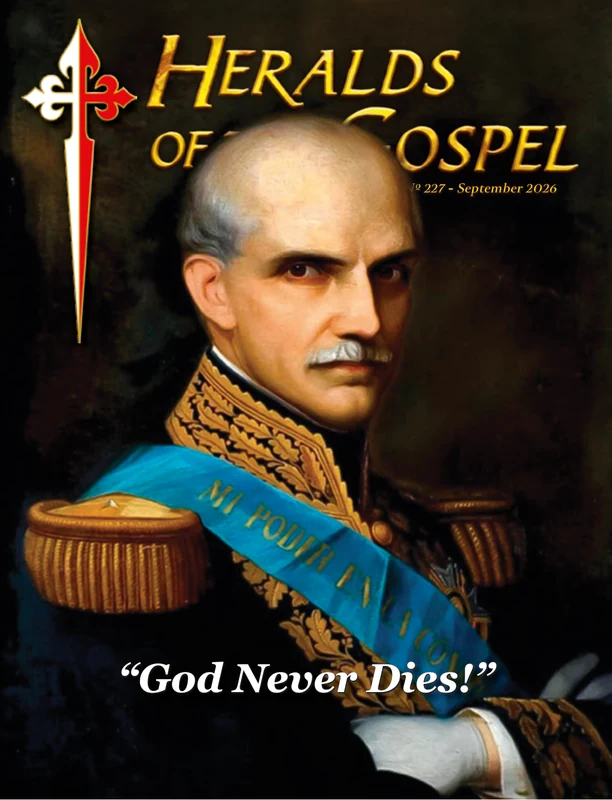
 Heralds of the Gospel Magazine, Vol. 20, nº 227, September 2026
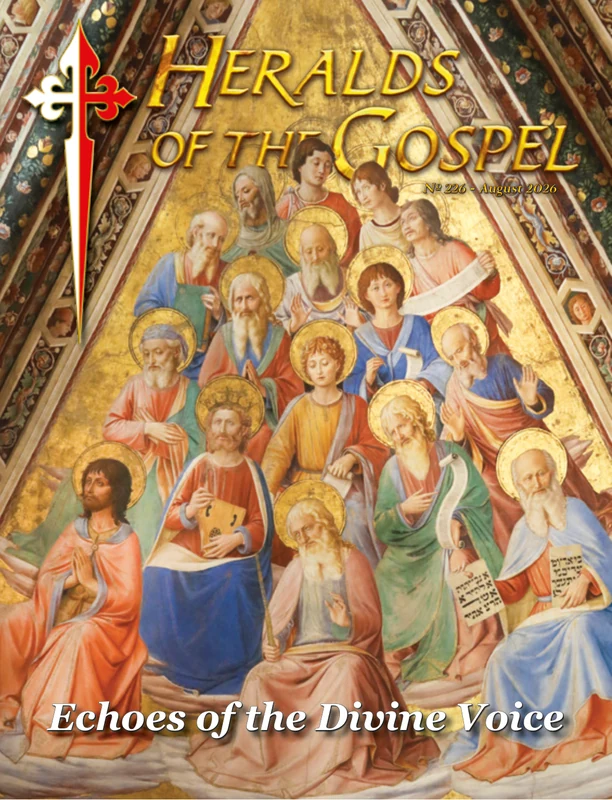 Heralds of the Gospel Magazine, Vol. 20, nº 226, August 2026
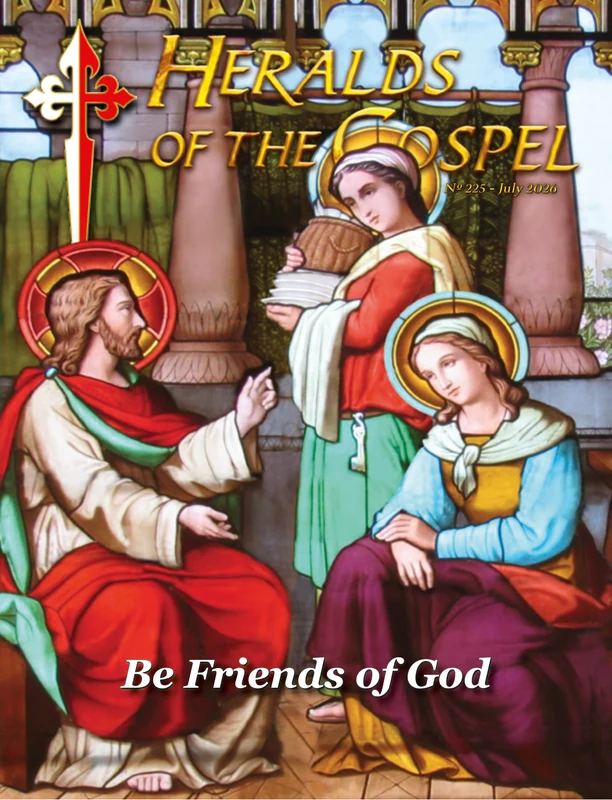 Heralds of the Gospel Magazine, Vol. 20, nº 225, July 2026
 Who are the Heralds of the Gospel?
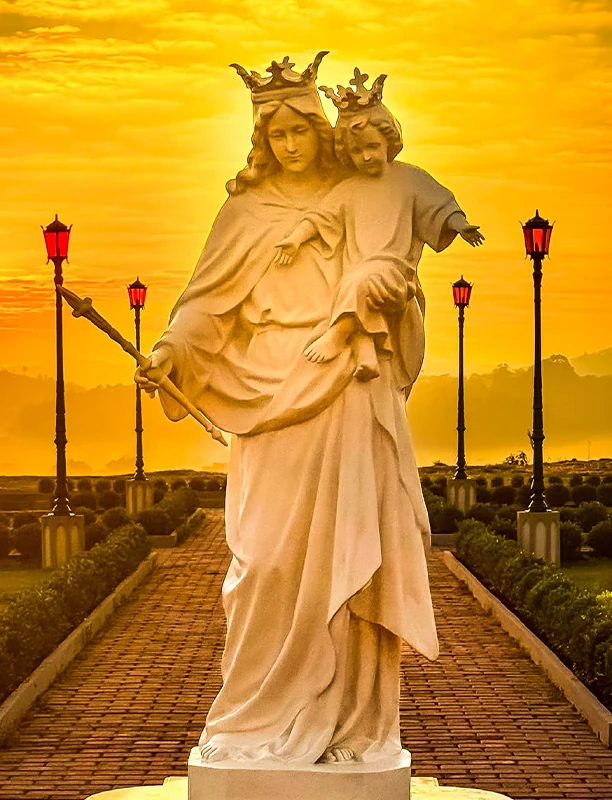 Help of Christians
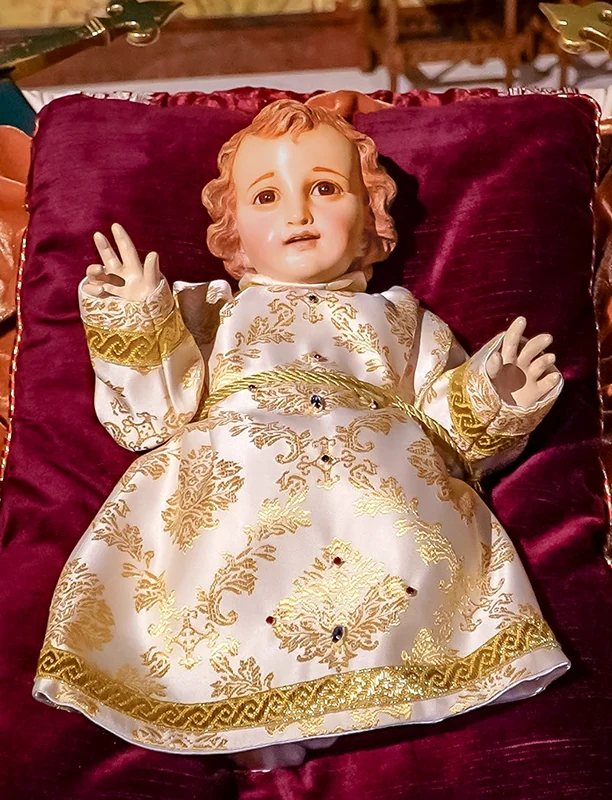 Christmas Carols






The fiercest of persecutions
The year 304 saw a great change in the world scene. The Church had not been persecuted by the Roman emperors for decades, the number of the elect had multiplied and, in some places, Christian temples had even been erected. Of course, such expansion could not be tolerated by Christianity’s adversaries…Diocletian was the reigning emperor. Faced with the threat of the barbarians approaching his borders, he realized that he alone could not reach every point where his enemies, both external and internal, were fighting. So he decided to share the government with men he trusted, and in 286 he appointed a certain military man named Maximian as co-emperor, dividing his dominions in two: the latter took the West, and he the East. Years later, in 293, the new political system underwent another addition: two new emperors were appointed, Galerius and Constantius Chlorus, who, under the title of Caesars, would be subordinate to the Augustus emperors. Thus the Roman tetrarchy was born. However, Galerius hated Christians. In a diabolical enterprise, he obtained from Diocletian – who up until that point had done nothing against the Christians because, it seems, he was not opposed to their existence or freedom – decrees upon decrees of condemnation; never, however, with the radicalism and cruelty he desired. Finally, in the year 304, Augustus published one last edict, which unleashed the bloodiest, the fiercest and the most ruthless persecution ever seen.Galerius, in his diabolical hatred, spared no effort to obtain decrees of condemnation and extermination of the Christians, unleashing a cruel persecution
Impressive martyrdoms were reported in all parts of the empire – although with lesser intensity in the West. We need only cite the examples of St. Sebastian, St. Vincent, St. Gervasius, St. Protasius, St. Agnes, St. Lucy, among others, as well as entire towns of slaughtered Christians.Impressive martyrdoms are related from every part of the Roman Empire. Men, women and children give their lives for their faith in Christ


Two children make the tyrant tremble
The town of Complutum, now Alcalá de Henares, is witness to the impressive story of two brothers, Justus and Pastor, aged seven and nine respectively. They were attending school, still learning their first lessons, when they heard rumours that Dacian was approaching. Far from being overcome with terror, the two boys were in fact “burning with the desire to die for the Lord.”1 So, without fearing the atrocities that could befall them in that situation, they left their belongings at school, went to the governor’s residence and voluntarily presented themselves as Christians. It was not long before they were brought before the proconsul, who, instead of being moved, was enraged to see that even children dared to confront him. Convinced that a good correction would be enough to diminish the boys’ enthusiasm, he ordered them to be mercilessly flogged. The executioners carried out the sentence in the most barbaric manner.2 However, when they were brought back before the judge, the two brothers continued to proclaim their faith with courage. They were truly willing to die for Christ. Surprised and unsure, Dacian ordered the incarceration of Justus and Pastor that night. The next morning, the tyrant changed his tactics of persuasion, offering the boys all sorts of favours. However, as St. Thomas Aquinas says, “truth is strong in itself, and is overcome by no attack.”3 Whoever is persuaded of the truth neither trembles in the face of persecution nor falters in the face of honours. Accordingly, the two children firmly refused the proconsul’s gifts. The audience was amazed at the valour with which the two exhorted each other to remain faithful to Christ. Dacian could tolerate no more. To conceal his shameful defeat, he ordered that the martyrs be beheaded immediately, but outside the city, for fear that the people would discover the nefarious crime and revolt. The heroic brothers walked joyfully to the place of execution, leaving the governor insecure, apprehensive and utterly defeated! St. Ildephonsus tells us of the beautiful dialogue of mutual encouragement between the boys on their way to execution: “Justus, the youngest, fearful that his brother would lose his strength, spoke the following words to him: ‘Do not be afraid, little brother, of the death of the body and of the torments; receive the blow of the sword calmly. The God who deigned to call us to such a great grace will give us strength commensurate with the pain that awaits us.’ Pastor replied: ‘You say good things, my brother. I will gladly join you in martyrdom so that with you I may obtain the glory of this battle.’”4 Thus, they were both beheaded on the night of August 6, 304.
Seeking sanctification at any age
Faced with the story of such an impressive martyrdom, we still have a question. Considering that Justus and Pastor were just children, did they fully realize what they were doing? Were they not too puerile to measure the consequences of their actions? Did God really want them to present themselves to the governor and die so young?It is very difficult to go into the merits of these questions. But there is no doubt that the voluntary acceptance of death comes from a grace given by God, and these two brothers – along with all those who died for the name of Christ at a young age5 – would not be inscribed on the list of saints if they had not been genuine martyrs. In fact, all people are called to walk the path of Christian perfection, and God asks even little children to be holy. It is undeniable that these children responded to the grace of martyrdom, but they would never have had the strength to carry out such a great act of heroism if they had not first admired and learned from the example of the adults who served as their role models: parents, relatives and teachers. Indeed, in the words of St. Therese, “as little birds learn to sing by listening to their parents, so children learn the science of the virtues, the sublime song of Divine Love from souls responsible for forming them.”6 How important it is to help children walk the paths of virtue from the earliest age, to lead them to Jesus who calls them to Himself (cf. Mt 19:14)! On the other hand, how reprehensible are those who impede them from following the Divine Master’s teachings; it would be better that a millstone be tied to them, and they be cast into the depths of the sea (cf. Mt 18:6). ◊Justus and Pastor responded well to the grace of martyrdom because they first admired the example of their role models: parents and teachers
Notes
1 DEL MARTIRIO DE LOS SANTOS JUSTO Y PASTOR. In: COMISSÃO EPISCOPAL ESPANHOLA DE LITURGIA. Textos litúrgicos proprios de la Archidiócesis de Madrid. Barcelona: Coeditores Litúrgicos, 2007, p.66.
2 Cf. BUTLER, Alban. Vidas de los Santos. Ciudad de México: C. I.-John W. Clute, v.III, p.275.
3 ST. THOMAS AQUINAS. Summa contra gentiles. L.IV, c.10.
4 ÁBALOS, Juan Manuel. Santos Justo y Pastor. In: ECHEVERRÍA, Lamberto de; LLORCA, SJ, Bernardino; REPETTO BETES, José Luis (Org.). Año Cristiano. Madrid: BAC, 2005, v.VIII p.144.
5 To cite only examples from the same persecution: St. Pancras suffered martyrdom at the age of fourteen, St. Agnes at the age of twelve, and St. Barulas at the age of seven (cf. CANTÚ, Césare. História Universal. São Paulo: Editora das Américas, 1954, v.VII, p.147;153-154).
6 ST. THERESE OF LISIEUX. Story of a Soul. Third Edition. ICS Publications, Institute of Carmelite Studies, Washington, D.C., 1996, p. 147.