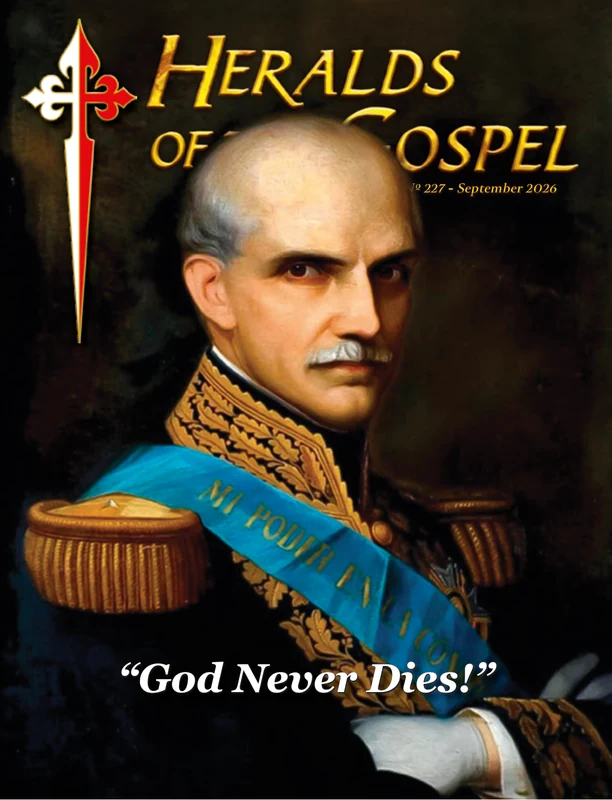
 Heralds of the Gospel Magazine, Vol. 20, nº 227, September 2026
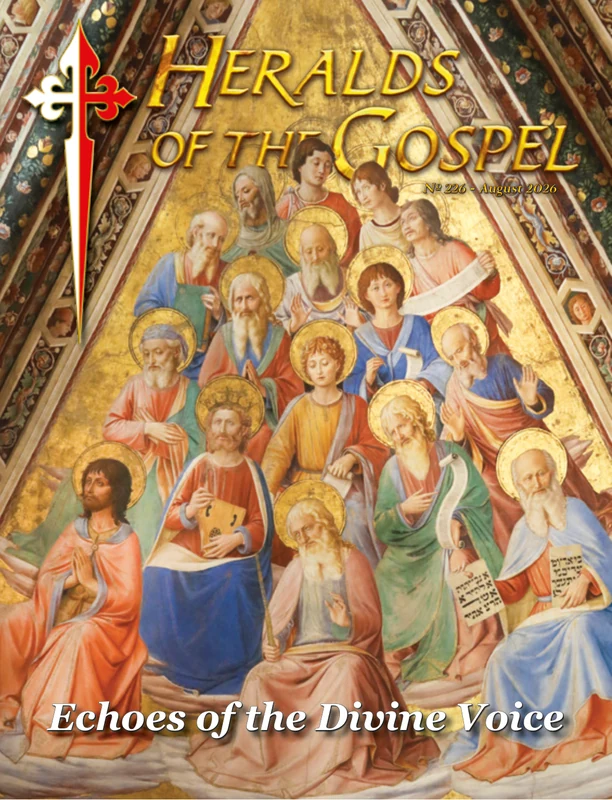 Heralds of the Gospel Magazine, Vol. 20, nº 226, August 2026
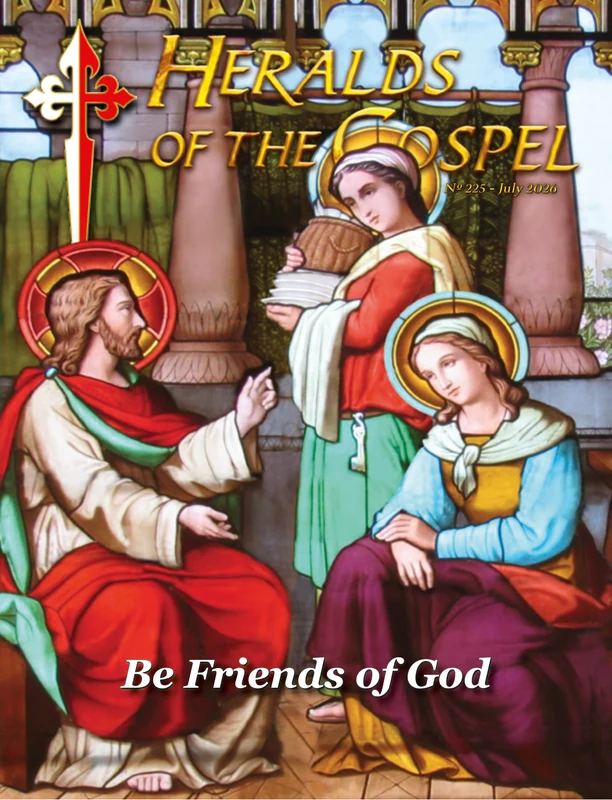 Heralds of the Gospel Magazine, Vol. 20, nº 225, July 2026
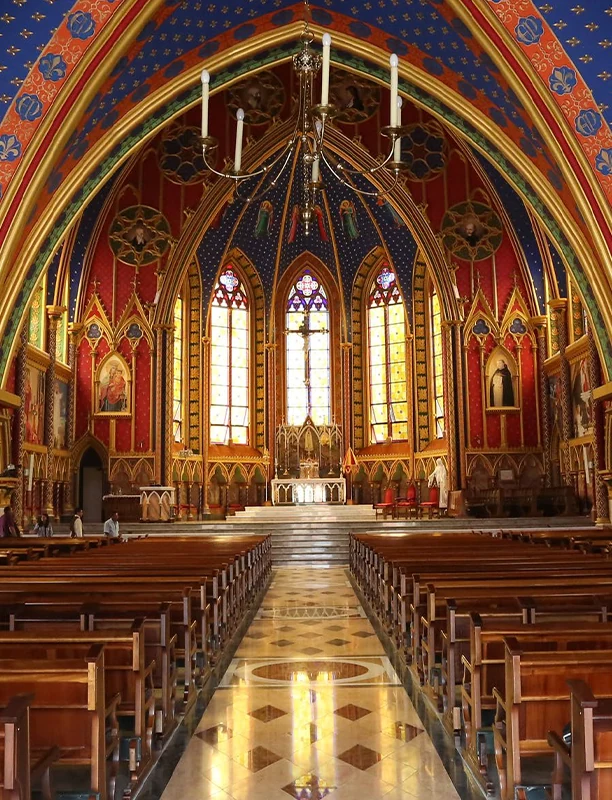 Who are the Heralds of the Gospel?
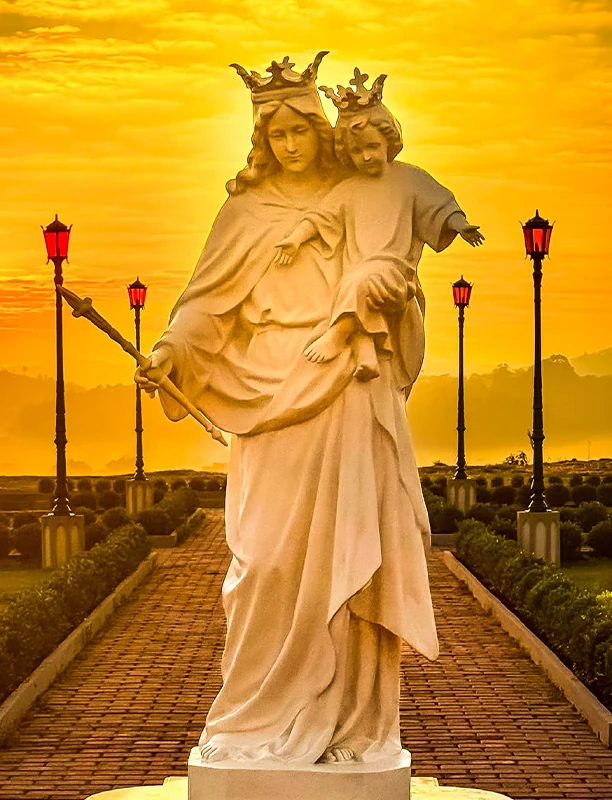 Help of Christians
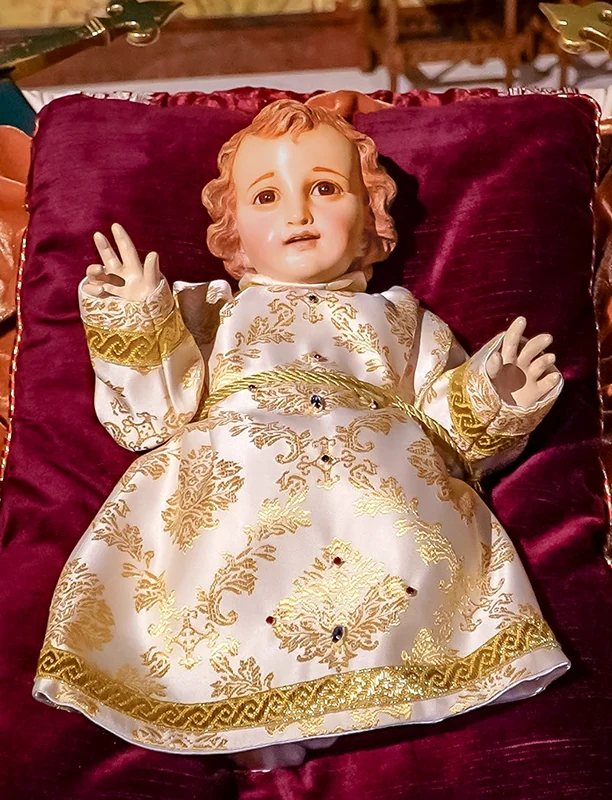 Christmas Carols






 Before Pius IX proclaimed the dogma of the Immaculate Conception, this truth was the object of controversy among the faithful
Proclamation of the dogma of the Immaculate Conception by Pope Pius IX - Church of Saint-Sauveur, Plancoët (France)
Fierce battles in defence of the Marian prerogative
Belief in the Immaculate Conception of Mary was a peaceful matter, a devout certainty for the faithful in general throughout the first eleven centuries of the Church’s history.2 It was only during the Middle Ages that this doctrine began to be questioned, even by important scholars – some based on strong opinion and others only on their inability to prove it according to theological science – so that, in a sense, Catholics were divided into “Immaculists” and “Maculists”. The former fought for this truth to be elevated to the status of a dogma of the Faith straight away; the latter were firmly opposed to this. In the 15th century, the battle became intense, giving rise to a great controversy. However, as the disputes grew, so did the number of cities and nations that officially commemorated the feast of the Immaculate Conception. Thus, in February 1477, Pope Sixtus IV approved the feast of the Conception of Mary by means of the Bull Cum præexcelsa, granting the same indulgences reserved for the Solemnity of Corpus Christi to those who celebrated it. The same Pontiff promulgated two Apostolic Constitutions called Grave nimis, the first in 1481 and the other in 1483, addressed to preachers who attacked the mystery of Mary’s conception, reaffirming the institution of the feast on December 8 for the universal Church. It was in this context that an illustrious Franciscan preacher and great Marian writer appeared: Friar Bernardino de Busti.The author of the Little Office
Born in Milan in 1450, Bernardino studied jurisprudence before joining the Order of Friars Minor, where he distinguished himself for his piety and knowledge of theology and philosophy, as well as ecclesiastical and civil law. He died in the odour of sanctity, probably on May 8, 1513, and popular devotion did not delay in acclaiming his saintliness. Amidst the debates about the Immaculate Conception, Friar Bernardino was always a great devotee and defender of this privilege. He published various Marian writings, including the Mariale de singulis festivitatis Beatæ Virginæ Mariæ, in 1492 and considered his magnum opus, and the Officium et Missa de Immaculata Conceptione, approved by Sixtus IV in 1480.3 He is also credited with authoring the Little Office of the Immaculate Conception, approved by Pope Innocent XI in 1678 and whose recitation soon spread widely throughout the Catholic world.Famous devotees
This devotion was spread by great Saints such as Alphonsus Rodríguez, coadjutor Jesuit brother, who recommended it to all as a special means of honouring the Blessed Virgin. As porter of the college in Mallorca, he transcribed the hours of the Office by own hand and distributed them among the students, as well as to his fellow Jesuits, teaching them how to pray it, so that the practice spread to many houses of the Society of Jesus. St. Alphonsus Mary de Liguori, Doctor of the Church and founder of the Congregation of the Most Holy Redeemer, also prayed the Little Office daily. The Blessed Virgin once appeared to him and ordered him to spread it. Finally, the Marian Congregations gave us an example in the diffusion of this prayer at the beginning of the 20th century. Many sodalities recited the Office of the Immaculate together at their meetings, and not a few claimed to have received copious graces through this devotion.The division of the Little Office
Following the traditional division of the Divine Office, defined by the Church on the basis of biblical tradition – “Seven times a day I praise Thee” (Ps 119:164) – and with which God is praised at different times of the day, the recitation of the Little Office of the Immaculate Conception is also divided into hours and, although it can be prayed all at once, it is recommended to adopt this division, which renews the Marian praises throughout the day. Thus, the hours are divided into seven, as follows: Matins before dawn, Prime at six in the morning, Terce at nine, Sext at twelve noon, None at three in the afternoon, Vespers in the evening and Compline at night. The Office begins with the verse “Come, my lips, and now proclaim the Blessed Virgin’s spotless fame,” and beginning each hour we ask Our Lady’s help, saying: “Make speed, O Lady, to befriend me. From the hands of the enemy defend me.” This is followed by a Glory be, to signify that “the glory of the Most Holy Trinity is the ultimate and absolute end of all prayer and of the existence of all creatures, including Mary and Jesus himself as Man.”4 Throughout the hours, the Immaculate Conception is poetically extolled in a constant parallel between Mary and her pre-figures in the Old Testament, also emphasizing the victory of the One who, with the moon under her feet, crushes the head of the vile serpent forever and ever. At the end of each hour, a prayer is recited in which it is declared that the Blessed Virgin neither forsakes nor despises anyone, and She is asked to turn a gaze of pity upon those who implore Her to obtain from her Divine Son the forgiveness of sins and the crown of eternal beatitude. Finally, Our Lady is asked to accept our devotion in praise of her pure conception, and the Little Office ends with a final prayer asking God that, through the Virgin Mary’s Immaculate Conception and “purified by her intercession,” we may be granted entry to Heaven.Praise to Mary for every moment
Let us briefly consider each hour of this simple devotion, which begins with Matins: “Hail, Queen of the Heavens, Hail Mistress of earth! Hail Virgin most pure of Immaculate birth. Clear star of the morning, in beauty enshrined! O Lady, make speed to the help of mankind. God chose You eternally His Word’s Mother to be, by whom He created the earth sky and sea. You He ordained the fair Spouse of His heart, for in Adam’s sin You never had part. Amen.” A possible point for meditation at this hour is Mary’s suppliant omnipotence, exalting her Immaculate Conception through it. Throughout the hours, the Immaculate Conception is poetically extolled in a constant parallel between Mary and her pre-figures
Immaculate Virgin - National Museum of Krakow (Poland)
A devotion for our times!
Many are the Saints throughout the ages who have recommended devotion to the Blessed Virgin, despite those who have questioned and even contested it… I leave it to the reader to conclude which is the best path to follow, with this simple thought: if God chose to come to us through Mary, why should we not go to Him by the same route? If we have this straight and safe road, why run the risk of going astray? The one whom the Archangel Gabriel called “full of grace” (Lk 1:28) is an inexhaustible source of gifts and graces for us, of which She herself wants to make us partakers: “Above all creatures did God so love Her that truly in Her was the Father well pleased with singular delight. Therefore, so far above all the Angels and all the Saints so wondrously did God endow Her with the abundance of all heavenly gifts poured from the treasury of His divinity that this Mother, ever absolutely free of all stain of sin, all fair and perfect, would possess that fullness of holy innocence and sanctity which, under God, one cannot even imagine anything greater, and which, outside of God, no mind can succeed in comprehending fully.”6 In an age when people seem to hold virtue in disdain, banishing it from society, the Little Office, with its filial praise of the Immaculate Virgin, emerges as a particularly appropriate prayer, one in complete contrast with the heinousness of a world that is increasingly distanced from God. Dear reader, set aside a few moments of your time to practise this pious devotion, if you are not in the habit of doing so! The Little Office gives us the opportunity to reaffirm our Marian devotion at different hours of the day; by praying it we can be sure that Mary Most Holy will also be for each one of us a Mother and Advocate throughout the trials and phases of this great office that is our life. ◊Notes
1 ST. THOMAS AQUINAS. Summa Theologiæ. I, q.44, a.4.
2 Many Fathers, from the first centuries of the Church, explained and reaffirmed devotion to the Immaculate Conception of Mary. Among the most prominent are: St. Irenaeus, St. Cyril of Jerusalem, St. Justin, St. Augustine and St. Ephrem.
3 Cf. DI FONZO, Lorenzo. Bernardino de’ Bustis. In: PASCHINI, Pio (Dir.). Enciclopedia Cattolica. Firenze: Sansoni, 1949, v.II, p.1406.
4 ROYO MARÍN, Antonio, OP. La Virgen María: Teología y espiritualidad marianas. 2.ed. Madrid: BAC, 1997, p.471.
5 CORRÊA DE OLIVEIRA, Plinio. A santa intransigência, um aspecto da Imaculada Conceição [Holy Intransigence, one Aspect of the Immaculate Conception]. In: Catolicismo. Campos dos Goytacazes. Year IV. N.45 (Sept., 1954); p.2.
6 PIUS IX. Ineffabilis Deus.