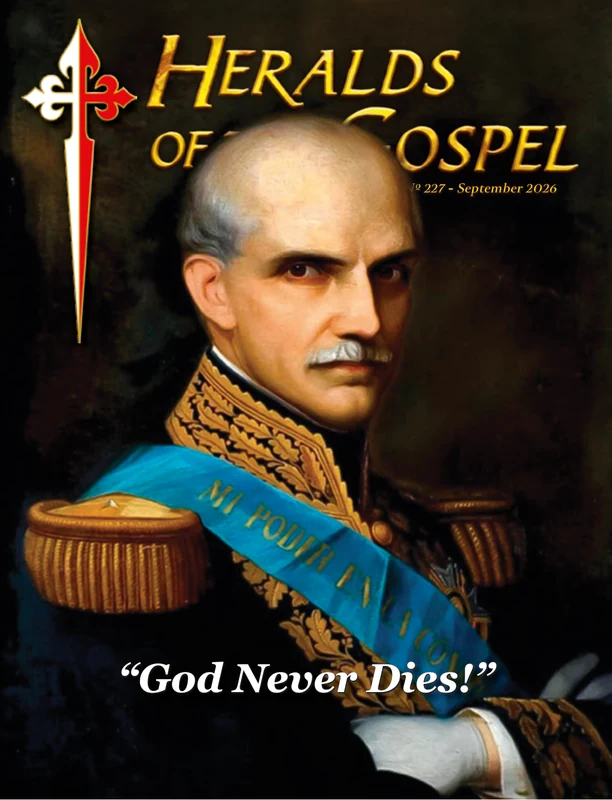
 Heralds of the Gospel Magazine, Vol. 20, nº 227, September 2026
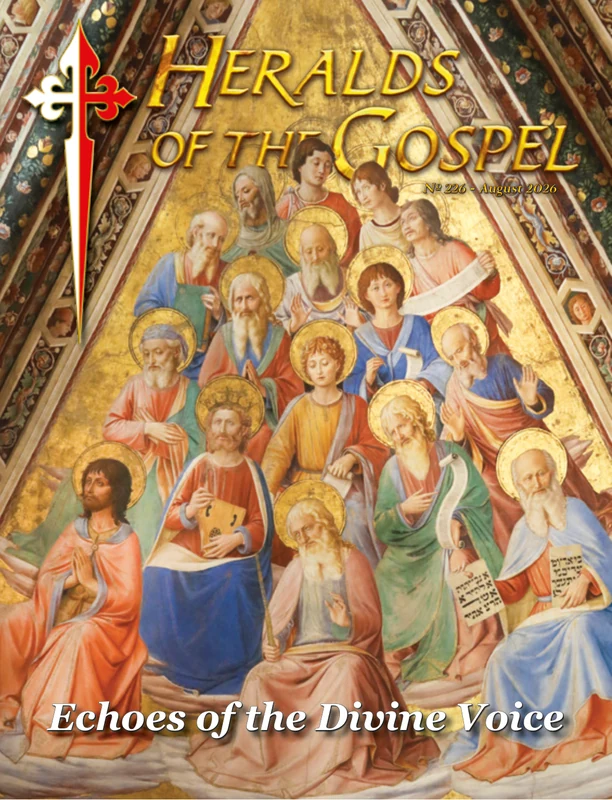 Heralds of the Gospel Magazine, Vol. 20, nº 226, August 2026
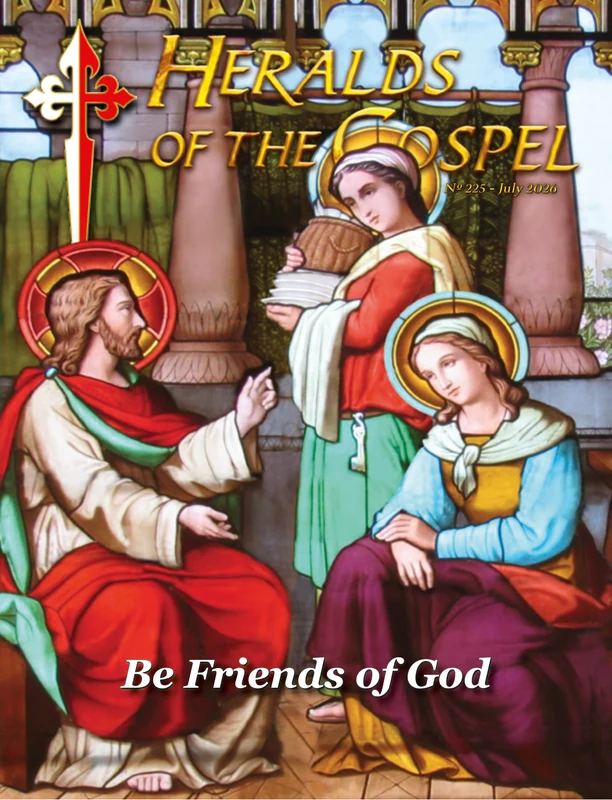 Heralds of the Gospel Magazine, Vol. 20, nº 225, July 2026
 Who are the Heralds of the Gospel?
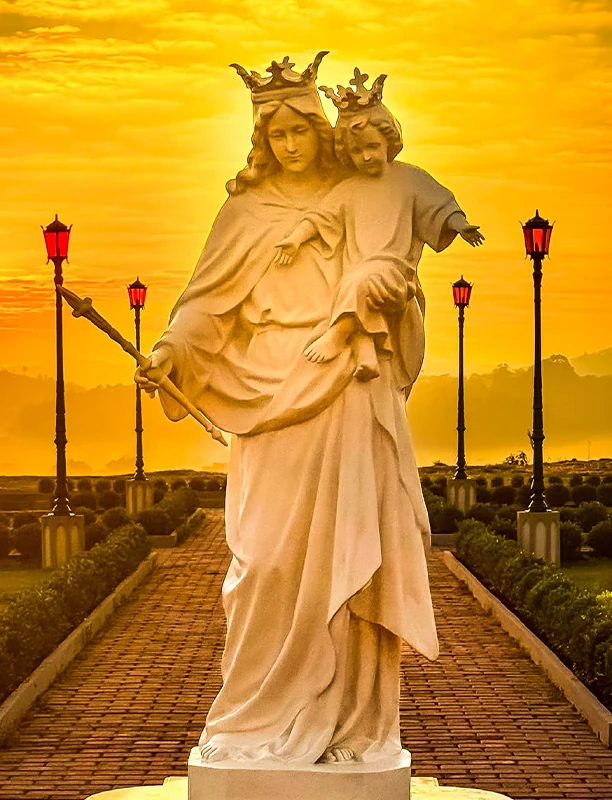 Help of Christians
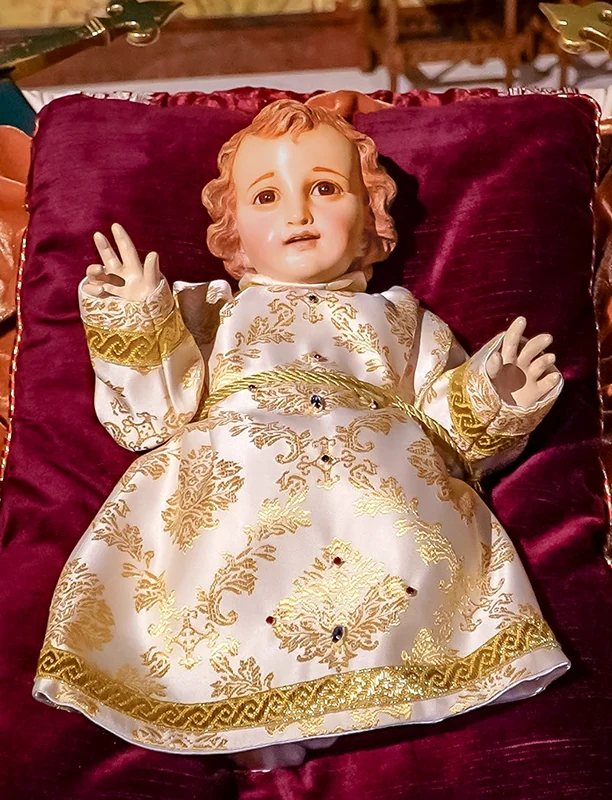 Christmas Carols






A House that God built for Himself
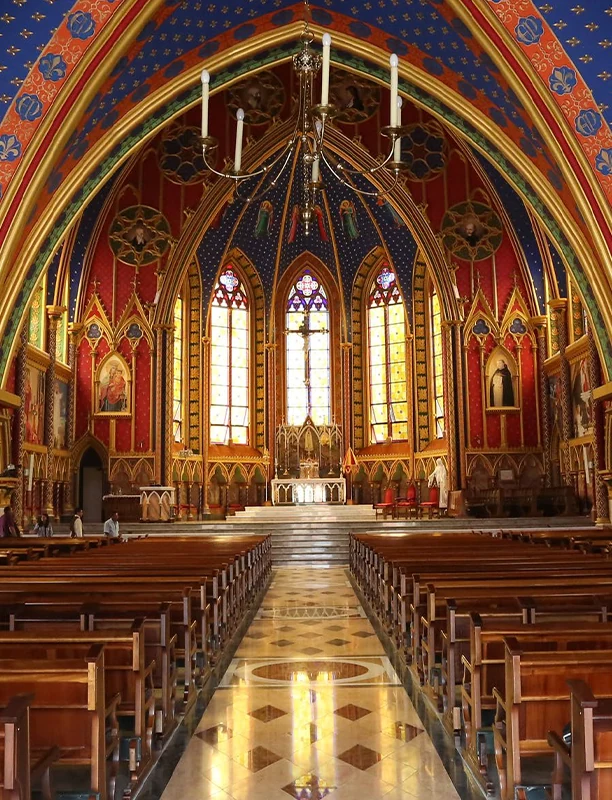
Perhaps the great Temple of Solomon – built centuries later by skilled but human hands, with precious but perishable wood – was the most splendid reflection of the “house of God” that Jacob contemplated on that occasion. Yet God Himself is the architect of the true House of God, and its memory will not perish: all generations will proclaim Her blessed (cf. Lk 1:48), because the One whom Heaven and earth could not contain was carried in her womb. This Temple is Mary Most Holy, in whom “God dwelt not only by nature, by essence, presence and power, as in the world; not only by grace, through faith, hope and charity, as in the Church; not only by glory, through the vision of the Supreme Good, through the enjoyment and perpetual possession of that infinite treasure, as in Paradise; but was present in Her by bodily indwelling.”2 Although in time Mary was not the first of the creatures to come forth from the hands of the Most High, God already knew her name and had chosen Her for Himself even before the fish leaped in the waters, the birds crossed the sky, and the fruits multiplied on the bountiful earth. This is the teaching the Church, expressed by Pius IX in the Bull Ineffabilis Deus: “[The Creator] from the very beginning, and before time began, chose and prepared a Mother. In Her, the Son of God would become incarnate, and from whom, in the blessed fullness of time, He would be born into this world […] Above all creatures did God so love Her that truly in Her was the Father well pleased with singular delight.3Who is like unto Mary?
 Allegory of Our Lady as Gate of Heaven - St. Patrick’s Church, Iskaheen (Ireland)
Blessed by her fruit and her holiness
St. Bonaventure6 teaches that we can contemplate the Blessed Virgin under three aspects: in the grace of her conception, in the grace of sanctification and in her bodily nature. Although a daughter of Eve, Our Lady did not inherit a nature that was debased by sin, and her human qualities are excellent in the highest degree. We need only mention that her intelligence, for example, besides being strengthened by infused knowledge, is so penetrating and comprehensive that it surpasses that of all the wise men of history, as St. Bernardine of Siena explains: “How great is the difference between your understanding and Mary’s? It is enormous, like that of understanding the leg of a fly and understanding all things. […] But let me give a better example: take the understanding of all learned men and consider what they understand about God’s creatures, and add St. Augustine, who, contemplating them, said much that is noble about them: I say that all of this is nothing in comparison with Mary’s understanding.”7 Upon this spotless nature, God poured out abundant and unfathomable graces, as indicated by the greeting that the Archangel Gabriel addressed to Her at the Annunciation: “Hail, full of grace.” To comprehend the reality expressed by the word full, we must consider the size of the container. A thimble may be full, it is true, but it will not contain the same amount as a large barrel that is also full to the brim. Now, what would be the volume of the treasure kept in a “vessel” capable of containing the Infinite, God Himself? Such is Mary, and thus we glimpse the magnitude to which we refer when we call her “full of grace”.8 The Fathers – both Greek and Latin – did not dare, in their wisdom, to measure the grace that dwells in Mary’s soul, considering Her an abyss unfathomable to anyone but God.9 “Jacob’s Ladder” - St. Peter’s Church, Hamburg (Germany)
House of God… and Gate of Heaven!
In order to gain a better idea of the immeasurable goodness of the Blessed Virgin, let us recall an episode narrated by Dona Lucilia Corrêa de Oliveira. While still a young girl, she lived in a spacious and dignified house, in the small city of Pirassununga, in the interior of São Paulo. Her father was a lawyer and defended several causes in the region, assuring a dignified life for his family. However, there was a certain time when the family’s reserves were depleted and he was left with just one coin… Serene because the larder was full, he carried on with the family routine, waiting for the situation to improve. It was then that a beggar knocked at the door of the house and, pleading for charity, held out his hat. The head of the family then took that last coin and, trusting that God would take care of the future, gave it to the man. Now, Our Lady has not just one coin, but the fullness of sanctity. And incomparably greater than the compassion of Lucilia’s father on that occasion, is the mercy of Mary when we, in humility, stretch out our hand to Her and implore her help. In Jacob’s dream, Angels descended and ascended the ladder; through Mary, God Himself descended to earth, and it is through Her that all men may ascend without fear to the Most High. Being the Mother of Christ, Our Lady became the link that united God to man, and consequently man to God. Thus She is not only the “House of God”, but also the “Gate of Heaven”. The Virgin and Child - Church of Our Lady of the Assumption, Lanquais (France)
Notes
1 In this regard, see the article: The Promise of Abraham in the Hands of a Woman, on pages 24 and 25 of this issue.
2 ST. LAWRENCE OF BRINDISI. Marial: María de Nazaret, Virgen de la plenitud. Madrid: BAC, 2004, p.103-104.
3 PIUS IX. Ineffabilis Deus, n.1.
4 Cf. ST. THOMAS AQUINAS. Summa Theologiæ. I, q.25, a.6, ad 4.
5 Cf. ST. ANSELM OF CANTERBURY. Oratio VII. In: Obras Completas. Madrid: BAC, 1953, t.II, p.318.
6 Cf. ST. BONAVENTURE. In I Sent., dist.44, dub.3. In: Opera Omnia. Parisiis: Ludovicus Vivès, 1864, t.II, p.161.
7 ST. BERNARDINE OF SIENA. Sermons. Siena: Tipografia Sociale, 1920, p.103.
8 Cf. CONRAD OF SAXONY. Speculum Beatæ Mariæ Virginis. Florentiæ: Quaracchi, 1904, p.60-61.
9 Cf. TERRIEN, SJ, Jean Baptiste. La Madre de Dios y Madre de los hombres: según los Santos Padres y la Teología. Madrid: Voluntad, 1928, t.II, p.243-244.
10 PIUS IX, op. cit.
11 ST. BERNARD OF CLAIRVAUX. Sermón en el Domingo de la octava de la Asunción. In: Obras Completas. 2.ed. Madrid: BAC, 2006, v.IV, p.397.
12 ST. JOHN DAMASCENE. Or. I. In Dormit., apud ALASTRUEY, Gregorio. Tratado de la Virgen Santísima. 3.ed. Madrid: BAC, 1952, p.719.
13 BASIL OF SELEUCIA. Or. in Annunt., apud ALASTRUEY, op. cit., p.719.
14 ST. LOUIS-MARIE GRIGNION DE MONTFORT. True Devotion to Mary, n.1. In God Alone, Bay Shore, NY: Montfort Publications, 1987, p. 291.