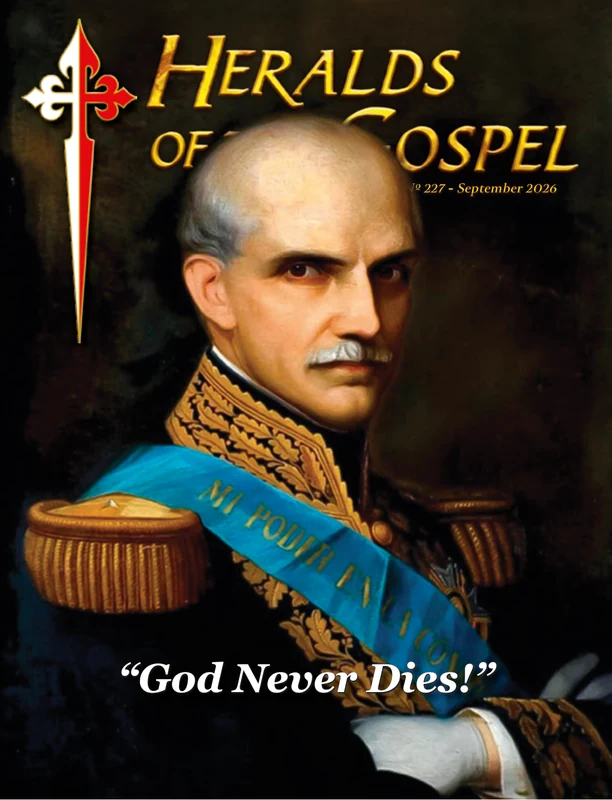
 Heralds of the Gospel Magazine, Vol. 20, nº 227, September 2026
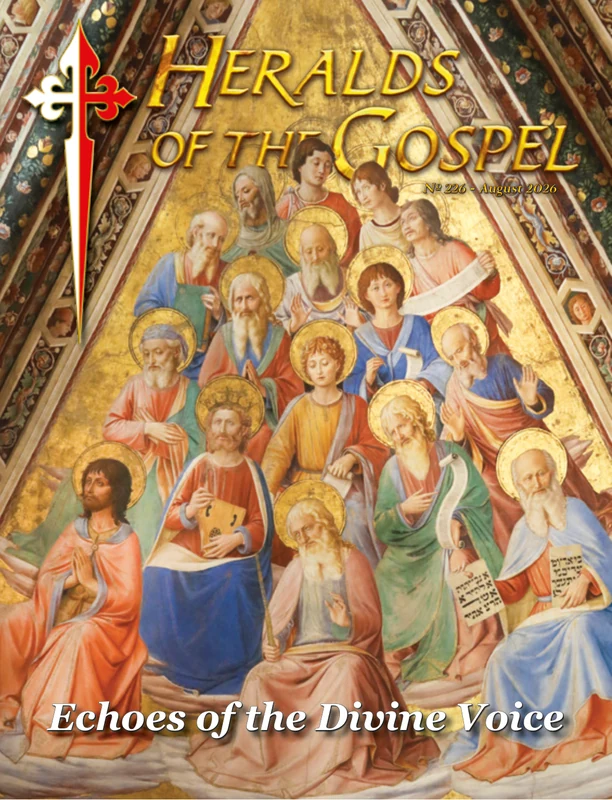 Heralds of the Gospel Magazine, Vol. 20, nº 226, August 2026
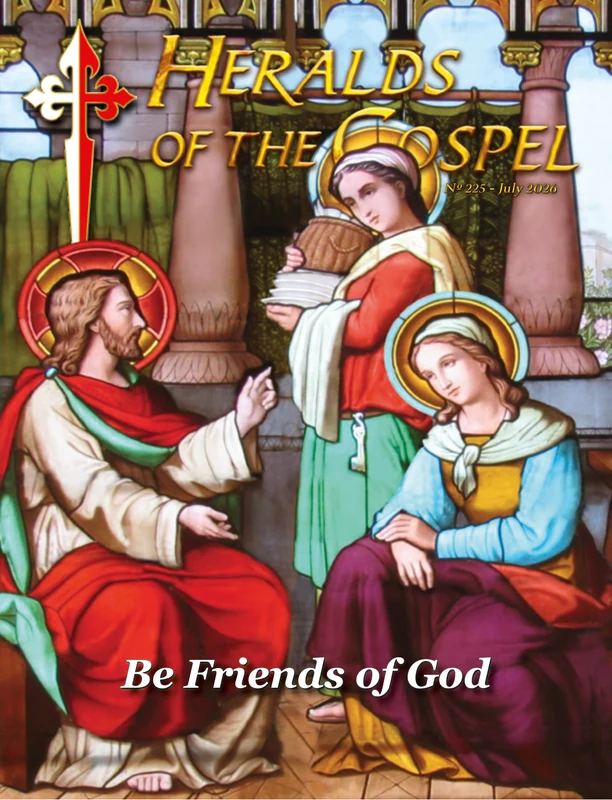 Heralds of the Gospel Magazine, Vol. 20, nº 225, July 2026
 Who are the Heralds of the Gospel?
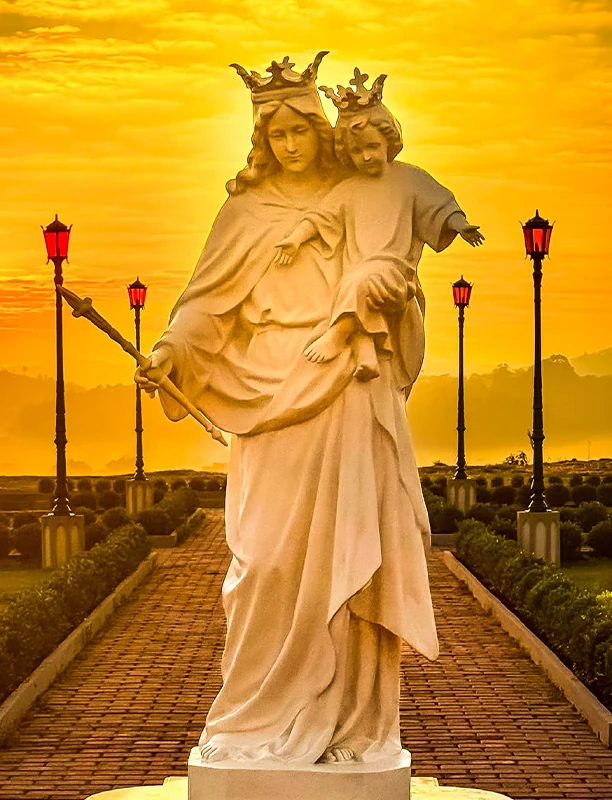 Help of Christians
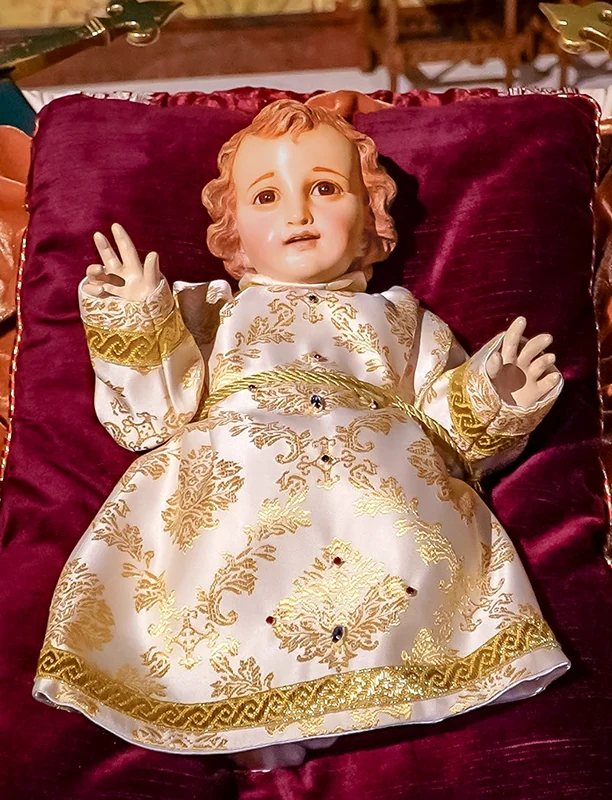 Christmas Carols








Gospel of the Ash Wednesday
“Beware of practicing your piety before men in order to be seen by them; for then you will have no reward from your Father who is in heaven.Thus, when you give alms, sound no trumpet before you, as the hypocrites do in the synagogues and in the streets, that they may be praised by men. Truly, I say to you, they have received their reward.But when you give alms, do not let your left hand know what your right hand is doing, so that your alms may be in secret; and your Father who sees in secret will reward you.
And when you pray, you must not be like the hypocrites; for they love to stand and pray in the synagogues and at the street corners, that they may be seen by men. Truly, I say to you, they have received their reward. But when you pray, go into your room and shut the door and pray to your Father who is in secret, and your Father who sees in secret will reward you.
And when you fast, do not look dismal, like the hypocrites, for they disfigure their faces that their fasting may be seen by men. Truly, I say to you, they have received their reward.But when you fast, anoint your head and wash your face,that your fasting may not be seen by men but by your Father who is in secret; and your Father who sees in secret will reward you.” (Mt 6:1-6;16-18).
I –Time of Penance and Reconciliation
In the Liturgical Cycle, throughout the year, the Church recalls the most important episodes of the earthly life of the Incarnate Word with didactic wisdom. The solemnities of the Annunciation and Christmas, the commemorations of the Easter Triduum and the Ascension of Our Lord into Heaven, among others, form a varied kaleidoscope, presenting diverse aspects of the infinite perfection of our Redeemer to the piety of the faithful. The graces that Providence poured forth in each of these historic moments in some way revivify and descend on those who devoutly participate in the festivities. Preceding the most important solemnities—the Birth of the Saviour and His Passion, Death and Resurrection—the Church allots two periods of preparation: Advent and Lent. For the celebration of such sublime mysteries, it is fitting that the faithful purify their souls of failings and attachments, to prepare them to receive the divine gifts. On Ash Wednesday, the forty days preceding Holy Week begin. The three readings of this day—a passage from the Prophet Joel, an excerpt from the epistle of St. Paul and another from the Gospel—speak to us of the need for fasting and penance as a way to better combat vices, mortify the body and encourage the elevation of mind to God. Because, as Pope St. Leo the Great teaches us, “we mortify ourselves to extinguish concupiscence in us. And the result of mortification should be to renounce unjust actions and evil desires.” 1 As we will see further on, the liturgical texts in question make special reference to a form of penance which is particularly pleasing to God and which is essential for our spiritual life. It concerns avoiding excessive self-love, and the tendency to call attention to ourselves, so that the soul, cleansed and adorned with the virtue of humility, offers the Lord a sacrifice of pleasing aroma.
“Remember man, that you are dust” “Be reconciled with God”
The Ash Wednesday liturgy also reminds us of our mortality: “Memento homo quia pulvis es et in pulverem reverteris — Remember, man, that you are dust and unto dust you shall return,” categorically declares one of the two formulas used by the Church for the distribution of ashes. 2 After the ceremony, a dark smudge marks the foreheads of the faithful; its starkness seems to proclaim: “death could claim us at any moment, and reduce us to dust!” The thought of the terrible passage from this life to eternity is often disturbing, yet such considerations are highly beneficial to convince us of the need of avoiding sin, which closes the gates of Heaven to us forever: “Remember your last end, and you shall never sin” (Sir 7:36). For that reason, Dom Prospero Gueranger recommends: “If we wish to persevere in good, where the grace of God re-established us, let us be humble, accept the sentence, and consider life as nothing more than a journey, longer or shorter, which ends in the tomb.” 3“Be reconciled with God”
In the first reading, St. Paul affirms: “We beseech you on behalf of Christ, be reconciled to God” (II Cor 5:20). Sin indeed distances us from God, making reconciliation necessary. Catholic doctrine teaches that not even the merits of Our Lady added to those of the Angels and the blessed in Heaven, and all who could have been created but were not, would be sufficient to repair the offence of a single venial sin. How much more so where grave sin is involved! A comparison can be made between venial sin and poor manners, which are more or less censurable, depending on the dignity of the person offended. For example, an act of impoliteness, trivial in itself, would be much graver if it were directed at a Pope. If it were committed, instead, against the infinite Being, who is God, there would be no human act capable of offering adequate reparation. How, then, is it possible to make satisfaction for all the sins committed by humanity since Adam and Eve? St. Paul tells us the solution prepared by Divine Wisdom: “For our sake He made Him to be sin who knew no sin, so that in Him we might become the righteousness of God” (II Cor 5:21). The Incarnation of the Second Person of the Blessed Trinity, with His Passion and Death on the Cross, was the means chosen to restore full friendship with God to fallen humanity. On the other hand, the quantity of grace won by the sacrifice at Calvary was so superabundant that even all the faults of humanity combined could not surpass the infinite merits of the Most Precious Blood of Christ. 4 If Jesus had not paid the debt incurred by our first parents, by the oblation of His Body, our reconciliation with God5 would have been impossible and the gates of Heaven would be closed to us forever.II – Self-Love, Prayer and Fasting
In the Gospel passage that we consider today, we see the Divine Master use a typical scene from those times as a didactic example. From a historical perspective, He admonishes an attitude particularly common among the Pharisees. But, since the word of God is eternal, it contains a lesson for the people of every era.The primary drain of merits
“Beware of practicing your piety before men in order to be seen by them; for then you will have no reward from your Father who is in heaven.”


Giving alms to win approval
“Thus, when you give alms, sound no trumpet before you, as the hypocrites do in the synagogues and in the streets, that they may be praised by men. Truly, I say to you, they have received their reward.”
We should expect a reward from God alone
“But when you give alms, do not let your left hand know what your right hand is doing, so that your alms may be in secret; and your Father who sees in secret will reward you.”
Ostentatious prayers are all in vain
“And when you pray, you must not be like the hypocrites; for they love to stand and pray in the synagogues and at the street corners, that they may be seen by men. Truly, I say to you, they have received their reward”
We should be discreet in our life of piety
“But when you pray, go into your room and shut the door and pray to your Father who is in secret; and your Father who sees in secret will reward you.”

Fasting becomes a social affair
“And when you fast, do not look dismal, like the hypocrites, for they disfigure their faces that their fasting may be seen by men. Truly, I say to you, they have received their reward.”
Joy and cleanliness in practicing virtue
“But when you fast, anoint your head and wash your face,that your fasting may not be seen by men but by your Father who is in secret; and your Father who sees in secret will reward you.”
III – Lent Invites us to Grow in Humility
The Gospel of Ash Wednesday shows us the true spirit of Lent. We must not perform good works to win the approval of others, nor should we yield to pride or vanity. We should seek, rather, to please God alone in all things. In fasting, praying or carrying out any good work, we should avoid setting our sights on the benefits that we may win as a result. We should only seek the glory of the One who created us. Because everything we have, except sin, belongs to Him: our being, our intelligence and our soul are God’s. Our merits are also His, since without divine aid we are incapable of doing any good. Therefore, if we perform a good deed, we should immediately give credit to the Creator, paying Him due restitution of the merits, since they are His and not ours. “Let him who boasts, boast of the Lord” (I Cor 1:31), the Apostle warns. By the priesthood common to all the baptised, 21 each of the faithful is called, in certain circumstances, to act as mediator of the graces that come from God for the benefit of others, and of the praise that ascends from them to the Most High. On these occasions, we should carefully avoid appropriating anything to ourselves, since everything we have—virtue, goodness and beauty, the faculties of soul and the qualities of the body, and the development of our physical, intellectual and moral being—all comes from God. St. Teresa of Jesus defines humility in this way: “God is Sovereign Truth, and to be humble is to walk in truth, for it is absolutely true to say that we have no good thing in ourselves, but only misery and nothingness.” 22 We must acknowledge the goods that God has given us and render Him thanks, never setting ourselves in the line of this praise, nor considering ourselves the source of any virtue or quality.
Notes
1 ST. LEO THE GREAT. In sermone 6 de Quadragesima, 2.
2 Roman Missal. 3.ed. Vaticano: Libreria Editrice Vaticana, 2002, p.198.
3 GUERANGER, Prosper. L’Année liturgique. Le temps de la Septuagésime. Tours: Maison Alfred Mame et fils, 1921, p.240.
4 Cf. ST. THOMAS AQUINAS. Summa Theologica, III, q.48, a.2.
5 Cf. Idem, q.1, a.2, ad 2.
6 ST. THOMAS AQUINAS. Summa Theologica, II-II, q.147, a.1, ad.1.
7 GOMÁ Y TOMÁS, Isidro. El Evangelio explicado. Barcelona: Casulleras, 1930, v.II, p.185.
8 ST. JOHN CHRYSOSTOM. Homiliae in Matthaeum. Hom. 19,1.
9 BOSSUET, Jácques-Bénigne. Œuvres Choisies de Bossuet. Versailles: Lebel, 1821, v.II, p.47-48.
10 TUYA, OP, Manuel de. Biblia comentada. Madrid: BAC, 1964, v.II, p.127.
11 Idem, ibidem.
12 Idem, p.126.
13 BOSSUET, op. cit., p.48.
14 GOMÁ Y TOMÁS, op. cit., p.186.
15 MALDONADO, SJ, Juan de. Comentarios a los cuatro Evangelios – I Evangelio de San Mateo. Madrid: BAC, 1950, p.282.
16 Cf. TUYA, OP, op. cit., p.129. Interestingly, the Salamanca professors make a point of translating the Greek word hestótes as “posing” (instead of “standing”), rightly observing that “posing” would fit much better with the context of this passage.
17 Catechism of the Catholic Church, n.2559.
18 ST. AUGUSTINE. De sermone Domini, 2, 3.
19 Cf. TUYA, OP, op. cit., p.151-152; GOMÁ Y TOMÁS, op. cit., p.191.
20 ST. JEROME, apud ST. THOMAS AQUINAS, Catena Aurea.
21 By Baptism, we participate “in the priesthood of Christ, in His prophetic and royal mission” (Catechism of the Catholic Church, n.1268).
22 Cf. ST. TERESA OF JESUS. Interior Castle. Sixth Mansion, c.10, § 6-7.
23 ST. AUGUSTINE. Sermo 185: PL 38,999. In: Liturgy of the Hours I. Second Reading of December 24.
24 ST. AUGUSTINE. De Civitate Dei, XIV, 28: “Two cities have been formed by two loves: the earthly by the love of self, even to the contempt of God; the heavenly by the love of God, even to the contempt of self.”
25 Garrigou-Lagrange, OP, Reginald. La Sainte Trinité et le don de soi. In: Vie Spirituelle n.265, maio, 1942.