 Heralds of the Gospel Magazine, Vol. 20, nº 227, September 2026
 Heralds of the Gospel Magazine, Vol. 20, nº 226, August 2026
 Heralds of the Gospel Magazine, Vol. 20, nº 225, July 2026
 Who are the Heralds of the Gospel?
 Help of Christians
 Christmas Carols









Enveloped in grandeur and mystery, the prophets are key figures in history, and it is difficult to find souls comparable to them.
However, the Divine Craftsman often allows men of little virtue to appear alongside such giants of faith, perhaps to make divine power and its supremacy over human misery shine in a special way…
This is, for example, what happened in the time of Elisha, disciple of the great Elijah.
Naaman, the Syrian general
It all began with the arrival of a caravan from Damascus to the territory of Israel. The imposing entourage was led by none other than the most prestigious general of the king of Syria: Naaman.
The monarch of the chosen people feared it was a trap that would justify a military campaign against his domains, but that was not the case. The reason for the unexpected excursion was the terrible disease that the officer had contracted and from which he hoped for a cure.
The Second Book of Kings narrates that Naaman suffered from leprosy and was advised by a young slave girl – Jewish by birth and religion – to seek out the prophet Elisha, “the man of God” (5:8), in Israel, who could cure him.
To this end, Naaman obtained permission to undertake the journey and departed, armed with letters of recommendation from the Syrian sovereign, begging the neighbouring kingdom for the unusual favour.
The unfolding of the story, with its manifestations of faith and scepticism, as well as the episode of Naaman’s healing in the waters of the Jordan, are widely known, as the liturgical cycle contemplates them annually.
However, it is quite likely that not many recall the subsequent episodes, narrated below.
In the shadow of Elisha, Gehazi
Naaman emerged healed from the waters of the Jordan. The miracle had occurred by order of the prophet Elisha, without the latter even having spoken personally to the general, for he had done so through a servant.
Gehazi – as Scripture calls him – was this trusted assistant of the providential man and the witness of the great wonders he performed.
He had certainly been present when Elisha instructed a widow to fill numerous jars with the oil that miraculously flowed from a single bottle, in order to pay the debts of her deceased husband (cf. 2 Kgs 4:1-7).
On another occasion, it was at his suggestion that Elisha prophesied the birth of a son to a certain Shunammite woman who had favoured him (cf. 2 Kgs 4:12-17). And, years later, he beheld the resurrection of that same boy, after being struck down by a sudden illness (cf. 2 Kgs 4:18-37).
Undoubtedly Gehazi had been with Elisha when he saved his fellow prophets from death – or at least from terrible indigestion – by neutralizing a noxious pottage with the simple gesture of throwing meal into the pot (cf. 2 Kgs 4:38-41).
And, even more admirable, he was the one who, at his master’s command, distributed twenty barley loaves that multiplied to the point of feeding a multitude (cf. 2 Kings 4:42-44)!
The humble potentate and the greedy servant
However, it is not enough to live in the shadow of a prophet to become holy like him… It is necessary to admire him with all one’s heart, imitate his works, and practise his teachings.
As will become clear, Gehazi was far from observing these requirements, for his aspirations were diametrically opposed to those of his master.
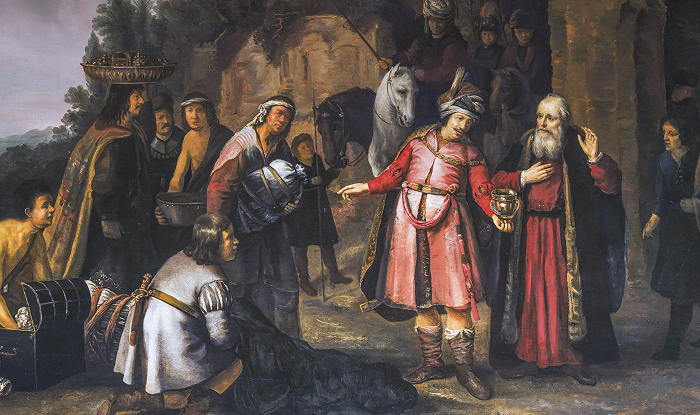
Sacred History recounts that, after being miraculously healed, Naaman presented himself once again at Elisha’s door to humbly thank him for his benefits.
This time, the prophet received him in person and, refusing the rich gifts he insisted on offering, allowed the general to take with him a certain quantity of soil from the country, for he, even though living among pagans, had decided from then on to worship only the one true God.
As the Syrian caravan moved away, Gehazi, who loved riches more than Elisha, thought to himself: “See, my master has spared this Naaman the Syrian, in not accepting from his hand what he brought. As the Lord lives, I will run after him, and get something from him” (2 Kgs 5:20).
And he set off quickly, to appropriate goods he did not deserve and demand payment for a cure he had not performed…
Ultimately, such a dishonest attempt could only end in failure.
A leper is healed and a healthy man made leprous…
Upon seeing Gehazi running after his caravan, Naaman stopped to see what he wanted. The deceit displayed by the servant is surprising:
My master has sent me to say, “There have just now come to me from the hill country of Ephraim two young men of the sons of the prophets; pray, give them a talent of silver and two festal garments” (2 Kgs 5:22).
Through this fraud, Gehazi obtained from the general – who, moved by gratitude and generosity, suspected nothing – everything he asked for and even an extra talent…
Satisfied with the success of the operation, he returned to his service in the presence of Elisha, having first taken care to hide the gifts he had acquired, in order to deceive the prophet, concealing his sin.
This naive trick, however, was immediately unmasked by the man of God:
“Where have you been, Gehazi?”
“Your servant went nowhere,” he replied.
Did I not go with you in spirit when the man turned from his chariot to meet you? Was it a time to accept money and garments, olive orchards and vineyards, sheep and oxen, menservants and maidservants? Therefore the leprosy of Naaman shall cleave to you, and to your descendants for ever.
And this is what happened: “So he went out from his presence a leper, as white as snow” (2 Kgs 5:27).
Punishment for some, reward for others
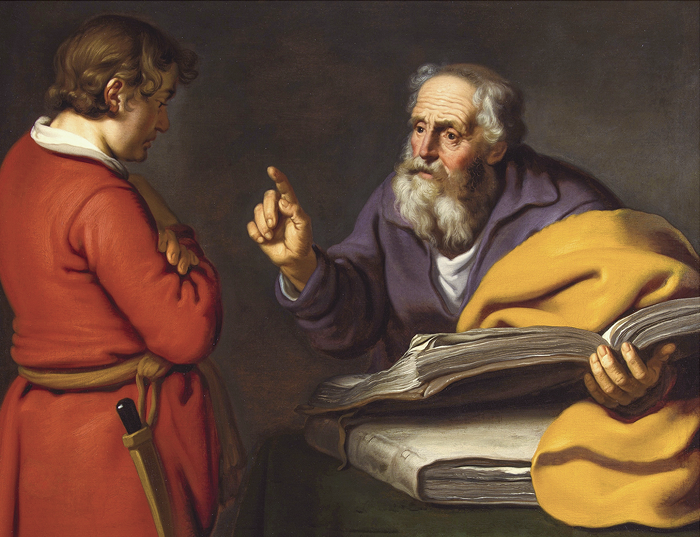
Everything suggests that, once a leper, Gehazi withdrew from Elisha’s service. Scripture, sparse in details, does not allude to this particular fine point; what is certain is that his name does not appear again in the prophet’s story.
Instead, we see him later conversing with King Joram (cf. 2 Kgs 8:4-5) – not a person, incidentally, of virtuous character – and then the sacred texts never mention him again.
What would have been his fate if he had imitated the unpretentiousness, righteousness, and holiness of his master? We do not need to meditate much to obtain an answer, for the Book of Kings itself presents it to us in the following chapter.
It happened, amidst the conflicts between Israel and Syria, that Elisha repeatedly revealed to the king of Israel the exact position of the enemy troops, their plans, and ambushes.
Discovering that these revelations were not the work of a traitor, but rather of the prophet, the Syrian sovereign decided to arrest him.
So, one morning Elisha awoke and saw his city surrounded by “horses and chariots and a great army” (2 Kgs 6:14), who came in search of him. At the sight of this spectacle, his servant – who was certainly no longer Gehazi – exclaimed in terror:
“Alas, my master! What shall we do?”
“Fear not,” Elisha replied. “for those who are with us are more than those who are with them.”
Considering Gehazi’s unworthy attitude in far less demanding circumstances, it is conceivable that, in such a danger, he might have fled from Elisha’s company, preferring to save himself rather than trust in prophecy…
The new servant, on the contrary, remained with the providential man when the situation seemed hopeless.
Although he did not fully understand his master’s statement, he saw in his eyes the certainty that only those who fight for God can convey; and he believed. In return for such an act of trust,
Elisha prayed, and said, “O Lord, I pray Thee, open his eyes that he may see.” So the Lord opened the eyes of the young man, and he saw; and behold, the mountain was full of horses and chariots of fire round about Elisha (2 Kgs 6:15-17).
His weakness was surmounted by devotion to the prophet, and his earthly vision became supernatural.
If Gehazi had been faithful, perhaps he would have been with Elisha in this wonderful episode.
He would have contemplated the legions of warrior Angels, and observed the adversaries blinded by divine power; he would have witnessed the fulfilment of impressive prophecies in the midst of the war against the Syrians (cf. 2 Kgs 6–7).
He might perhaps have witnessed the prophet’s last moments, closing his eyes to this life while he opened them to eternity…
Whom shall we imitate?
Throughout history, God’s wise and eternal plans, despite the recalcitrance of men, always come to pass.
It is up to us to choose whether we will be Elisha or Gehazi; whether our memory will be a blessing for posterity, or whether, on the contrary, it will bear the marks of curse or oblivion; whether we will work for the execution of divine plans, or whether we will figure in them only as a contemptible blot…
The choice is in our hands!