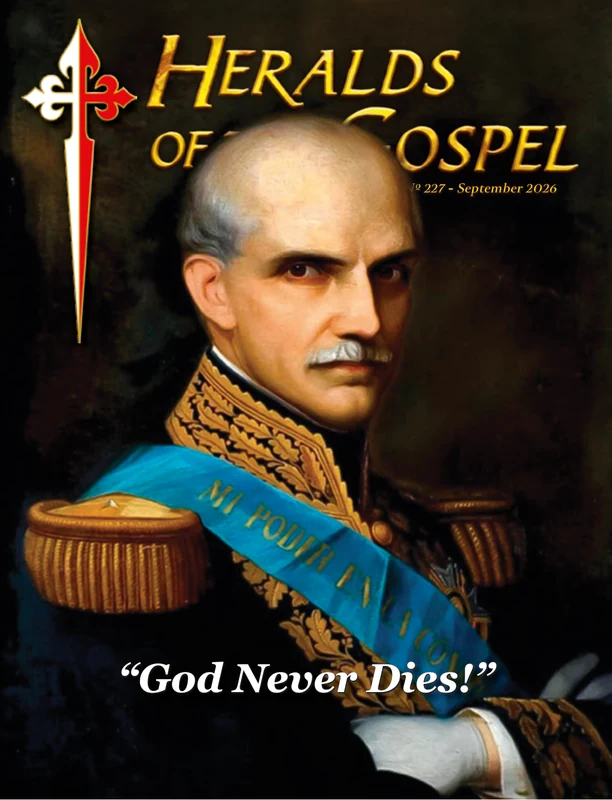
 Heralds of the Gospel Magazine, Vol. 20, nº 227, September 2026
 Heralds of the Gospel Magazine, Vol. 20, nº 226, August 2026
 Heralds of the Gospel Magazine, Vol. 20, nº 225, July 2026
 Who are the Heralds of the Gospel?
 Help of Christians
 Christmas Carols








The dawning of a vocation
The son of a devout family from the Auvergne region of France, Gabriel-Antoine Mossier was undoubtedly a beloved soul. At about twelve years old, he was enrolled at Billom, a renowned Jesuit school which dates back to the 15th century. There he met Victor Bosdure, a boy his age, with whom he established a fraternal relationship that would last until the end of their lives. As was customary in the colleges of the Society of Jesus in those times, at the beginning of the school year, a retreat was preached to the students, always an occasion of many graces. At the end of the retreat, while the two friends were talking about the inspirations they had received, they decided to share a thought they could no longer keep to themselves: what they wanted to be when they grew up! Compelled, however, by a typically childlike taste for secrecy, they both agreed not to reveal it to each other immediately, but to write their plans on slips of paper and place them in a hole in the wall for safe keeping. In this way, one day in the future, when they returned to Billom, they could retrieve the little papers and discover each other’s choice. Now, as was to be expected with two young boys not yet used to long waits, they had no sooner stored the papers than they went back to get them, open them, and read their contents. On Victor’s slip was written: “I shall be a missionary.” As for Gabriel’s, we will not reveal its contents quite yet; let time and history do that for us.His military career
 Without hesitation, young Gabriel decided to join the French army
A French dragoon with a Prussian flag captured in the Battle of Jena-Auerstedt - Armed Forces Museum, Paris
A faithful friend
 Mossier was soon promoted to corporal and later to lieutenant; however, the ideal of religious life began to grow in his soul…
At top, Gabriel Mossier as lieutenant in the 3rd Regiment of Dragoons; below, French dragoon from the same regiment in the 1830s
The war
1870! It was a year that would mark the history of France forever and, with it, that of our officer, for the terrible Franco-Prussian War had begun. For him, the news of the conflict met his most ardent and passionate desires. This was what he was born for! During the long journey that separated him from the battlefield, many thoughts assailed his mind. First and foremost, of course, were his eager hopes for the great feats he would accomplish during the war. Nevertheless, other cogitations – subtle but penetrating – also came to him and weighed on his conscience. Had the Blessed Virgin Mary not given him to sense her mysterious predilection? Had he not mapped out another destiny for his life when he wrote that note in Billom? Was Providence not waiting for him somewhere else?A visit to Heaven
Like every Christian, Gabriel knew that death is no trifling matter. Accordingly, he prayed to Mary to give him the opportunity to be truly reconciled with God through the Sacrament of Confession before the moment of the battle arrived. At a certain point during the exhausting march, his division had to pause, not only to recuperate its energy, but also to inquire as to what route to follow, a mission that was entrusted to Lieutenant Mossier. While he was consulting the inhabitants of the region, he heard comments about the existence of a Trappist monastery in the vicinity. This was precisely what he was looking for. After presenting the commander with the information he had gathered, Gabriel asked permission to spend the night in that monastery, the Trappe of Gethsemane, together with another soldier who was a friend and confidante. They both set out immediately. After being received by the priest in charge of hospitality, they asked him to hear their Confession, after which they went into the cells assigned to them. Ah, what peace they found there! At two in the morning they awoke, not to the sound of the trumpets for a new march, but to the bells that invited them to praise Our Lord. Inside the church, they experienced the profound and vivid emotion of hearing those heavenly chants sung by men who looked more like Angels. It was the antechamber of Heaven! As they left that “earthly paradise” to return to the valley of tears, recollected and silent, they seemed transformed. Breaking the silence, Gabriel confided to his friend: he had heard an inner voice calling him to that life. It was the same voice which had once spoken to his heart during his first retreat, the same voice which, at the age of twelve, had led him to write on his slip of paper: “I shall be a Trappist.” Time had passed, the child had grown, but the call remained. Things could not continue this way, concluded the thirty-five-year-old lieutenant. However, the duty of fighting for France caused him to postpone his commitment for a while longer. But the vow had been made: if he returned from the war alive, he would be a Trappist.The end of the war
The 3rd Regiment of Dragoons initiated its action, leaving behind it a trail of bravery and blood, despite the negative results gained by the campaign. Finally, on the morning of August 16 came the moment Mossier had been dreaming of: to lead a cavalry charge. At Gravelotte, the opposing armies met. Sabre in hand, there stood Gabriel; shouting “Long live France,” he launched himself against the Prussian ranks with all his fury. After that night at the Trappe of Gethsemane, Gabriel promised: if he returned from the war alive, he would be a Trappist
Scene from the Battle of Gravelotte, by Alphonse-Marie-Adolphe de Neuville - Museum of Orsay, Paris
The great decision
From Heaven, the patient Mother could wait no longer for her errant son. She would at last go out to meet him! One day, Captain Mossier was alone in his room when, suddenly, he seemed to hear the sweet, gentle and now familiar voice of the Blessed Virgin. In the depths of his soul, She said: “I let France pass before Me, but my turn has come. You made a promise to Me, you gave Me your word of honour that you wanted to be mine.” And She concluded: “All your hopes of vengeance, of glory, of advance, are but empty pretexts to hide your cowardice.”1 Cowardice… How that word resounded in the depths of his heart! Mossier and coward were two seemingly irreconcilable terms. Was he not the fearless warrior who had fought intrepidly at the Battle of Gravelotte? How could such a brave officer acknowledge himself as weak? Poor Gabriel… He had yet to learn how much harder it is to conquer oneself on the altar of holiness than to defeat one’s enemy on the battlefield! Now receiving this lesson, he accepted it lovingly, but also painfully. He spent the entire night praying for strength. The next day, he changed his life! Undoing his ties with the world and its deceptive hopes, he searched out the humblest Trappist monastery in France, and soon found it: Chambarand. On entering the Trappist vocation, he insisted on remaining a simple servant monk, far from the glories of the priesthood, wishing to live forgotten by all, but always remembering Her who had never forgotten him. Gabriel-Antoine Mossier was now dead and Brother Marie-Gabriel had been born. If he had once sunk through pride, through humility he would rise from the mire of sin. And to do this, he would now apply all his military training to the fight against the old man. If Gabriel Mossier left the French army, it was because he knew he was called to join the incomparably more glorious phalanx of Mary’s soldiers
Views of the Trappe of Chambarand at the end of the 19th century
Notes
1 DU BOURG, Antoine. Du champ de bataille à la Trappe: le Frère Gabriel. Paris: Perrin, 1939, p.72-73.