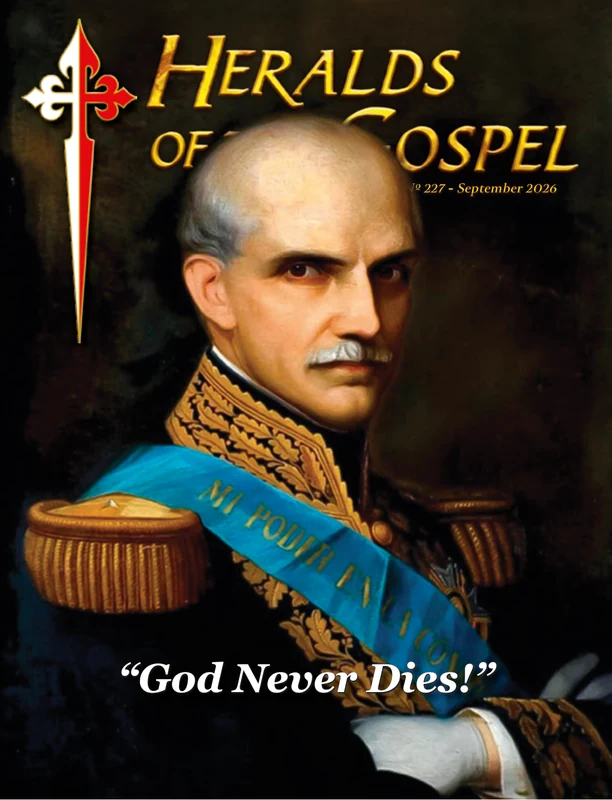
 Heralds of the Gospel Magazine, Vol. 20, nº 227, September 2026
 Heralds of the Gospel Magazine, Vol. 20, nº 226, August 2026
 Heralds of the Gospel Magazine, Vol. 20, nº 225, July 2026
 Who are the Heralds of the Gospel?
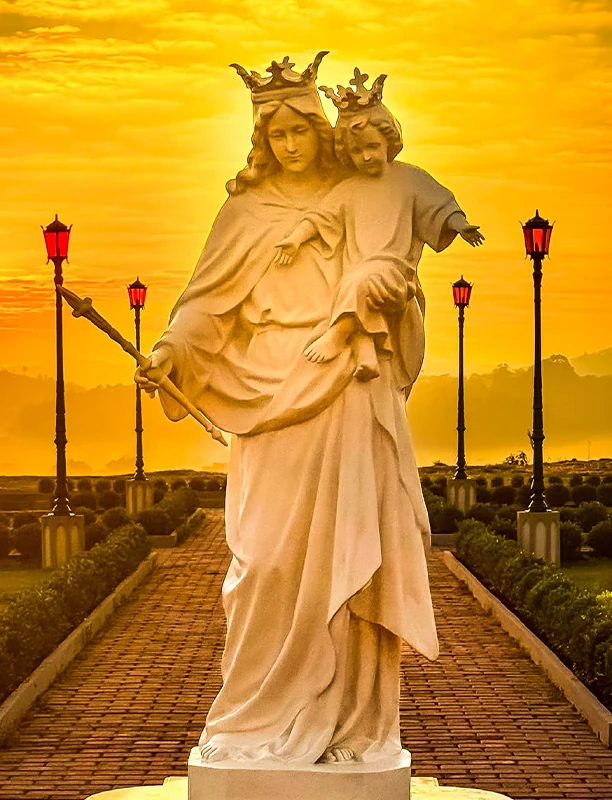 Help of Christians
 Christmas Carols






Regarding the relationship between Dr. Plinio and Dona Lucilia, it could be observed that their souls were interwoven in a bond of mutual affection, consideration and esteem.
For his part, there was the most deeply ingrained filial affection, acknowledging everything she did for him. She, in turn, possessed every manner of tenderness and devotion; but very careful and measured, for she feared being carried away by sentiment and losing her equilibrium.
She did not want to be attached to anything, not even to her own son, but to bear him a love that was entirely disinterested. Explained Dr. Plinio:
My affection for her was an act of admiration, which is something very laudatory because it is the recognition of a quality. On her part, there was an attitude of hopefulness in my regard, an invitation to attain that quality. This is the essence of affection.
Beyond natural ties
Nevertheless, there can be not the slightest doubt that, beyond natural ties, there existed between them a sublime and supernatural love, an affinity composed of grace.
Called to be the mother of an uncommon man, it is evident that, by a special endowment of the Holy Spirit, Dona Lucilia clearly and profoundly perceived his innocence of soul and the degree of his virtuousness.
She herself, in a letter to Plinio dated April 23, 1950, made manifest her happiness and gratitude to God for having him as a son:
With all my heart, with all my soul, I thank you for the letter you so affectionately left me, and which brought me so much comfort […].
I wept, it is true, but thanks be to God, it was from happiness for having received, I, so unworthy and ‘liberal’, the immense gift from the Sacred Hearts of Jesus and Mary Most Holy, of such a holy son, so good and devoted, whom I bless with all my soul, and for whom I ask every Divine protection, and the Light of the Divine Holy Spirit.
There is nothing stronger in the order of creation than the union between souls that love each other, having sanctity as their objective! Compared with this, a diamond itself is like a speck of rice flour.
More than mother, a true Catholic
Moreover, Dr. Plinio was an apostolic Roman Catholic man with such love for the Church that, having a mother such as Dona Lucilia, he carried his detachment to the point of valuing the fact of her being Catholic much more than her being his mother.
Let us look at certain passages in which this is made evident:
If I love Mama so much, it is because she led me to the Church. And if I loved her until the end, it is because I observed her until the end, and until the end I noted that everything in her led to the Catholic Church.
I have said many times that I loved and respected Mama. Without a doubt, I respected her as a mother, but that was not the most important thing. The main reason why I loved her was because of this union of souls that existed between us, with sights on God.
For her having reflected for me the Catholic Church, the Sacred Heart of Jesus and the Immaculate Heart of Mary, and for everything which in her was consonant with me, deliberately placed there by God in order to reflect Him, I was moved to love her in a very special way, more for these aspects than because she was my mother according to nature.
I remember hearing Dr. Plinio relate, during a lunch, an edifying episode that transpired between them. Dona Lucilia was already of a certain age when he posed himself the following question:
To what extent do I love my mother, and to what extent do I love the principles that she represents? If she became a Protestant, would I continue to love her in the same way, or would I have aversion to her? No! I would have aversion, because what I love in her is that which she represents!
Once, while they were seated at the table, he could not resist. He thought: “It is difficult, but I am going to put her to the test, because I want to see what her reaction will be upon hearing this.” And he said to her:
Mama, do you know what I was thinking the other day? That, God forbid, but if you had the disgrace of ceasing to be a Catholic and become Protestant, I would forsake the house and leave you to live alone.
I would continue to maintain you financially, I would take care of all your necessities and I would visit you once a year or every six months, but our relationship would be broken!
Dona Lucilia accepted this naturally, much as she would if someone had said: “I am thirsty and am going to drink this glass of water.” She responded praising his attitude.
Years later, Dr. Plinio would comment: “On that day I began to love and admire her more than before! Because I had put her to the test, and she had passed with flying colours!”
Were she not his mother, he would love her with the same affection
On the other hand, Dr. Plinio affirmed that, many times during his life, he asked himself a question which appeared to be the opposite of the previous one, but which was fundamentally the same: “Do I love her so much because she is so good, or because she is my mother?”
“If, instead of being my mother, she were my aunt, or a lady of society, or a relation, or an elderly cousin, would I love her as I do? Yes or no?”
And the reply came immediately, leaving no room for doubt: even if she were not his mother and, consequently, there were no natural connection between them, knowing her to be anywhere in the world, he would have loved her with the same tenderness, the same affection, the same esteem and the same appreciation!
I would want to have her as a mother. And if she were, for example, my aunt, I would arrange a pretext to go to her house every day; I would find a way for her to be my sponsor, I would do anything to make it explicable that, although her nephew, I would have the same affinity with her that I have with Mama. If she were a cousin, simile modo.1
If she were a lady of society, it would be much more difficult, but I would succeed in the end, arranging things the same way.
Taken, with slight adaptations, from: CLÁ DIAS, EP, João Scognamiglio. O dom de sabedoria na mente, vida e obra de [The Gift of Wisdom in the Mind Life and Work of] Plinio Corrêa de Oliveira. Città del Vaticano-São Paulo: LEV; Lumen Sapientiæ, 2016, v.I, p.161-166