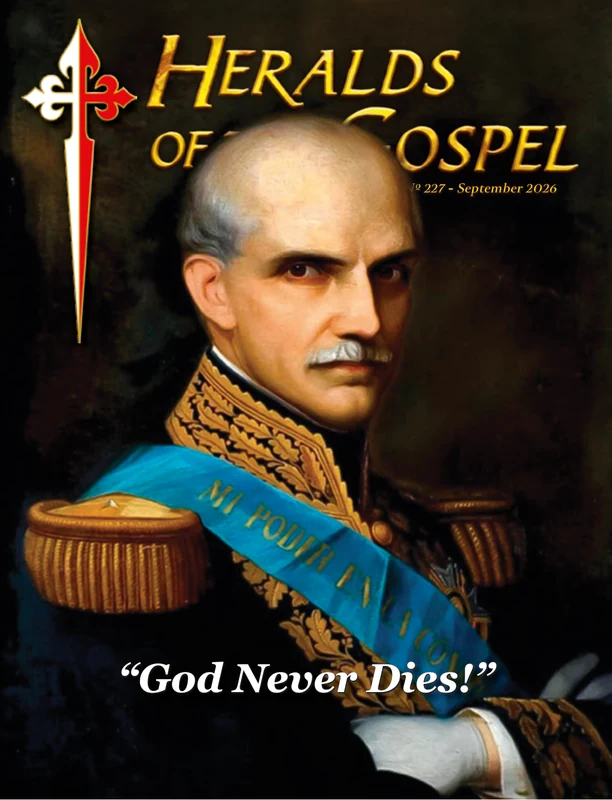
 Heralds of the Gospel Magazine, Vol. 20, nº 227, September 2026
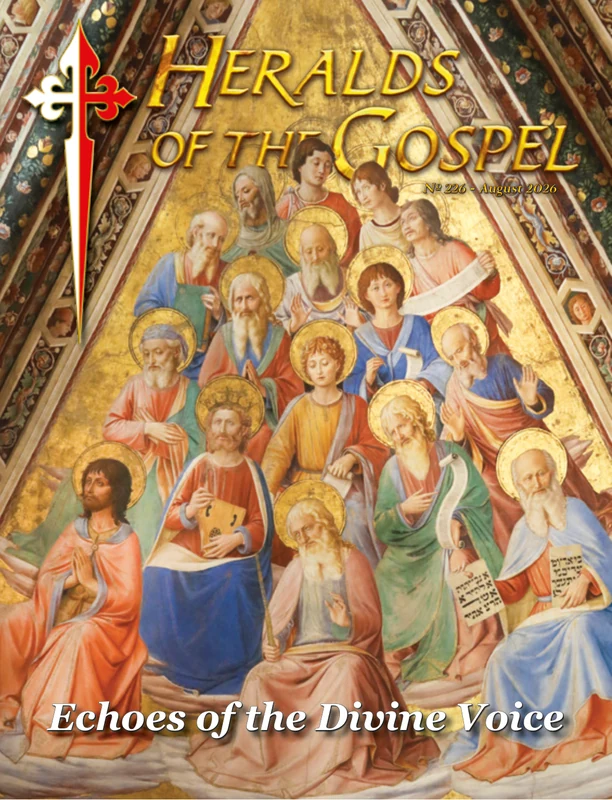 Heralds of the Gospel Magazine, Vol. 20, nº 226, August 2026
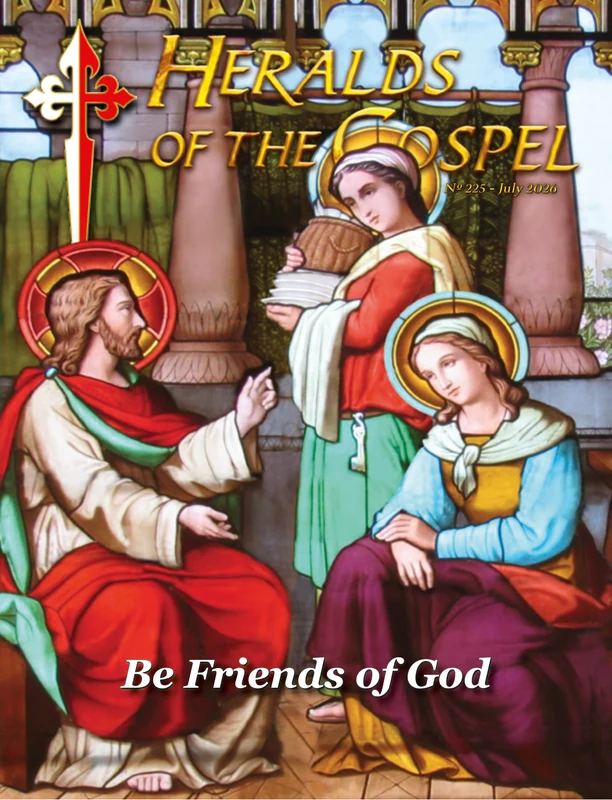 Heralds of the Gospel Magazine, Vol. 20, nº 225, July 2026
 Who are the Heralds of the Gospel?
 Help of Christians
 Christmas Carols






If there was no shortage of physical suffering, it paled in comparison to the moral. We have already seen how, as an only child, João’s isolation was his hallmark. And when he began to interact with classmates, neighbours and even some family members, he saw a world opening up before him that was completely opposed to innocence, in which self-interest, opportunism and malice dominated. What would the rest of his years be like? On this point, we are faced with a difficult problem: how can we recount in detail the nine thromboses, three embolisms, mononucleosis and tuberculosis that afflicted him before reaching middle age, as well as the crucible of countless trials that his spirit had already undergone? None of them seem less important or lacking in significance to us; none of them are unrelated to the supernatural perspective that we are following in these pages. But let us advance a little further in Msgr. João’s life, to a period which, both because of its seriousness and because of its rather parabolic character, demands greater attention.Msgr. João learned from an early age the language of suffering, which was to be the inseparable companion of his existence
“The accounts are settled and now your end has come”
The year 1994 was about to end. The then Mr. João had organized a week of tributes to Dr. Plinio for the occasion of his birthday on December 13, without imagining that it would be his last on this earth. On the final day of the celebration, which went brilliantly, he conducted the choir and orchestra. When the stage curtains closed amid exclamations and applause, he leaned on the music stand, exhausted, and said: “Now, after this public recognition of Dr. Plinio, I can die!” In his filial devotion, he had shown, to the fullest extent possible at that time, all his admiration and affection for his spiritual father and, feeling overcome by physical malaise, he uttered, like Simeon, his Nunc dimittis (cf. Lk 2:29-32). Once again in his quarters, he was struck by pains in his back and chest. And it was in this condition that he reached the year-end celebrations…
A miracle is born from boundless confidence
He emerged from the dark tunnel of sarcoidosis in the most unexpected way. In April 1995, while still in the United States, Msgr. João was stricken with a violent thrombosis, which resulted in a pulmonary embolism. He returned to hospital and underwent numerous tests. On the 26th, the feast of the Mother of Good Counsel, he was given a small picture of this invocation. Holding it in his hands, he prayed earnestly for guidance in the midst of this terrible situation. On the continent in the opposite hemisphere, another ardent prayer was rising from Dr. Plinio’s paternal heart to Our Lady’s feet: “Since the image of Our Lady of Good Counsel is on display here, I cannot forget […] our João, who is still in the United States at the moment. Let us ask Our Lady that, in accordance with her designs, She may return him to our midst as quickly as possible with his health restored.”3In Mary, the prayers of father and son met, and Heaven could not resist them. On that same day, April 26, the doctors revealed a surprising prodigy: the tests required by the circumstances showed not only a recovery from the embolism, but also a cure of the sarcoidosis, of which, inexplicably, there remained not even the slightest trace. That terrible phase would end with Msgr. João’s wise intervention in resolving a very different problem, with which the reader is already acquainted: the kidnapping of a member of the Group. This kept him abroad until the end of August, and he would only return to Brazil in time to accompany another via crucis: that of his spiritual father. The reunion took place at the door of the ambulance that was taking Dr. Plinio to the hospital where he would spend his last days.The slow and terrible agony of his physical strength was accompanied by the fading of his interior lights, until the most cruel dark night settled over Msgr. João’s soul
“The friend in whom I trusted…”
“The greatest manifestation of love is the perfect giving of oneself.”4 In the new stage that began with Dr. Plinio’s death, Msgr. João spared no effort, expending his own health, time and attention to reach out to those who needed his help, and offering his friendship to those fighting for the sake of good.One of the greatest sorrows he suffered during this period was the fact that some members of the Group, envious of the prominence that the situation gave him, decided to hinder his action and influence. In this way, the words of the Psalmist were once again fulfilled: “Even my bosom friend in whom I trusted, […] has lifted his heel against me” (41:9). Several of those he had previously considered to be his brothers in the ideal joined forces to destroy his honour and spread grave moral calumnies that had no basis in fact. St. Thomas had rightly said: “The wicked, […] unable to criticize the life of the just, are in the habit of slandering them, accusing them of not acting with an upright intention.”5 Despite everything, after the years had passed and relations with those people had ceased, Msgr. João still prayed for them and was concerned for their eternal salvation, just as he would be for faithful friends.One of the greatest sorrows he suffered after Dr. Plinio’s death was the fact that some brothers of ideal joined forces to hinder his action and influence

“Lord, not just one drop!”
As a result of his ordination to the priesthood in 2005, suffering, which had always been present in Msgr. João’s life, found its most sublime meaning, making applicable to him, as alter Christus, the teaching of theology: “The friendship of Jesus […] is as strong as it is tender; it tends to purify through trial and to associate souls with the mystery of the Redemption through suffering.”6 His life would become, in its own way, an extension of the Holy Sacrifice. But to effect this, the Redeemer would ask for his consent. It was the year 2009. In the early days of May, Msgr. João travelled to Europe to deal with the interests of the work. In Rome, he was celebrating a Holy Mass. At the moment of Communion, with the chalice in his hands, he made a false step and some of the Precious Blood splashed on his white vestment. While he was purifying the cloth, he felt Our Lord say to him: “My son, I have shed all my Blood for you; can you not shed a few drops for Me?” The Most Sacred Body of Jesus is in the glory of Heaven and therefore can no longer suffer; it is therefore in His Mystical Body that Christ continues to suffer His Passion. At that moment, the wounded face of the Church was presented to Msgr. João, asking him to allow himself to be nailed to the cross and to suffer with her and for her. “Lord, not just one drop! For You I want to shed all my blood,” was his prompt and generous response.Complete abandonment into the hands of Providence
A severe malaise consumed him when he returned to São Paulo. He went to hospital thinking that his eyes were seeing the lights of the city for the last time, and there he was diagnosed with advanced pneumonia. His acceptance, however, remained intact. To two Heralds who brought some of his belongings, he said: “We must be willing to accept every sacrifice that Providence asks of us, and to fulfil His designs.” Following this intention to the letter, he applied it even to the little things: “I do not even know what time it is, I do not know anything; I decided to leave myself in the hands of Providence,” he commented to one of his sons who visited him in intensive care. To another, who expressed regret at the pain he was enduring, he replied: “What makes a man’s life is suffering. The rest is worthless.” The first steps of his slow recovery were accompanied by an intense inner trial. Once again he felt like a “discarded bandage”. One afternoon, however, those who went to visit him found a special sparkle in his eyes, a sign that some light had been lit in his soul. He then revealed that grace had given him the certainty that he would not die on that occasion: “I still want to make use of you.”The consummation of the sacrifice
After an arduous recovery, a brief interval of calm followed. Did Msgr. João know that he had very little time left to complete part of his mission on this earth? What is certain is that in the meantime he fought for the two conquests that were most dear to him: the glorification of his spiritual father and the perpetuity of the institution he had founded. The beginning of his masterpiece on Dr. Plinio, which he himself wrote, and the pontifical approval of two societies of apostolic life crowned his efforts. During this period, during the Offertory of a Mass he was celebrating, Msgr. João received a mysterious sign: he heard, with the ears of the spirit, a carillon playing. An intense joy accompanied the phenomenon, giving him to understand that Providence was advising him of something very great, unthinkable to the human mind, that would happen. But for this vision to be realized and the bells to ring with joy on earth, or perhaps in eternity, he would have to face a terrible storm, commensurate only with the glory that was to come. As has already been mentioned in several of the articles in this issue, after morning Mass on June 2, 2010, while having breakfast in the company of some of his children, Msgr. João suffered a stroke. This was the beginning of a harrowing period that would last for more than fourteen years.
Minor vexations became commonplace. In any number of circumstances, attempts to express the smallest wish or make himself understood in routine matters such as the menu, medication or changing a simple watch were frustrated. To someone unfamiliar with suffering, such difficulties may seem insignificant. However, can you imagine the heroism required to endure them uninterruptedly, patiently and in high spirits for more than a decade, without ever uttering a single complaint? Another serious obstacle would be added: his personality was characterized by a marked agility, which had allowed him to be present with his subordinates in situations of danger, only to disappear when they were resolved. In fighting for the interests of the Church, he had never weighed efforts or distances. Due to the immobility of the right side of his body, however, he was now forced to use a wheelchair and depend on the help of others for everything. In a jocular tone, he once remarked that, on his own, he could not even shoo away a mosquito… The difficulty in getting around would generate a thousand inconveniences and aggravate many others. Every day, God asked him for another renunciation, another acceptance. And what was not asked of him, he spontaneously mortified. When it came to eating – a small satisfaction that would have been so legitimate in his state – he made a habit of reducing his portions considerably whenever the meal served pleased him in a particular way. And his practice was similar with regard to his rest: he never extended it beyond the usual time – not even if he had lost hours of sleep due to insomnia or indisposition. And the examples could go on and on… In fact, Msgr. João himself had set the limit: he would give “all his blood” to Providence. His last months resembled a spiritual battle in which he seemed to want to offer Heaven everything he could, in vigils, prayers and sufferings of the most diverse kinds, without ever giving in to discouragement. While his carnal eyes were closing to this world, his spirit experienced an unprecedented elevation, evinced in the enhanced sublimity of his dealings with both supernatural realities and those around him.When presented with the wounded face of the Church, and asked to suffer with her and for her, the response of Msgr. João was immediate: “Lord, for You I want to shed all my blood!”

Co-redemptor with Christ
He could well have said with St. Paul: “in my flesh I complete what is lacking in Christ’s afflictions for the sake of His body, that is, the Church” (Col 1:24). Indeed, in the sufferings endured by our founder with such love and generosity, we have seen fulfilled the words of an eminent contemporary theologian when he commented on this bold – and very real! – statement of the Apostle: “We can utilize our sufferings by putting them at the service of Christ’s redemptive work. […] We can and must be co-redemptors with Christ.”7Msgr. João’s sufferings, united to those of infinite value of the Divine Victim of Golgotha, will bear fruits of grace throughout the centuries and will perpetuate his presence by means of his legacy, his children and his action in souls and events. May those who benefit from this gift value the high price that was paid for them because, when holiness seemed extinct from the earth, there was a man who made the ideal of divine perfection proposed by Jesus (cf. Mt 5:48) his goal; when humanity trampled the Law of God underfoot, sinking into the mire of illicit pleasure, someone suffered for them without them knowing it; when the Barque of Peter was threatened by the worst storm in its history, the sorrows of a righteous man became a pledge to the Father of its victory. The Church was born when the Blood gushed from the open side of Christ on the Cross; it spread through the blood of the martyrs, and until the end of the world, blood will be the sole guarantee of the triumph of the Bride of the Lamb without blemish, of the Lion of Judah. ◊His last months were a spiritual battle in which he offered Heaven everything he could, until the moment in which, having completely emptied the chalice of suffering, he gave his very life
Notes
1 CLÁ DIAS, EP, João Scognamiglio. Letter to Dr. Plinio, 15/3/1995.
2 Idem, ibidem.
3 CORRÊA DE OLIVEIRA, Plinio. Conference. São Paulo, 26/4/1995.
4 GARRIGOU-LAGRANGE, OP, Réginald. El Salvador y su amor por nosotros. Madrid: Rialp, 1977, p.380.
5 ST. THOMAS AQUINAS. Commento al Libro di Giobbe, c.I. Bologna: Studio Domenicano, 1995, p.38.
6 GARRIGOU-LAGRANGE, op. cit, p.492.
7 ROYO MARÍN, OP, Antonio. Jesucristo y la vida cristiana. Madrid: BAC, 1961, p.575-576.