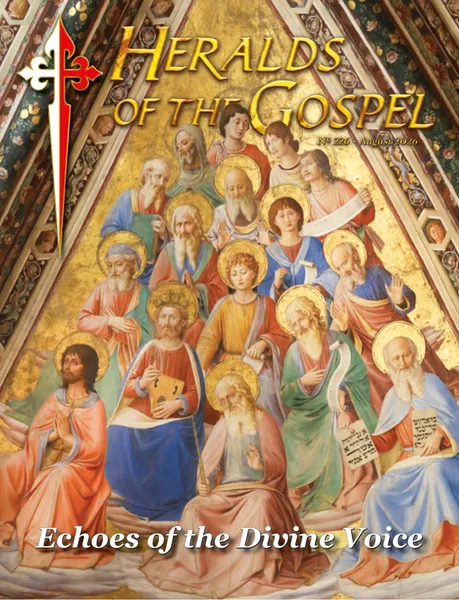
 Heralds of the Gospel Magazine, Vol. 20, nº 226, August 2026
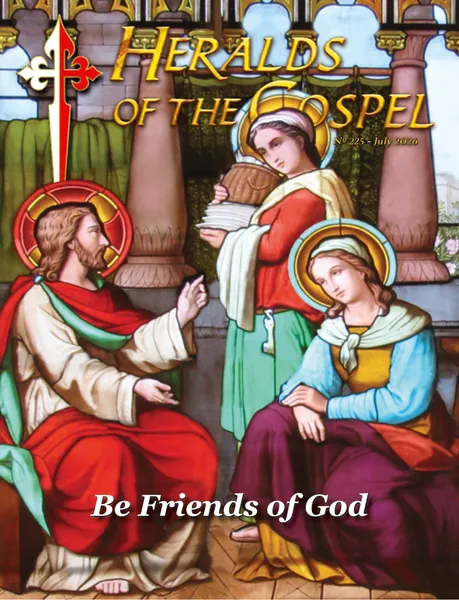 Heralds of the Gospel Magazine, Vol. 20, nº 225, July 2026
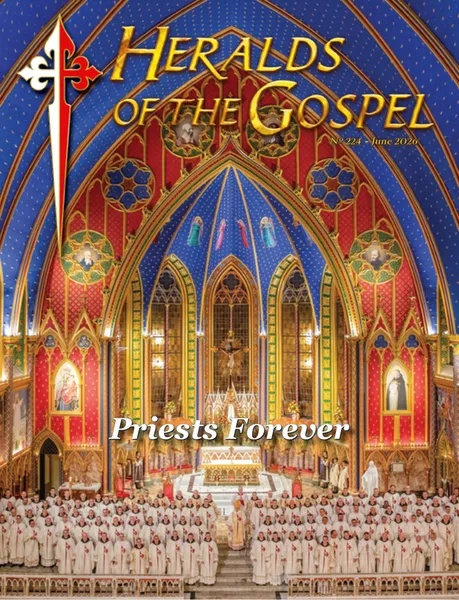 Heralds of the Gospel Magazine, Vol. 20, nº 224, June 2026
 Who are the Heralds of the Gospel?
 Help of Christians
 Christmas Carols






Countless times we heard our beloved founder comment on the parable of the prodigal son, analysing the characters that make up the scenario divinely idealized by Our Lord Jesus Christ: the father, the older brother, the prodigal son himself in his various states of soul.
However, we were surprised one day to hear him comment on a fourth figure, absent from the parable, but probably contemplated by the Saviour: the mother of the two young men.1
What would have been the attitude of this mother upon seeing her younger son leave his father’s house and venture into the world? First of all, she would not let him leave…
And if by chance the son managed to escape from home, the mother, saddened by his departure, would not be content to wait resignedly for his return, but would search for him tirelessly until bringing him back.
This beautiful reflection helps us to understand the historical era in which we live. Indeed, humanity in our days is a “prodigal daughter” of God, upon whom a great forgiveness must descend.
However, she is unable return to her father’s house on her own and needs a merciful mother to rescue her. Where can she find such a kind and gentle mother?
A sure answer may lie in the sublime fresco of Our Lady of Good Counsel.
Let us carefully examine some aspects of this fresco and see how it encapsulates, in every detail, a maternal smile.
Counsel of Mary, counsel of Christ
The first detail that deserves attention is the title given to the Blessed Virgin, invoked in the painting as She who can give us good counsel.
Now, how do we define the term counsel? In a general sense, it is a recommendation aimed at solving a particular problem. Therefore, in difficult circumstances that call for serious decisions, nothing can be more valuable than receiving good counsel!
From this point of view, there could be no one more trustworthy than Our Lady to advise us in any circumstance; She is, after all, the Mother of the Incarnate Wisdom!
When contemplating the Genazzano fresco, one peculiarity often goes unnoticed: the Virgin’s gaze is not fixed directly on the faithful who come before her, as is usually the case in most images of Our Lady, but her head inclines slightly towards the Child, indicating to us that Jesus is the source of all the wisdom from which She draws to counsel us.
For this reason, the Divine Infant, despite being small, is represented with a physiognomy of one who has already reached maturity.2
In this exchange of gazes between Mother and Son, moreover, the union of wills between them is manifested, in such a way that Mary transmits to us what Jesus desires, guiding us along the paths that the divine will has designed for our lives.
Therefore, her counsel enjoys the precision and infallibility of the very words of her Divine Child.
On the other hand, the filial gesture of the Infant in embracing His Blessed Mother gives us the example of the intimacy with which we should turn to Mary, who is also our Mother, and of the disposition of soul necessary to receive her counsel.
According to Dr. Plinio Corrêa de Oliveira,3 when the Child Jesus grasps Our Lady’s neck with His little fingers, He not only wants to hold on, but also to turn her face towards Himself, as if saying: “Mother, look at Me!” It is the perfect prayer of a good son!
An unparalleled gaze
In her earthly life, Our Lady possessed, to an eminent degree, the gift of transmitting to those who approached her the virtues overflowing from her soul.4
Indeed, it is characteristic of perfect virtue not to be practised only individually, but to be “contagious” to other souls.
We can imagine, for example, when She met Mary Magdalene, still a sinner, and they made eye contact for the first time.
What must have transpired within that poor soul at such an august moment? These are mysteries of grace…
However, we are free to imagine that the purity of Our Lady, like a pure white mantle, covered her hardened heart and, from the mire of her debauchery, the lily of virginity began to sprout, which would soon be restored to her!
A similar wonder continues to be worked through her fresco. How many times do souls despair in the face of their miseries and failings, and no longer know where to turn to be able to abandon a vice…
They lack the strength to confess their errors and receive God’s forgiveness. What can they do? Simply, turn to the Mother of Good Counsel.
She does not always utter words, but She nevertheless speaks clearly through the motion of divine grace, more precious than all discourses! Looking intently at the fresco is sufficient for lost innocence to begin to be restored.
Then, Our Lady strengthens the soul so that it may seek a priest and receive, in the Sacrament of Confession, the consummation of the work of mercy begun by her most pure gaze.
Communication that transcends words
While Mary’s gentle eyes, with their slightly oriental shape so beautifully represented in the fresco, further accentuate her maternal quality and affection, her lips, marked by a discreet smile, reveal the habitual seriousness of one whose soul is at peace, always ready for an encounter with God.
“In everything Mary was grave and circumspect, never laughing, speaking little, saying only what was necessary, listening easily, always affable with everyone,”5 narrates an ancient depiction of the Blessed Virgin.
Certainly, when walking along the roads of Nazareth, Mary would have cordially greeted her neighbours and acquaintances, along with any fortunate visitors to the region.
Later, She also favoured the Apostles with countless words and counsels accompanied by a smile. And all this, which was not recorded in the Gospels, is transmitted to us by the fresco of Genazzano in its ineffable “changes of physiognomy.”
Our Lady of Good Counsel acts in this way: through the imponderables of her face, she gradually penetrates our soul with a soothing balm, until working a mysterious conversion.
She seems to be alive before our eyes, and her soft, serene, and maternal voice whispers in the depths of our hearts that sublime recommendation, always suited to human need, which indicates an infallible path: “Confidence!”
Our Lady will restore humanity!
“What happened to me?” asked Joris-Karl Huysmans, the renowned French writer, when he found himself converted to the Catholic Faith by a mysterious grace.
How was it possible that his soul, sunken as it was in the abyss of vice and sin, desired to change and tread the path of penance and holiness? Finding no answer in the world to this question, he acknowledged:
It is the Virgin who acts upon us in these cases; it is She who moulds us and places us in the hands of her Son, but her fingers are so delicate, so fluid and gentle that the soul, which they have grasped, feels nothing.6
Just as happened with Huysmans, and happens within each of us, Our Lady will one day intervene in history, restoring to humanity the life of grace and pouring out upon all creation the fullness of the effects of Redemption.
Whatever happens, let us look to the fresco of Our Lady of Good Counsel, who will say to us: “My son, my daughter, confide! And I will guide you on the right path!”