 Heralds of the Gospel Magazine, Vol. 20, nº 227, September 2026
 Heralds of the Gospel Magazine, Vol. 20, nº 226, August 2026
 Heralds of the Gospel Magazine, Vol. 20, nº 225, July 2026
 Who are the Heralds of the Gospel?
 Help of Christians
 Christmas Carols









Two worlds in constant opposition
On his first day at school, after one or two classes, recreation time arrived. Going out onto the spacious grounds, he looked around for his cousins amid the multitude of boys running and shouting. They had promised to introduce him to the other students. And where were the famous cherry trees? Finally, one of his cousins appeared, breathless and excited. “Plinio!” he shouted. “Where are the cherry trees?” the new student asked, hoping to enjoy some of his favourite fruit during his first break. “Let’s play soccer!” the cousin responded. The hard battle of life had begun for Plinio, with the tragedies, disillusionments, and failures that every child of Adam must experience. His first disappointment was that of not finding the anticipated cherry trees. Then, he saw before his eyes two worlds developing side by side, in constant opposition – that of the priests, turned toward the sacred, with their grave bearing and austere garb, creating around themselves an environment symbolizing tradition and eternal truths. The other was the world of the students, riveted in that post-war era by the vulgar “modernity” of Hollywood and drawn to the resulting simple and carefree manners. It was not difficult to detect traces of the first anarchist and libertarian germs that would infect society decades later. At school, these two antagonistic influences naturally alternated several times throughout the day. At the beginning of recess, everyone filed in silence to the playground entrance, where a young teacher in clerical dress blew a whistle. At this signal, it seemed that a tornado struck the boys, dispersing them in all directions. The more rambunctious ones usually assembled in a corner of the playground to tell jokes, or to criticize and mock the teachers; others devised small uprisings against bothersome disciplinary norms. Most of the students were carried along by their young leaders, on the crest of the changing times. Although the good and pious Jesuits priests preached orthodox doctrine for months on end, when students got together during their recreation, an argument or a careless quip by a boy during a five-minute conversation was capable of tearing down all that the professors had achieved with hours and hours of classes. Plinio did not allow himself to be dominated by these surroundings. Although his light complexion and hair and slim physique were not likely to intimidate others, he decided to confront the situation. Deep down, he opted to fight to preserve in his soul the innocence that Dona Lucilia had so zealously protected and fostered. Now it was up to him and him alone to preserve the white robe of the Faith and of chastity that he had received at Baptism.Maternal apprehension
Dona Lucilia discreetly observed her son’s slightest attitudes, to see if he was resisting bad influences or was imperceptibly being carried along by them. Through Plinio’s speech, gestures, his way of treating others, and, especially, through the “sixth sense” unique to mothers, Dona Lucilia sought to detect possible symptoms of his succumbing to the new modes. In the late afternoon, when it was almost time for Plinio to return from school, Dona Lucilia would go to the terrace of the house and wait for him. She wanted to see him arriving from a distance, to observe shades of difference in her son’s behaviour after accumulated exposures to the school and street setting, that so contrasted with the home environment. As he approached she stepped inside, and peered at him through a window. She saw him calmly open and close the heavy entrance gate, climb the stairs with dignity and ring the bell. She waited for him to come into the room, then hugged and kissed him and gave him her blessing. She was relieved to see that her son was the same as on the first day of classes.A change brought on by fidelity
But one day she noticed a sudden change. Plinio arrived with a pile of textbooks and notebooks under his arms. The gate was unlatched. He kicked it open and, after entering, pushed it closed with his shoulder. He crossed the yard with a quick and heavy step and ran up the stairs two at a time.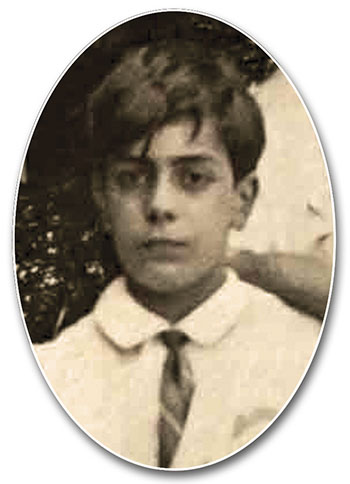 Despite the change in his attitude, a merely exterior and tactical one, he sacrificed nothing of his fidelity
Plinio at St. Louis School, in 1921
Taken, with minor adaptations, from: Dona Lucilia. Città del Vaticano-Nobleton: LEV; Heralds of the Gospel, 2013, 244-249