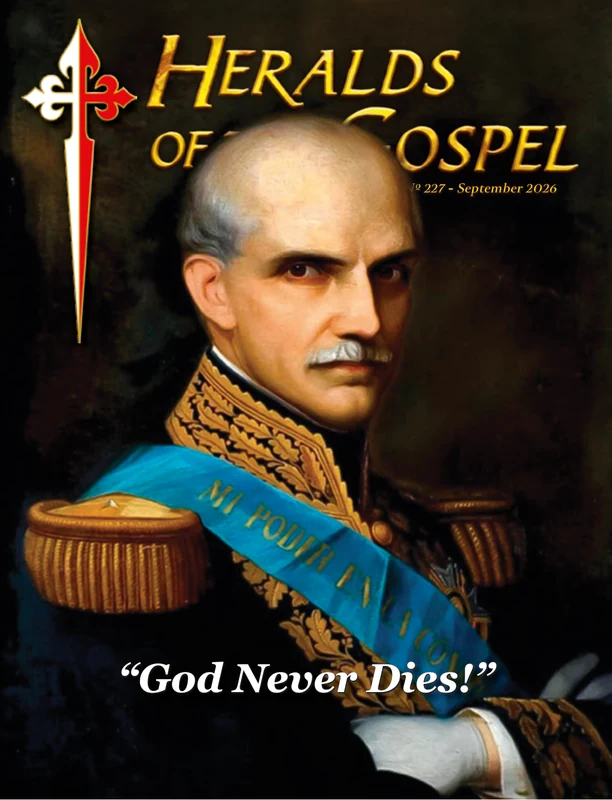
 Heralds of the Gospel Magazine, Vol. 20, nº 227, September 2026
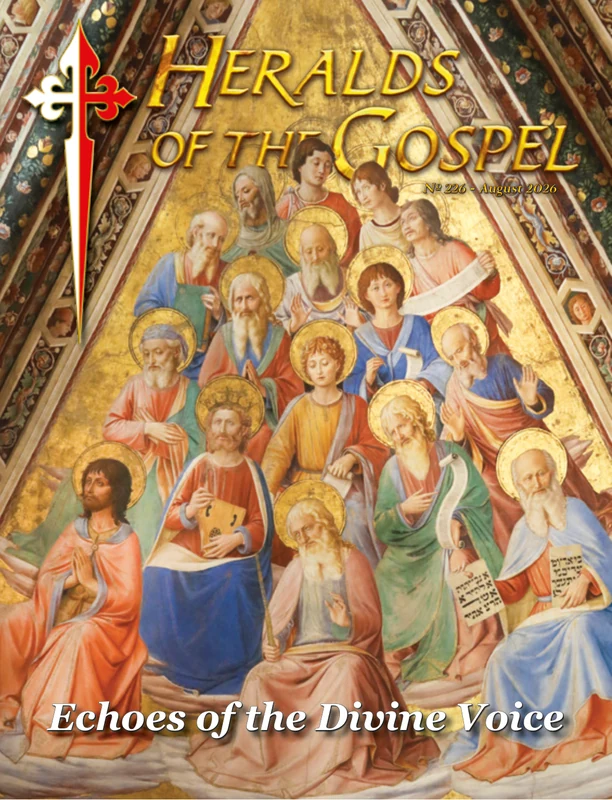 Heralds of the Gospel Magazine, Vol. 20, nº 226, August 2026
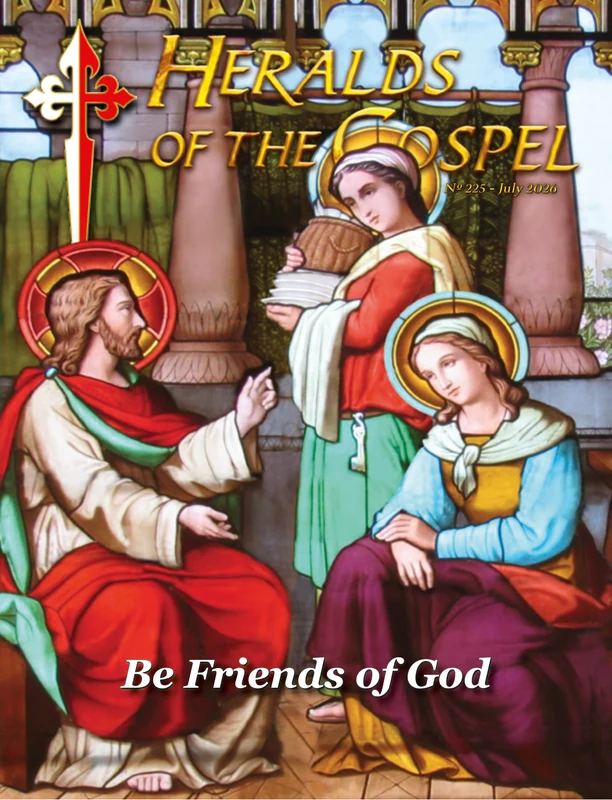 Heralds of the Gospel Magazine, Vol. 20, nº 225, July 2026
 Who are the Heralds of the Gospel?
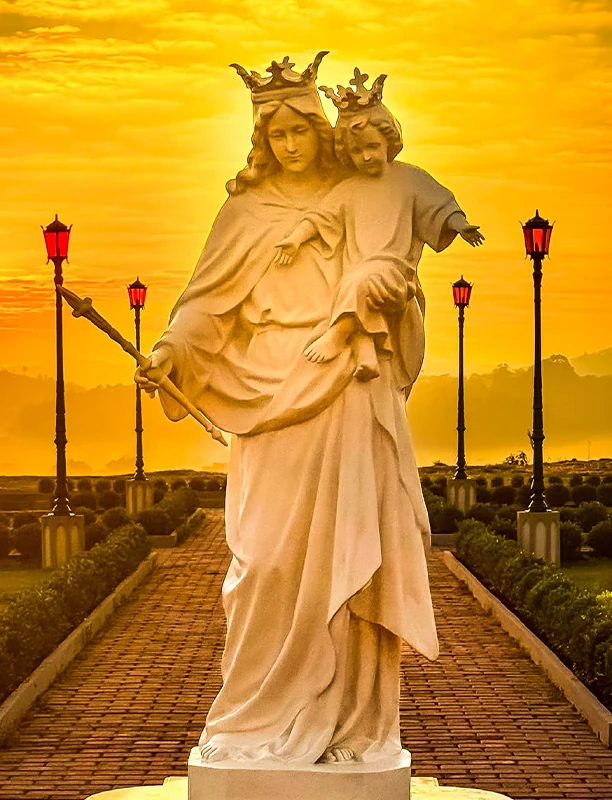 Help of Christians
 Christmas Carols








Different means to achieve the same end
Thanks to the emphasis placed on the universal call to holiness, made to the faithful of whatever state or condition,1 this perspective has come back to the fore in our days, after several centuries of neglect and conformism. It means reawakening in the baptized the interest in perfection, which is the following of Christ, since, regardless of the way chosen, holiness concerns everyone without exception! Furthermore, it is necessary – avoiding great disparities, but without reversing the order of things in the Church – to properly demonstrate the position of the state of perfection and its relationship to the call to the plenitude of charity proper to the lay state. To this end, we propose to the reader a reflection on perfection based on Thomistic doctrine, in order to demonstrate the harmony existing between the state of religious life and secular life, so often set at odds in modern history. In effect, the fragmentation of theology into Dogmatic and Moral, and its subsequent segmentation into treatises dedicated to cases of conscience and ascetical manuals, ended up suggesting two parallel levels of Christian life. The first would be that of perfection – understood as following Christ by the renunciation of material goods, marriage and one’s own will – and the second would consist in avoiding moral evil, represented by mortal sin and vice, although without aspirations to holiness, reserved only for religious. Monks of the San Giacomo Charterhouse - Private collection
What constitutes perfection?
First of all, it is fitting to inquire what constitutes perfection. St. Thomas answers with the words of St. Paul: “Above all these put on love, which binds everything together in perfect harmony” (Col 3:14). Let us look at the theological reason given by the Angelic Doctor after citing the infallible authority of Scripture: “A thing is said to be perfect in so far as it attains its proper end, which is the ultimate perfection thereof. Now it is charity that unites us to God, who is the last end of the human mind […]. Therefore the perfection of the Christian life consists radically in charity.”2 The next step to be taken is to ask whether one can be perfect in this life by bringing charity to its full realization. The common answer tends towards the negative: “Perfection, let us leave it for Paradise.” However, the Angel of the Schools did not think so: “The Divine law does not prescribe the impossible. Yet it prescribes perfection according to Matthew 5:48, ‘Be you… perfect, as also your heavenly Father is perfect.’ Therefore seemingly one can be perfect in this life.”3 It is clear, as St. Thomas himself explains, that there is a difference in degree between the perfection that is possible while on pilgrimage in via and that of the blessed in patria. In Heaven, perfection “answers to an absolute totality on the part of the lover, so that the affective faculty always actually tends to God as much as it possibly can.”4 In the present life, it is impossible to reach this very high level of affective contemplation, which means a definitive immersion in divine charity. Nevertheless, there is a way of perfection by which one excludes “obstacles to the movement of love towards God,”5 and this can be acquired while yet an earthly wayfarer. Moreover, Aquinas firmly establishes the relationship between charity and the practice of the commandments of God’s Law, and he does so, as always, by means of various authoritative arguments from Sacred Scripture: “You shall love the Lord your God with all your heart” (Dt 6:5); “You shall love your neighbour as yourself” (Lv 19:18); “On these two commandments depend all the Law and the prophets.” (Mt 22:40). Finally, he concludes: “The perfection of charity, in respect of which the Christian life is said to be perfect, consists in our loving God with our whole heart, and our neighbour as ourselves. Therefore it would seem that perfection consists in the observance of the precepts.”6 This is a conclusion of great importance, and should be underscored: perfection consists in keeping God’s Law. To be saved, everyone must observe it and, therefore, the call to perfection – as is clear in the Gospel – is universal; it is not restricted to a few.How to attain perfection?
Having clarified what perfection is; another question now arises: how can we attain it in this life? In two ways, replies the Angelic Doctor: “First, by the removal from man’s affections of all that is contrary to charity, such as mortal sin; and there can be no charity apart from this perfection, wherefore it is necessary for salvation. Secondly, by the removal from man’s affections not only of whatever is contrary to charity, but also of whatever hinders the mind’s affections from tending wholly to God.”7 Some might see outlined in this reply a subtly attractive “minimalist morality.” To be perfect, it would suffice to “merely” avoid mortal sin, as was just affirmed. But could St. Thomas Aquinas, the sun of theology, be leading Christians along a secondary path? First of all, it is necessary to consider that the rejection of mortal sin requires heroism. Moreover, it cannot be achieved without a holy life, permeated by the rays of the theological virtues and regulated by the cardinal virtues. How, for example, can a young man be pure – overcoming the devil, the tempestuous incitement of passions and the seductive example of the world – if not by striving hard, with the help of grace? And we might apply questions like these to people of all ages, in the face of the most varied moral situations. For human beings abandoned to their natural powers, it is impossible to abstain from mortal sin; this can only be done with God’s help (cf. Mt 19:26).Precepts and counsels
Returning to the preceding question, however, if perfection consists in the practice of the Commandments, how is it that one can be even more perfect by not only avoiding violation of the Divine Law, but by removing any obstacle that distances the will from the love of God? Let us leave the answer to St. Thomas himself: The Holy Family - National Viceroyalty Museum
 Tepotzotlán (Mexico)
Perfection and following
On the other hand, St. Thomas equates perfection with following Christ. Commenting on the Lord’s invitation to the rich young man, transcribed at the beginning of this article, he explains it thus: “The Calling of St. Peter and St. Andrew”, by Federico Barocci - Museum of San Lorenzo de El Escorial (Spain)
Called to tread the same path
In conclusion, in these times so much in need of a true spiritual renewal, it is fitting to rediscover the value of the theology of following, as the evangelical proposal for reaching the perfection to which the Divine Master invites us. This following, however, is proposed to us in varying ways, not as different, parallel or opposite ways, but as distinct ways of travelling the same path, which is Christ himself. Some have been called to married life and have the merit of completing the number of the elect, bequeathing to them the Faith and educating them in it. Others have been gifted with a more demanding vocation, that of leaving everything. Free from the concerns of the world, they travel the path of salvation with greater ease, without ever forgetting that they are at the service of the Church, to complete its beauty, as standard-bearers of perfection, giving everyone the necessary courage not to give up halfway and tending continually towards Christ, the goal and perfection of our life. ◊Taken, with minor adaptations, from: La centralidad del seguimiento de Cristo en la santificación del cristiano. In: A vida religiosa hoje [Religious Life Today]. São Paulo, Lumen Sapientiæ, 2018, v.I, p.11-44
Notes
1 Cf. SECOND VATICAN COUNCIL. Lumen gentium, n.41.
2 ST. THOMAS AQUINAS. Summa Theologiæ. II-II, q.184, a.1.
3 Idem, a.2.
4 Idem, ibidem.
5 Idem, ibidem.
6 Idem, a.3.
7 Idem, a.2.
8 Idem, a.3.
9 Cf. ST. THOMAS AQUINAS. Quodlibet, IV, q.12, a.2.
10 Idem, ad 3.
11 Idem, ibidem.
12 ST. THOMAS AQUINAS. Summa Theologiæ. II-II, q.184, a.3, ad 1.