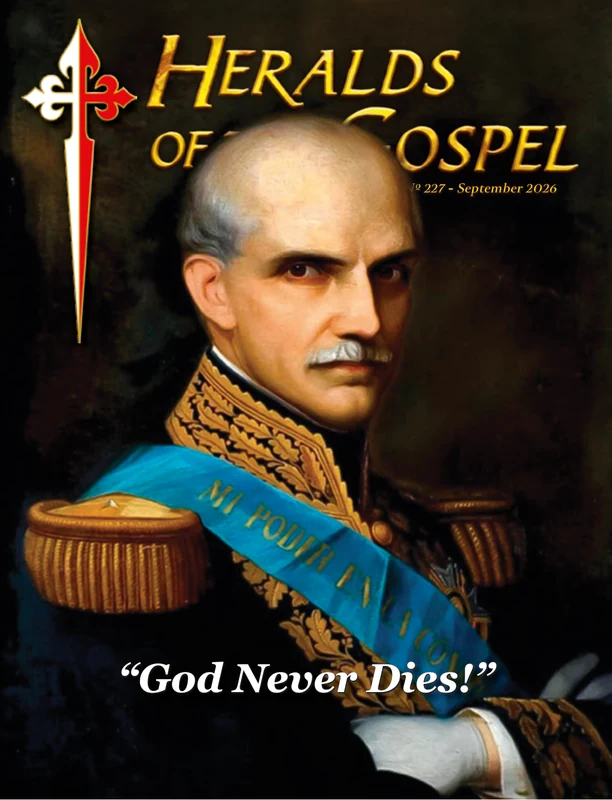
 Heralds of the Gospel Magazine, Vol. 20, nº 227, September 2026
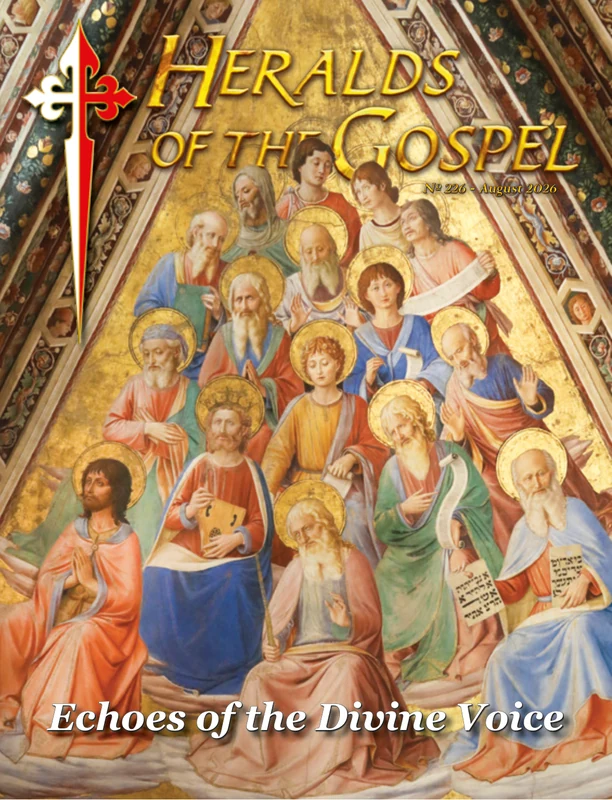 Heralds of the Gospel Magazine, Vol. 20, nº 226, August 2026
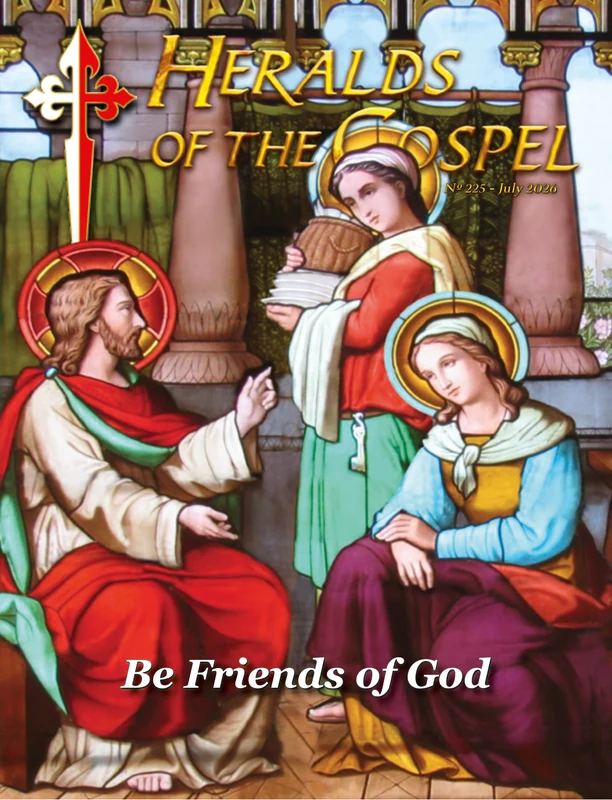 Heralds of the Gospel Magazine, Vol. 20, nº 225, July 2026
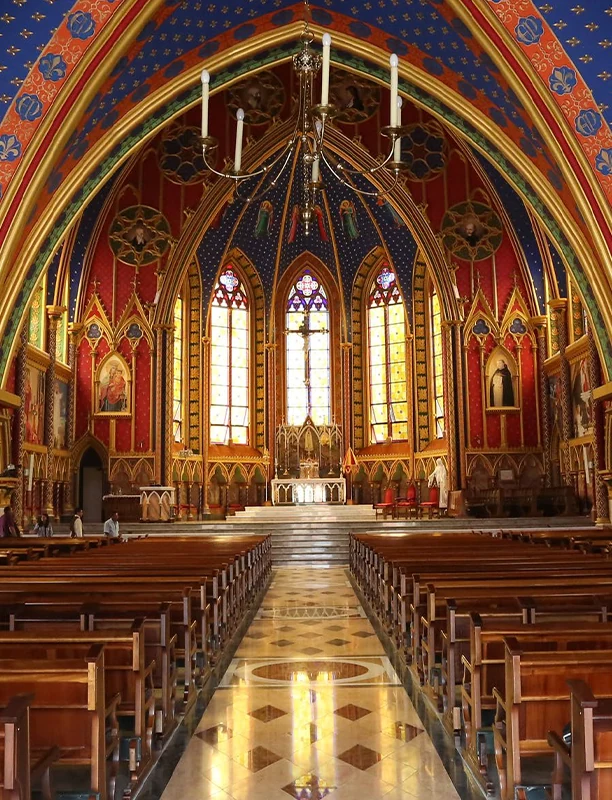 Who are the Heralds of the Gospel?
 Help of Christians
 Christmas Carols








Amid generalized confusion, Blessed John Dominici was the man sent by Heaven to resolve a calamitous situation for the Church, of which the complex juridical aspects were only the tip of the iceberg.
 Blessed John Dominici, by Fra Angelico, detail from the Crucifixion and the Saints - Convent of San Marco, Florence (Italy)
Conversation with the Pope by the hearth
At the close of 1406, before a hearth in the Apostolic Palace of the Vatican, the elderly Angelo Correr, recently elected Pope Gregory XII, conversed with a man of his fullest confidence, the priest John Dominici, a member of the Order of Preachers, regarding the doubts hovering over his Pontificate. — Fr. Dominici, over the course of the Conclave, I noted your fine diplomatic skills. As you know, I, along with the other Cardinals, took the oath to strive to bring the schism to an end and to initiate, for this purpose within three months, the necessary negotiations to obtain a personal meeting with the antipope of Avignon. This will not be possible without the help of a skilled diplomat. For my part, I am ready to renounce the Papacy, if it be necessary, to put an end to the schism. But I ask you to remain in Rome, for I need your help. — Holy Father, I am at your service. The schism has indeed become an interminable nightmare for all of Christianity. Nevertheless, since you have honoured me with your confidence, allow me to make an observation. Your readiness to abdicate, if it be necessary, for the good of the Church, is undoubtedly very important; but much more important is that this possible abdication be presented at the right moment, neither before or after. While the Pope pondered the words of that Dominican whom Providence had given him as an aid in such trying circumstances, the words of the Gospel came to his mind: “There was a man sent from God, whose name was John” (Jn 1:6).The only solution for the schism
 Gregory XII, by Joos van Wassenhove -
 Palazzo Barberini, Rome
Three “popes” instead of two
The consternation provoked by this complex situation was further aggravated by the indecisiveness of Gregory XII when the moment came for realizing the anticipated meeting with the antipope Benedict XIII. The impatience of the Cardinals of Rome and of Avignon grew in face of the endless negotiations. And when, at last, the date and place for the meeting had been fixed, Gregory XII changed his mind at the last moment, yielding to pressure from certain relatives and advisers. At almost the same time, he decided to create four new Cardinals – one of whom was Fr. John Dominici –, for he distrusted some members of the Sacred College who had made outward displays of inconformity with his decisions. The fact that two of the new Cardinals were nephews of the Pope only served to increase the discord. Statue of antipope Benedict XIII, Peñíscola (Spain)
The antipope John XXIII and the Emperor Sigismund
On the night of December 24, 1414, the majestic entourage of Sigismund of Luxembourg, head of the Holy Roman-Germanic Empire, reached the city of Constance, Germany. The Supreme Pontiff awaited him in the Cathedral for the solemn Christmas Mass. Following tradition, the emperor, clothed with a diaconal dalmatic of red brocade and with a crown on his head, chanted the Gospel of the solemnity: “In those days a decree went out from Caesar Augustus…” (Lk 2:1). This passage of Scripture evoked for everyone present the recent pontifical decree convoking the Council in Constance, at the request of the emperor. Amidst the climax of Christmas graces, this association of ideas contributed to a presentiment that the blessings of Heaven were at last beginning to be poured forth over humanity to bring the Great Schism to an end. Cathedral of Pisa (Italy)
A secret parchment
When the Council convoked by the antipope John XXIII was inaugurated, on November 4 of 1414, Cardinal Dominici was by that time the confessor and councillor of Gregory XII. He had also shown abundant proofs of his fidelity and diplomatic tact, whence the Roman Pontiff had decided to send him to Constance as Pontifical Legate. At this juncture, almost no one doubted that the voluntary abdication of the legitimate Pope was an indispensable condition for the termination of the Great Schism. Only one question remained: when and in what way should it be effected? Cardinal Dominici prepared to leave, but beforehand he asked Gregory XII to sign and seal with the Ring of the Fisherman a parchment he himself had prepared, whose existence must remain a secret until the moment it would be presented to the great assembly.Twofold concern of the Pontifical Legate
Cardinal John Dominici arrived at Constance on January 4, 1415, beset with a twofold concern. Firstly, that of taking care to avoid an attitude that could be seen to convey that Pope Gregory XII was giving legitimacy to any of the antipopes or the Council itself, which was not convoked by the Roman Pontiff and, therefore, could not be considered universal. Palace of the Popes, Avignon (France)
The Council deposes the two antipopes
On March 20 of 1415, John XXIII decided to flee from Constance, seeing that the great assembly, at that point dominated by conciliarists, was taking a course contrary to his plans. In the fifth solemn session, held on April 6, the decree Hæc sancta was promulgated, containing five articles with the most radical formulations of conciliarism. It was a violent and direct attack on the authority of the Pope, but devoid of juridical validity: in addition to sustaining an erroneous doctrine, it had been promulgated in an illegitimate manner. It is important that this point be very clear, for in the future many ill-informed or ill-intentioned authors would attempt to present it as part of the authentic Magisterium of the Church. Throughout the following sessions interest was essentially focused on the episode of John XXIII’s flight and the negotiations for his deposition, which was executed on May 29. On the other hand, the blatant obstinacy of antipope Benedict XIII eventually discredited him in the eyes of Christendom, so that he ceased to be an obstacle to the termination of the schism. Even so, he too was the object of a canonical process on the part of the Council, resulting in his solemn deposition.An unexpected intervention
On June 15, Prince Charles Malatesta arrived in Constance, as the plenipotentiary minister of the Roman Pontiff. He had come with instructions from Gregory XII to place himself at the service of Cardinal Dominici, and he brought the awaited declaration of abdication, whose official reading was scheduled to be made at the first solemn session. The conciliarists could already taste the sweet joys of victory. Two weeks later, on July 4, the XIV Solemn Session began, under the presidency of the Cardinal of Cambray. Blessed John Dominici had requested to make an intervention which was not scheduled on the agenda and was authorized do to so. Accordingly, before Prince Charles Malatesta, whom he had meticulously prepared, read the formula of abdication, Cardinal Dominici arose with a parchment scroll in his hands. It was the same one that had been signed and sealed by Gregory XII before his departure for Constance. It was no less than a decree of convocation for the Council of Constance. The Cardinal of Cambray immediately understood the importance of the words being read by Cardinal Dominici. The most radical conciliarists, who also understood, immediately set about creating a tumult in the sacred precinct, demanding that the session be annulled, as this intervention was not previously scheduled on the agenda. When Cardinal Dominici had finished speaking, Charles Malatesta immediately stood up and, unperturbed by the commotion, began the official reading of the formula of renunciation of Pope Gregory XII. With this completed, if the session were annulled, as the conciliarists wished, the renunciation of the Pope of Rome would also be considered null and void. The diplomatic manoeuvre of Cardinal Dominici had been precise and efficacious. The legitimate Pope had officially abdicated before a Council which was ultimately declared legitimate by his pontifical authority. The Great Schism was essentially vanquished. And the doctrine of the supremacy of the Pope over the Council was also preserved by means of the events; not only that of Gregory XII over the Council of Constance, but that of any legitimate Pope over any universal Council.Conciliarism and Gallicanism
What had taken place on July 4 of 1415 in the Fourteenth Session of that great assembly decisively marked the history of the Church, but did not impede the ongoing influence of conciliarism in some form on the life of the Bride of Christ and Christian nations. In treatises of Ecclesiology or Canon Law, conciliarism is often defined in a technical and sterile form as an “ecclesiological error,” the fruit of an egalitarian vision of the Church, which postulates that the plenitude of power falls to the Bishops gathered in universal Council, and not the Roman Pontiff. According to these manuals, conciliarism would be part of a much more widespread phenomenon that affects not only the spiritual realm, but also the temporal, and which is generally called Gallicanism, due to its birth and development in France, formerly Gaul of the Roman Empire. St. Peter’s Squre
A heresy reborn in the Council of Basel
Twenty years after the Council of Constance, in 1438, the Pragmatic Sanction, containing the deliberations of the Assembly of the Clergy of France, convoked by the king, was promulgated in Bourges by Charles VII, King of France. The Assembly’s decisions were inspired in the decree Hæc sancta of the Council of Constance and were the foundation for the so-called Gallican Liberties against the authority of the Pope. Thus, we see the conciliarist principles, formulated in the spiritual sphere, giving rise to the measures taken by the Gallicans in the temporal ambit, and not the contrary, as is often supposed. This same decree was invoked in 1439, in the schismatic phase of the Council of Basel, as the basis to attempt to depose Pope Eugene IV and elect the antipope Felix V. However, on this occasion, boldness reached the point of declaring excommunicated those who did not adhere to the conciliarist theses: “It is a truth of the Catholic Faith that the general Holy Council has power over the Pope and anyone else. The Roman Pontiff, of his own authority, cannot dissolve, transfer, or delay the general Council that has been legitimately convoked, without the consent of the latter, which makes up part of the same truth. Anyone who remains steadfast in denying these truths must be considered a heretic.”3The definitive solution for the problem of conciliarism
There is still much that could be said about Gallicanism in the seventeenth century, during the reign of Louis XIV. Nevertheless, limited space obliges us to leave the narration of this very interesting historical period for another opportunity, and to jump directly to July 18, 1870, a splendorous day for the Holy Roman, Catholic and Apostolic Church, on which the Successor of Peter solemnly defined, in the dogmatic Constitution Pastor Æternus, the dogmas of the primacy of universal jurisdiction of the Roman Pontiff and the infallibility of the Pontifical Magisterium, by force of which the conciliarist doctrines were formally declared heretical. Vatican Council I painted by a contempary