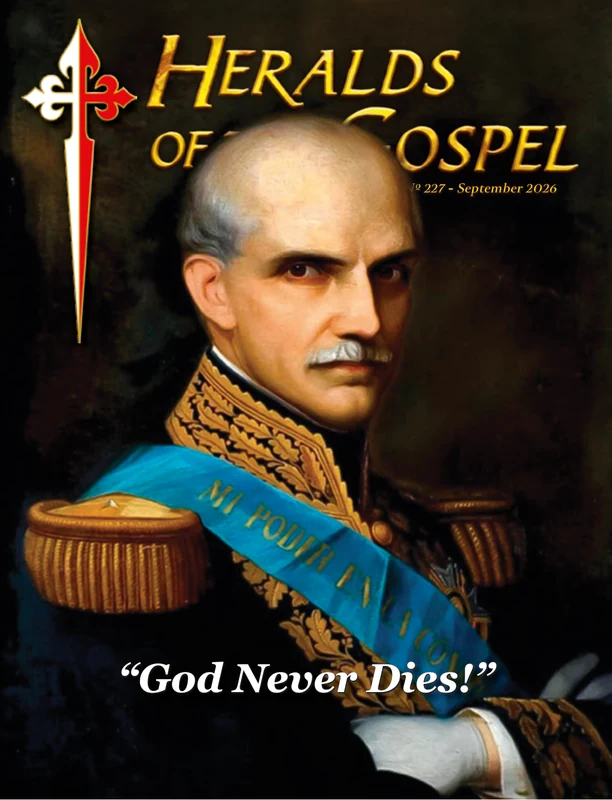
 Heralds of the Gospel Magazine, Vol. 20, nº 227, September 2026
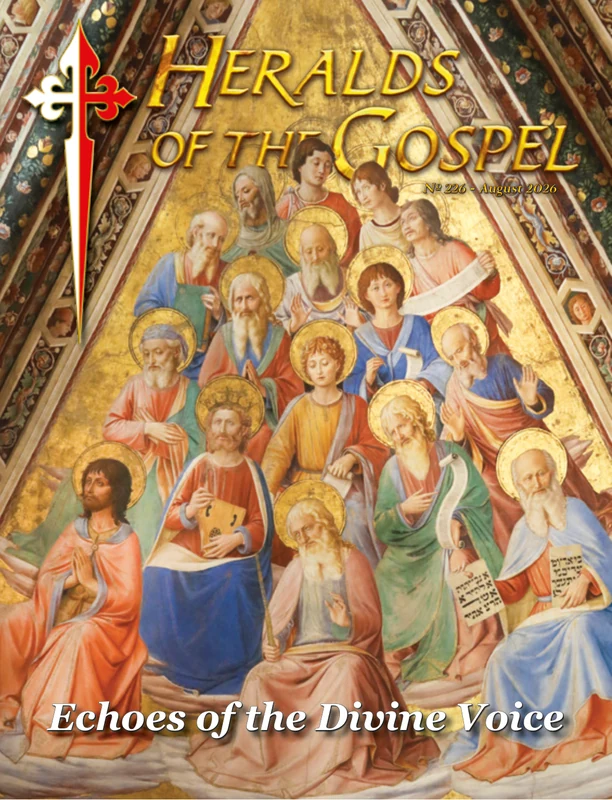 Heralds of the Gospel Magazine, Vol. 20, nº 226, August 2026
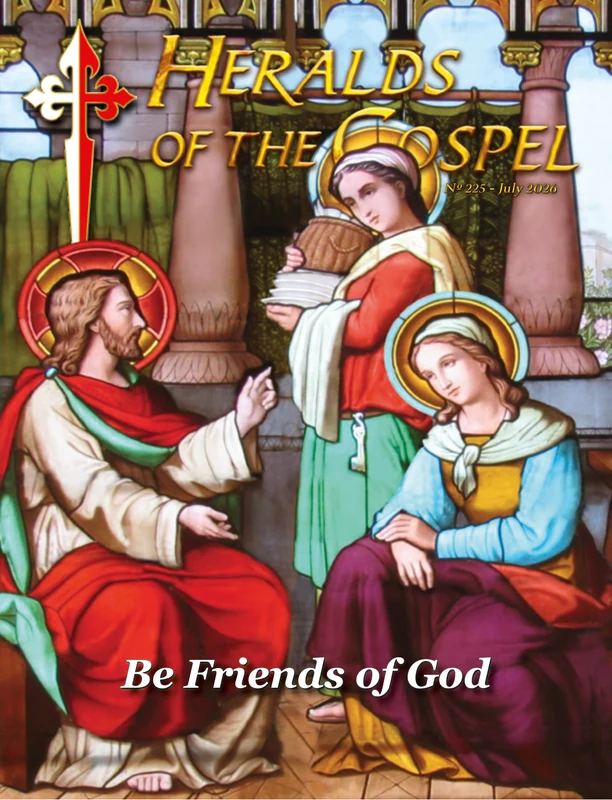 Heralds of the Gospel Magazine, Vol. 20, nº 225, July 2026
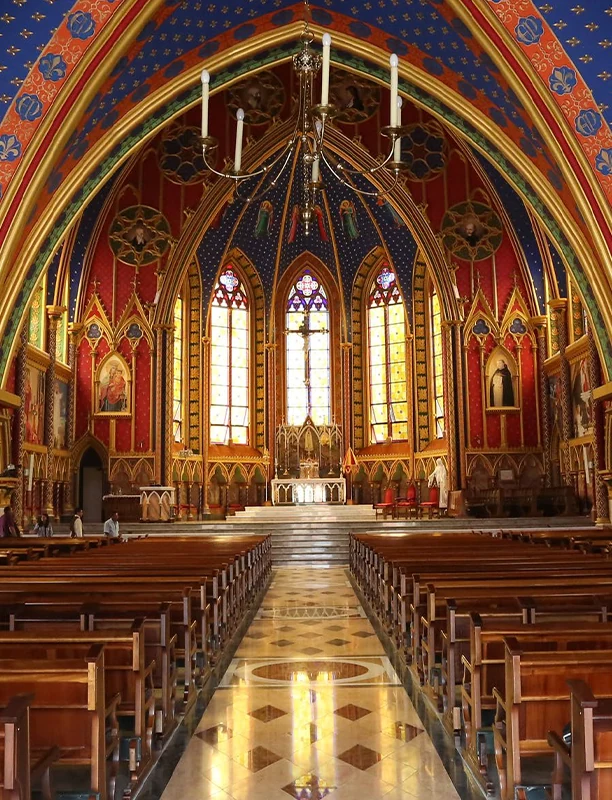 Who are the Heralds of the Gospel?
 Help of Christians
 Christmas Carols






The first predestined in view of Redemption
Associated to this loving relationship between God and His exceptional Mother, Daughter and Spouse, is someone chosen for a very special mission in the mystery of the Incarnation: St. Joseph. In God’s eyes, each member of the Holy Family of Nazareth participates in the same salvific plan of God, since the decree of predestination was one for Jesus, Mary and Joseph, and they were jointly and hierarchically the first of the predestined in view of the Redemption.4 Thus, in contemplating the great calling that St. Joseph received – nothing less than watching over God’s greatest treasures – we ask ourselves: with what gifts and graces might his soul have been enriched? Certain theologians, such as Cardinal Lépicier,5 with a view to outlining this remarkable man’s moral profile, explain that his greatness derives from three sources: firstly, from his relationship with the Incarnate Word; secondly, from his relationship with the Blessed Virgin; and finally, from his relationship with the Holy Church. Therefore, we will analyse, if only briefly, the incomparable gifts that Our Lord entrusted to His most chaste father, so that we can better admire the scope of this threefold calling.Participation in the hypostatic union
The order of creation finds its apogee in the hypostatic union of the Man-God, in which the human and divine natures are united, as in a joint, in the Person of the Word. Only the most holy humanity of Jesus Christ participates in this union in an absolute way. Our Lady, for her part, participates in this order in an extraordinary and intrinsic way, not substantial but real, through her necessary co-operation in the divine plan of the Incarnation. Together with Mary, St. Joseph was called to be an intimate part of this sublime reality, given his role directly linked to the Person of the Redeemer. As our founder, Msgr. João, points out in his work St. Joseph, Who Really Knows Him?...,6 the Holy Patriarch’s co-operation in the conception of Christ was not in a biological, but rather a moral sense, which is the noblest aspect. Thus, this co-operation with the plan of the hypostatic union was true, morally necessary and intimate because, by his willingness to fulfil God’s will in all its radicality and every nuance, it can be said that he implicitly accepted God’s plan for the virginal conception, in the joy of his soul, even if he was not aware of its details. Furthermore, without St. Joseph’s consent to betroth Mary, the Incarnate Word would not have been able to enter the world as the Creator wished from the beginning of humanity, that is, in the bosom of a well-constituted family. Only his consent would make it possible for Our Lady to be a Virgin and Mother in a dignified and fitting manner; and for him, through his right to everything that belonged to his wife, to also be a virgin and father, or better, the virginal father of Jesus, “the most perfect title for his relationship with the Son of God.”7A “god” for God himself
We must also consider him as Our Lord’s real father. In the first place, because God’s words not only symbolize, but, having their own efficacy, actually produce what they signify. Jesus evidently called St. Joseph “father”, which is in itself a striking proof of his true paternity. Moreover, the Blessed Virgin herself confirmed the virginal paternity of her husband, when She found the Child Jesus in the Temple and said: “Your father and I have been looking for you” (Lk 2:48).
St. Joseph with the Child Jesus - Cathedral of St. Andrew, Bordeaux (France)
Capacity to love “proportional” to the Son of God
In the heart of any father truly worthy of the name, we find a deep love for his son. However, how could a man render to his own son the love due to God, as happened in the case of St. Joseph? We have already said that Divine Providence always grants the elect all the graces necessary for the fulfilment of a specific mission. In this way, “God also gave Joseph a share in the corresponding love, the love that has its origin in the Father ‘from whom every family in Heaven and on earth is named’ (Eph 3:15).”10 This is why some authors go so far as to say that St. Joseph’s capacity to love was, in a way, proportional to the Son of God: “He [God the Father] either formed in him [Joseph] an entirely new heart or infused an exceeding increase of tenderness into the heart which he already possessed. Certain it is that He filled him with a love surpassing in generosity and fervour that of any other father; for it was needful that Joseph’s paternal love should be in a measure proportioned to the perfections of this adorable Son.”11 Therefore, despite not having contributed biologically to the generation of Jesus, St. Joseph loved Him as no father has ever loved his son in all of history. Far from diminishing his affection, this holy man’s unblemished virginity increased and purified it for, possessing a pure heart, nothing earthly or human interfered with his paternal affection for the Infant-God.Ambassador of the Holy Spirit to Mary
The Third Person of the Most Holy Trinity also acted in an eminent way towards the Holy Patriarch in the matter of the Incarnation. Our Lady is the Spouse of the Holy Spirit, since She conceived through His work (cf. Mt 1:20; Lk 1:35). But Mary is also the real Spouse of Joseph! How can this paradox be explained? Being invisible, the Paraclete gave His virginal Bride, as a substitute, a visible husband, who was to accompany Her everywhere and render Her faithful service.12 As some Josephine theologians put it, he was a “vice-Paraclete”. And there is more. The Holy Patriarch was the model adopted by God for the generation of Jesus’ humanity. Thus, the Divine Holy Spirit made Joseph’s temperament, dispositions and inclinations, as well as his own physical appearance, as similar as possible to those of the Saviour. This resemblance was undeniably fitting, so that Jesus would be considered, in the eyes of all, the real son of St. Joseph.13Exchange of hearts with the Queen of Angels
All the privileges of the Holy Patriarch we have analysed so far derive, in a certain way, from his marriage to the Blessed Virgin. Both his virginal paternity and his participation in the hypostatic plane were only possible because of the true and real marriage contracted between them.
The espousals of the Virgin”, by Juan Correa - Museum of Antequera (Spain)
Immaculate in his conception, and co-redeemer
A man called to have such a relationship with Our Lady could only have a moral stature that surpassed any human standard. It was certainly not appropriate for the Queen of Virgins to live with a man tainted by concupiscence and subject to the disorders of sin: “since the guardianship of terrestrial paradise was, after sin, entrusted to Angels alone, it would be fitting that Our Lady be espoused only to an angelic man,”18 since She is the Paradise of the New Adam. Therefore, in accordance with the theological hypothesis of which Msgr. João is a fervent adherent, we can conjecture that, just as the Blessed Virgin was exempt from the stain of original sin in view of her Divine Maternity, it was also fitting for St. Joseph – by a gift subordinate to the privilege of Mary’s Immaculate Conception, which is exclusive to Her – to be preserved from every stain of sin, in view of his virginal paternity and his cooperation with the Saviour and His Mother in the work of Redemption. Fr. Llamera recalls that St. Joseph’s redemptive co-operation “is very real and objective, at the same time unique […]. If we consider the free consent he gave to God’s plans by accepting his ministry, regarding the content of which he was given very particular insights, there can be no doubt that his intention directly encompassed the surrender of himself to the enterprise of regenerating mankind.”19 In this way, St. Joseph, having a mission so closely united to that of Mary Most Holy, would not only have been immaculate at his conception, but would also have received the ministry of co-redeemer!20Patriarch of the Holy Church
We must now consider a very important aspect of St. Joseph’s mission: he who was called to watch over the “[beginnings] of the mysteries of salvation”21 on earth was to continue his office in the Mystical Body of Christ from Heaven. In other words, by being the father of Jesus, Joseph should also be the father of the Church, for the Head cannot be separated from its members.22
St. Joseph, Patriarch of the Holy Church - Basilica of the Sacred Heart of Jesus, Rome
“Joseph was just”
The greater the gifts received from God, the greater the gratitude and love owed to Him. And how generously St. Joseph rendered them! By calling him a “just” man (Mt 1:19) in Scripture, the Holy Spirit pointed to the immense degree of charity that flooded his immaculate soul, for “a just man is fundamentally a self-giving man; he is a man who recognizes that he has received everything and who, consequently, considers himself obliged to return to God honour, glory, praise, adoration and gratitude for all that he has received […]. In a word: to be just is to be holy.”23 Holiness: this is the way in which we can render God love without measure. This is what the life of the Glorious Patriarch teaches us; this is undoubtedly what he ardently desires for each of us from the heights of Heaven, close to his Divine Son and his Most Holy Spouse. ◊Notes
1 ST. BERNARD OF CLAIRVAUX. Tratado sobre el amor a Dios, c.VI, n.16. In: Obras Completas. 2.ed. Madrid: BAC, 1993, v.I, p.323.
2 Cf. ST. JOHN OF THE CROSS. Subida del Monte Carmelo. L.I, c.4, n.3. In: Vida y obras. 5.ed. Madrid: BAC, 1964, p.371.
3 Cf. ST. THOMAS AQUINAS. Summa Theologiae. III, q.27, a.4.
4 Cf. FERRER ARELLANO, Joaquín. San José, nuestro Padre y Señor. Madrid: Arca de la Alianza, 2007, p.24.
5 Cf. LÉPICIER, OSM, Alexis Marie. São José, esposo da Santíssima Virgem Maria. Campinas: Ecclesiæ, 2014, p.38.
6 Cf. CLÁ DIAS, EP, João Scognamiglio. St. Joseph: Who Really Knows Him?... São Paulo-Toronto-Houston: Lumen Sapientiæ; Virgin of Fatima Assoc.; Heralds of the Gospel, 2023, p.192-194; 199.
7 Idem, p.195.
8 THOMPSON, Edward Healy. The Life and Glories of St. Joseph. Dublin: Burns & Oates, Limited, 1893, p.358.
9 Idem, ibidem.
10 ST. JOHN PAUL II. Redemptoris custos, n.8.
11 THOMPSON, op. cit., p.385.
12 Cf. Idem, p.220.
13 Cf. Idem, p.212.
14 Cf. MESCHLER, SJ, Maurício. São José, na vida de Cristo e da Igreja. Rio de Janeiro: Vera Cruz, 1943, p.95.
15 Idem, ibidem.
16 Cf. ST. THOMAS AQUINAS, op. cit., q.29, a.2.
17 CLÁ DIAS, EP, João Scognamiglio. Mary Most Holy: The Paradise of God Revealed to Men. Houston: Heralds of the Gospel, 2022, v.II, p.334.
18 CLÁ DIAS, St. Joseph: Who Really Knows Him?..., op. cit., p.40.
19 LLAMERA, OP, Bonifacio. Teología de San José. Madrid: BAC, 1953, p.154.
20 Cf. CLÁ DIAS, St. Joseph: Who Really Knows Him?..., op. cit., p.204.
21 SOLEMNITY OF ST. JOSEPH. Collect. In: THE ROMAN MISSAL. English translation according to the 3rd Typical Edition approved by the USCCB and confirmed by the Apostolic See. Chicago: Liturgy Training Publications, 2011, p.835.
22 Cf. CLÁ DIAS, St. Joseph: Who Really Knows Him?..., op. cit., p.412.
23 SUÁREZ, Federico. José, esposo de Maria. Lisboa: Rei dos Livros, 1986, p.50.