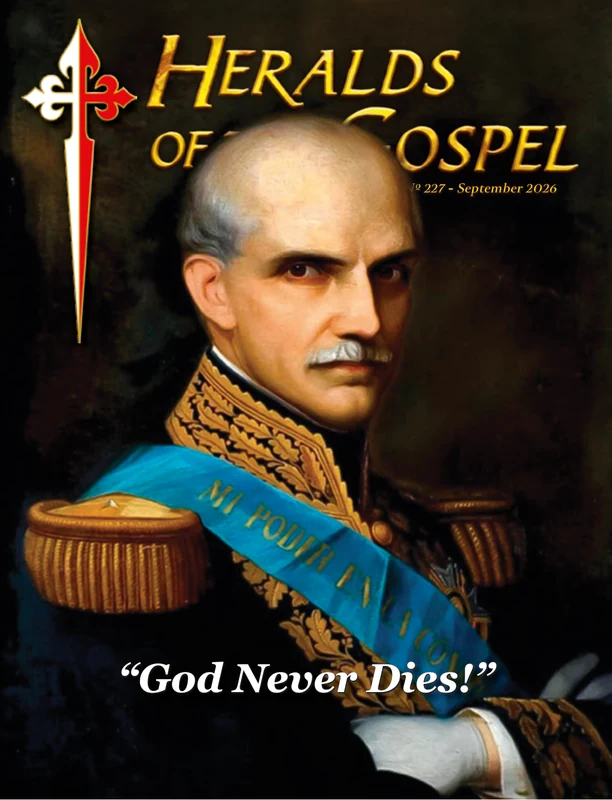
 Heralds of the Gospel Magazine, Vol. 20, nº 227, September 2026
 Heralds of the Gospel Magazine, Vol. 20, nº 226, August 2026
 Heralds of the Gospel Magazine, Vol. 20, nº 225, July 2026
 Who are the Heralds of the Gospel?
 Help of Christians
 Christmas Carols









Gospel of the Ash Wednesday
Jesus said to His disciples: 1“Take care not to perform righteous deeds in order that people may see them; otherwise, you will have no recompense from your heavenly Father.
2 “When you give alms, do not blow a trumpet before you, as the hypocrites do in the synagogues and in the streets to win the praise of others. Amen, I say to you, they have received their reward. 3 But when you give alms, do not let your left hand know what your right is doing, 4 so that your almsgiving may be secret. And your Father who sees in secret will repay you.
5 “When you pray, do not be like the hypocrites, who love to stand and pray in the synagogues and on street corners so that others may see them. Amen, I say to you, they have received their reward. 6 But when you pray, go to your inner room, close the door, and pray to your Father in secret. And your Father who sees in secret will repay you.
16 “When you fast, do not look gloomy like the hypocrites. They neglect their appearance, so that they may appear to others to be fasting. Amen, I say to you, they have received their reward. 17 But when you fast, anoint your head and wash your face, 18 so that you may not appear to be fasting, except to your Father who is hidden. And your Father who sees what is hidden will repay you” (Mt 6:1-6, 16-18).
I – Conversion: The Invitation of God’s Ambassadors
The Liturgy of Ash Wednesday opens the penitential season of Lent, which the Holy Church reserves for her faithful for a change of life. That resolution of conversion which we so often formulate at the beginning of the year and do not carry out, can be taken up again now, with the graces proper to this period. Wise as she is, the Mystical Bride of Christ wants our souls to be cleansed of the attachments we have accumulated over the months, with a view to the most important Solemnity of the year, the Easter Triduum, in which we commemorate the mysteries of Our Lord’s Passion, Death and Resurrection. At her petition, the Holy Spirit is attentive in distributing graces of amendment to Catholics who wish to take these days seriously.“Remember that you are dust”
At this celebration the Church prescribes the imposition of ashes, complementing in a very symbolic way the fasting that marks the Liturgy. This rite reminds us that all earthly goods are of no value to man who, in the normal process of nature, must die and return to the dust from which he came, as one of the formulas used in the ceremony clearly underlines: “Memento, homo, quia pulvis es, et in pulverem reverteris – Remember, man, that you are dust, and to dust you shall return.” The readings for this day bring together some of the most authoritative voices to speak in the name of God, from both the Old and New Testaments, urging us to return to the Lord, whom, unfortunately, we often abandon in order to embrace sin…“Return to Me!”: the cry of the true prophets
In the Old Testament we often observe how, after immense calamities occasioned by the sins of the chosen people, God calls them to conversion through His authentic emissaries, the prophets. This happened four hundred years before the Divine Redeemer’s coming, in the time of Joel, whose oracle is found in the first reading (cf. Jl 2:12-18). The prophet foresaw tremendous punishments for Israel: “Blow the horn in Zion; sound the alarm on my holy mountain! Let all the inhabitants of the land tremble, for the day of the Lord is coming! Yes, it approaches, a day of darkness and gloom, a day of thick clouds!” (Jl 2:1-2). The threat of imminent punishment has always been a resource used by God in prophetic language to urge a change of course. The Scriptures show how many times the warning was fulfilled when, ignoring the voice of the divine ambassador, the Jews failed to produce the works of conversion. To prevent the punishment, it was enough to adopt the way of penitence indicated: “return to Me with your whole heart, with fasting, and weeping, and mourning” (Jl 2:12). When there is clear recognition of sin, repentance and request for forgiveness, the Lord, who is Mercy, is willing to go back on His threats and forget the faults committed. And He does so even for His own glory, lest His inheritance – which in the New Testament is the Holy Church – suffer the infamy of hearing wicked say: “Where is their God?” (Jl 2:17). We see then that in penance we find the solution for many of the problems that beset our lives. For God not only forgives those who are converted, but also gives them new gifts to work a true restoration in their souls. When the divine footsteps begin to hasten and we hear the rumbling of the approaching chastisement, let us therefore ask the Lord for forgiveness with a heart open to correction. The Liturgy also offers us the example of one of the most admirable converts of the Old Testament: David, who heeded the rebuke of another ambassador of God, the prophet Nathan, and made amends. Psalm 51, known as Miserere was composed by him to ask God’s forgiveness for his sins of adultery and murder. It reflects the perfect posture of the contrite soul: “A clean heart create for me, O God, and a steadfast spirit renew within me” (51:12). How beautiful is the story of a person who heard the voice of the prophets and corrected his life! His name, far from becoming a sign of ignominy, becomes a title of glory: King David, ancestor of the Messiah!Christ’s ambassador among men
As in the Old Covenant, in the New Testament St. Paul the Apostle presents himself as the ambassador of God, this time made Man: Our Lord Jesus Christ. In the light of the mystery of the Redemption, this mission takes on a new light, as the Second Reading demonstrates: “Brothers and sisters: We are ambassadors for Christ, as if God were appealing through us. We implore you on behalf of Christ, be reconciled to God” (2 Cor 5:20). Reconciliation is for those who are outside of friendship with God, that is, for those who have committed any grave sin. With the exception of Our Lord Jesus Christ, of Our Lady and certainly of St. Joseph, who does not have some reason to beat his breast? To say otherwise would be presumptuous, for even if our conscience accuses us of only minor faults, we must consider that reparation for a single venial sin – since it is an offence against an infinite Being – cannot be made even by the merits of the Blessed Virgin, added to those of all the Blessed and Angels in Heaven. In order for our reparation to be satisfactory, the Father gave His Son to die on the Cross for us: “For our sake He made Him to be sin who did not know sin, so that we might become the righteousness of God in Him” (2 Cor 5:21). Finally, the Gospel, through the lips of the Divine Ambassador par excellence, warns us against the devil’s emissaries, whose hypocrisy, though dressed in religious garb, aims at leading us away from the path of salvation.II – Pride, Weapon of the Devil’s Ambassadors
The Gospel verses of this commemoration, already amply commented upon on another occasion,1 highlight the trilogy formed by almsgiving, prayer and fasting, as pious works that make us pleasing to God. In this sense, the current obligatory penance in Lent is reduced to something almost symbolic: two days of fasting – Ash Wednesday and Good Friday – in addition to abstinence from meat on Fridays. There is, however, a fast of which Our Lord speaks more especially, a penance which will never be abolished or mitigated, but only more and more highly recommended, and which we can practise with great benefit to our souls. This fast is concerned with illusions pertaining to the spirit more than to the flesh.Pride: the Pharisaism of every age
 The prayer of the Pharisee - Lázaro Galdiano Museum, Madrid
Do not ask for a reward already received
Jesus said to His disciples: 1 “Take care not to perform righteous deeds in order that people may see them; otherwise, you will have no recompense from your heavenly Father.”
The danger of “retributive affection”
2 “When you give alms, do not blow a trumpet before you, as the hypocrites do in the synagogues and in the streets to win the praise of others. Amen, I say to you, they have received their reward. 3 But when you give alms, do not let your left hand know what your right is doing, 4so that your almsgiving may be secret. And your Father who sees in secret will repay you.”
The emptiness of prayer for our own sake
5 “When you pray, do not be like the hypocrites, who love to stand and pray in the synagogues and on street corners so that others may see them. Amen, I say to you, they have received their reward. 6 But when you pray, go to your inner room, close the door, and pray to your Father in secret. And your Father who sees in secret will repay you.”
Vanity nullifies the value of any sacrifice
16 “When you fast, do not look gloomy like the hypocrites. They neglect their appearance, so that they may appear to others to be fasting. Amen, I say to you, they have received their reward. 17 But when you fast, anoint your head and wash your face, 18 so that you may not appear to be fasting, except to your Father who is hidden. And your Father who sees what is hidden will repay you.”
Good works should be seen, so that the One who inspired them may be praised
Just as Our Lord, in order to fully accomplish His mission, wished to manifest himself during the three years of His public life, so the Church, as a visible society, must shine before the eyes of all. Contemplating her splendours becomes an occasion of graces for men and women, continuing the action of Jesus Christ himself over humanity. But this “seeing” must always have Him as its centre and end. As far as we are concerned, when we have to be a point of reference for others, we must accept this only as a means to uplift them to God. The images presented by today’s Gospel show us how pride leads us into ridiculous behaviour; thus we are invited to simplicity of heart, and to never draw attention to ourselves. In short, these images teach us that whoever seeks his treasure on earth loses that of Heaven, and whoever renounces the rewards of the world gains those of Heaven.III – The Clash of Two Prophetisms
In the Gospel at the beginning of Lent, the Divine Master shows the contrast between false and authentic piety and penance. Hypocrites make a show of almsgiving, prayers and fasting in order to please men and receive the reward offered by the world. However, Jesus teaches us that we should only desire retribution from God, which is promised to us by His legitimate ambassadors. As in the days of Joel, of St. Paul or of Our Lord, the world today is also beset by terrible catastrophes. When it is not the threat of the most diverse forms of natural cataclysms, it is the danger of a world war on the verge of becoming nuclear that looms on the horizon. In the midst of this insecurity, God offers us once again in this Lent a favourable time for conversion.The false promises of the devil’s ambassadors
In the year 2023, this penitential period takes on a special character. As in the epochs considered in the readings of this Liturgy, it is given to us to choose between the ambassadors of Christ, who present to us the way of salvation, and the new ambassadors of the devil who, like the Pharisees of Our Lord’s time, offer solutions based on pride and human resources, whose ultimate objective lies on this earth. Scientific discoveries multiply in an attempt to make human life more pleasurable and prolong it indefinitely, as if full happiness were to be found in this world and not in Heaven. Ever more daring and invasive technological advances proliferate, whose acceptance always demands some “disinterested surrender”, given the deleterious effects on health of the omnipresent cybernetic devices. A new religion with its own morality is imposed, whose “acts of piety” aim only at impressing the dominant opinion, generally averse to the Law of God. It has become beautiful, for example, to ask pardon for “sins” committed against nature, sometimes going to extremes that violate common sense, or to do penance for acts considered “inappropriate” by the new morality, even if this means breaking with fidelity to the traditional teaching of Holy Church in matters of Faith and morals, while this same fidelity is considered rigidity and a lack of charity for not agreeing with the reigning relativism. St. Paul confronts the false prophet Barjesus - Carnavalet Museum, Paris
What do Christ’s ambassador’s offer?
In a diametrically opposite direction, the ambassadors of Our Lord Jesus Christ, whose voices resound in this Liturgy which opens Lent, urge a true conversion of heart, the fruit of sincere repentance and a trusting entreaty for pardon, which manifests itself in acts of piety and authentic penance. These ambassadors, as St. Paul stresses in the Second Reading, give full value to God’s grace, urging that it not be received in vain (cf. 2 Cor 6:1). It is worth asking ourselves: what prevents us from following the Apostle’s advice and allowing ourselves to be reconciled with God (cf. 2 Cor 5:20)? There are several factors, including: not recognizing our own faults; not seeing in the events that surround us the hand of Providence calling us to himself; not seeing in God the kind, compassionate, patient Father, full of mercy, who consented to sacrifice His Only-begotten Son in order to redeem us (cf. 2 Cor 5:21); not seeking salvation in divine grace, granted through the Sacraments. Simply put, we are prevented by giving more ear to the devil’s ambassadors than to Our Lord’s. Faced with the alternative presented to us at the beginning of this penitential period, let us heed the voice of Christ coming to us through His ambassadors. And if our conscience accuses us of some fault, let us make a good Confession, which will truly reconcile us with God and be the turning point for a return to the right path, on which we shall persevere, with the help of grace, from now on. ◊Notes
1 Cf. CLÁ DIAS, EP, João Scognamiglio. God Should Always Be in the Centre. In: Heralds of the Gospel. Nobleton. No. 28 (Feb., 2010); p.10-17. Having commented in detail in this article on the exegetical data concerning the customs denounced by Our Lord in the Gospel of Ash Wednesday, in the present lines more attention will be given to the moral applications beneficial for our days.
2 CCC 202.