 Heralds of the Gospel Magazine, Vol. 20, nº 227, September 2026
 Heralds of the Gospel Magazine, Vol. 20, nº 226, August 2026
 Heralds of the Gospel Magazine, Vol. 20, nº 225, July 2026
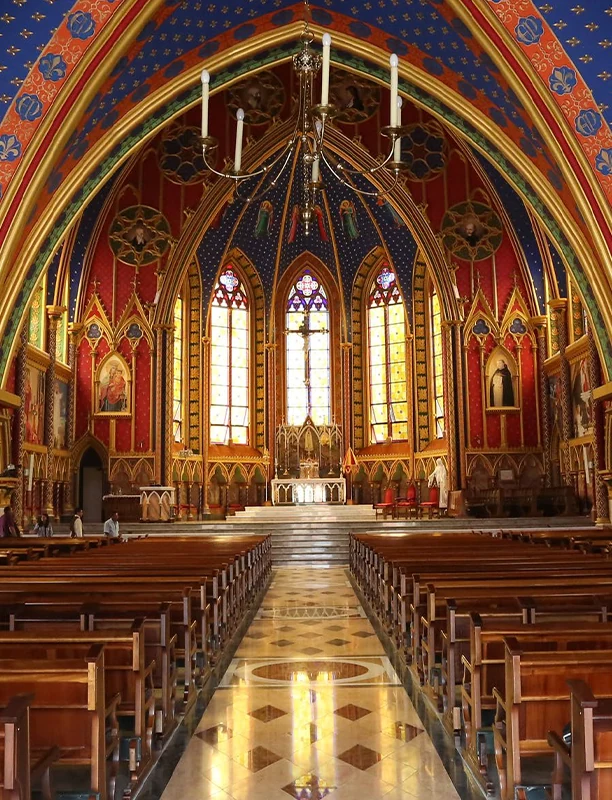 Who are the Heralds of the Gospel?
 Help of Christians
 Christmas Carols






“The whole is worth more than the sum of its parts.” This well-known maxim is considered indisputable, a universal philosophical principle.
Illustrious doctors have used it to describe the relationship between Our Lady and the Church, asserting that the Blessed Virgin, as a supremely excellent member of the Church, is less important than the Mystical Body of Christ – the “total Christ,” in the Augustinian expression.
A part, in effect, could not be worth more than the whole that includes it.
Among the defenders of the above stated principle is the Doctor of Hippo himself, who stated:
Holy Mary, blessed Mary! However, the Church is better than the Virgin Mary. Why? Because Mary is a portion of the Church, a holy member, an excellent member, a supereminent member, but a member of the total Body. If She belongs to the total Body, the Body is greater than each of its members.1
Data venia, is it really possible that such a question can be resolved in such simple terms?
A part or the reason for being?
As an initial argument, let us propose an example: imagine a stupendous royal palace, adorned with precious paintings and valuable ornaments, rich tapestries and priceless furniture.
The noble building, obviously, is not uninhabited: a large number of cooks, servents, guards, footmen and pages serve an expressive court of barons, viscounts, counts, marquesses and dukes, who, in turn, orbit around a powerful king, flanked by his queen.
This palace forms a varied ensemble, but can we affirm that the majestic couple is only a part of this ensemble, or rather, is the castle with its inhabitants merely a portion of what could be called “royal power”?
In short, if we remove the king and queen, what is the meaning of the existence of the castle and the court?
It can be observed, therefore, that some elements, although included within a given reality, cannot be considered mere parts of a whole, since they constitute the very reason for being of that totality.
Thus, although they are in an ensemble, their place is more properly above it.
Now, such a consideration is perfectly applicable to the role of Our Lady in relation to the Mystical Body of Christ.
If it is true that Mary Most Holy, as the Daughter of God, is a member of the Church, She is also Mother and Queen of that same Church, in addition to being Mother of all its members, beginning with its Head.
Inseparable in the eyes of God
Can we, accordingly, affirm that the Church is a reality distinct from Mary and, moreover, inferior to her?
Although, from the point of view expressed above, this is sustainable, it is worth remembering the happy words of Blessed Isaac, Abbot of the Monastery of Stella:
In the divinely inspired Scriptures, what is generally attributed to the Church, virgin and mother, applies particularly to the Virgin Mary. […] And when the text refers to one of them, it can be largely applied indistinctly and indifferently to both.2
It is clear from this passage that, in the eyes of God, they are inseparable. And this for several reasons.
Firstly, it is worth remembering that the Church was born, so to speak, in Mary: in effect, the Head of the Mystical Body was begotten in her, and it is also through her that all the children of God are begotten in Baptism.
Moreover, the Mystical Spouse of Christ came into the world from the wounded side of the Crucified One, and at that moment, the only soul that kept the gift of faith alive was His Holy Mother.
It could therefore be said that, in its inception, the community of the faithful was constituted by Our Lady alone.
Furthermore, by fulfilling God’s will in everything and being a shining example of all virtues, the Blessed Virgin became the exemplary cause, the typus of the Church.3
Mary, the ideal of perfection for the Church
It follows that, for the Church to better realize her ideal of perfection, she needs to become ever more like the Mother of God.
The Catechism rightly affirms that, when discussing the origin, mission, and destiny of the Church, there is no more profitable exercise than turning our gaze to Mary in order to “contemplate what the Church already is in her mystery on her own ‘pilgrimage of faith,’ and what she will be in the homeland at the end of her journey.”4
Thus, if we hope for a time when Our Lady will effectively reign in hearts – the Reign of Mary announced by St. Louis Grignion de Montfort5 – it is imperative that the Church, in every aspect of her life, comes to reflect the holiness of the Immaculate Virgin.
A certain medieval theologian even stated that the Eternal Word came into the world attracted and enticed by the sweet aroma of Mary’s holiness: “This sweet perfume enchanted the only Son of God and completely captivated Him! And He did not delay, but was immediately enticed and carried away from the bosom of the Father to the bosom of the Virgin.”6
Now, if throughout the world the Holy Church exhales the sublime fragrances of Marian holiness, will Jesus Christ not feel Himself drawn again – albeit in a different way – to the earth? Undoubtedly.
The Church will draw her Divine Spouse closer to herself as long as she perfectly and completely reflects the Mother of God, who can properly be called the “perfect Church, the Church fully realized in her earthly and eschatological dimension.”7
The whole must move towards the part
In conclusion, it is worth returning to the question posed at the beginning of the article: is the whole greater than the part?
In the case at hand, the answer defies human standards: it is up to the whole – the Church – to somehow identify itself with its very special part, that is, the Blessed Virgin Mary. Only in this way will the totality be complete and reach its own pinnacle.
How do these considerations apply to us, children of the Church and children of Mary? In everything and for everything: Totus tuus – I am all thine, O Mary! Our life of perfection, in effect, cannot be limited to the simple practice of virtues.
It is necessary to seek to live every second of our existence for Mary, with Mary and in Mary, so that as soon as possible we may glimpse the transfigured face of the Holy Church, fully configured with the Queen of Heaven, the Mother of God and ours.