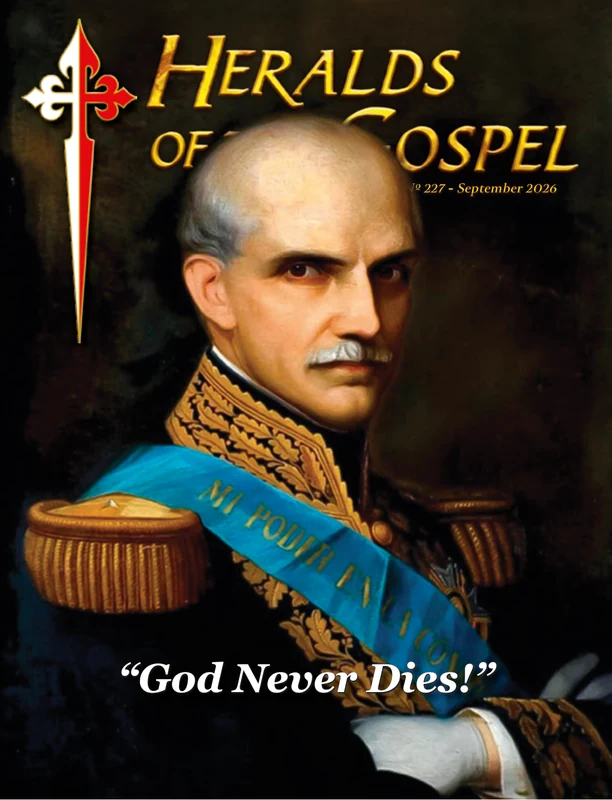
 Heralds of the Gospel Magazine, Vol. 20, nº 227, September 2026
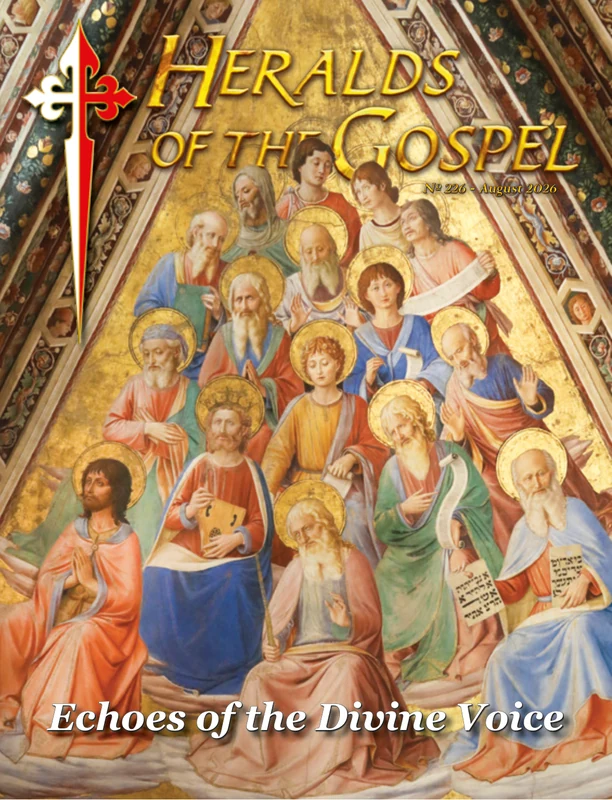 Heralds of the Gospel Magazine, Vol. 20, nº 226, August 2026
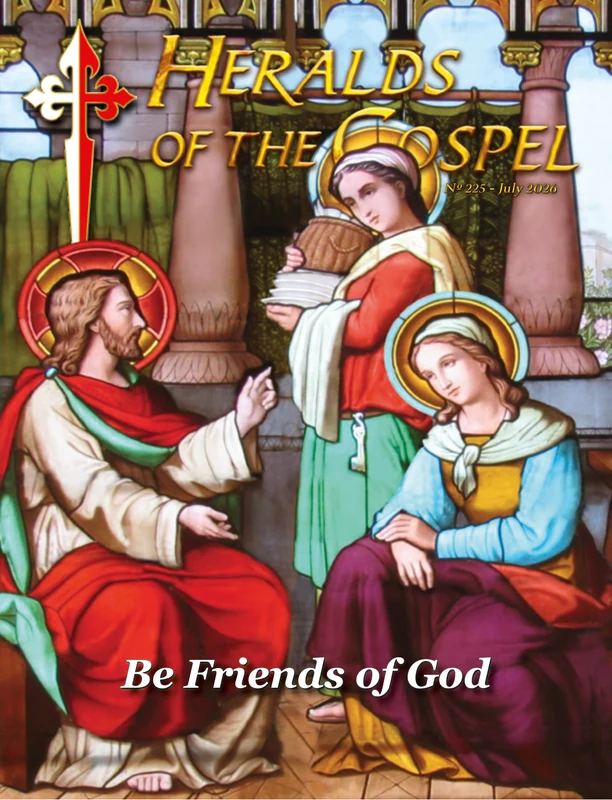 Heralds of the Gospel Magazine, Vol. 20, nº 225, July 2026
 Who are the Heralds of the Gospel?
 Help of Christians
 Christmas Carols






 Allegory of the Church - Strasbourg Cathedral (France)
“The Church resembles an immense soul…”
For Dr. Plinio Corrêa de Oliveira this supernatural phenomenon, a direct contact with the Holy Apostolic and Catholic Roman Church, touched his sensibility in such a way that he began to consider it as a person. This was a mystical image which he evidently developed in order to better explain to others what was going on in his heart: “Seeing all these aspects of the Church, I sometimes had a curious impression. I would say: ‘The Church resembles a person. It does not resemble an institution, but rather an immense soul, which is manifested in a thousand different ways, which has movements, grandeurs, sanctities, perfections, as if it were a single soul expressing itself through all the Catholic churches of the world, all the statues, all the Liturgies, all the tones of the organ, all the tolling of the bells… This soul has wept at the Requiems, rejoiced with the ringing of the bell on Holy Saturday and at Christmas vigils; it weeps with me, it rejoices with me. I see a soul in the Church, more than an institution.’” In the following passage, Dr. Plinio is more profuse in his explanation: “What I am speaking of is, of course, the Divine Holy Spirit, but when one is a child, the distinction is not so clear: I had the vague notion that the Church was a living institution […] as if it were a person, along the course of history, with the multiple mercies of a mother, the patience of a mother, the dignity of a mother, the savoir-faire of a mother, the knack of a mother; it is a Mother-Church! […] The most welcoming, most intimate, the kindest, most forgiving Mother that one can imagine; but also, the Queen most worthy of praise imaginable, a virginal warrior, à la St. Joan of Arc, capable of winning every victory, without losing her feminine delicacy, with effective strength, surpassing every marshal; inspirer of heroes!” From that moment onwards, a love was born within him that grew unceasingly… It was a love of devotion, so that during his entire life, the Church was his most deeply rooted passion; a love that was most pure and detached; a love unto slavery, but one which, far from being oppressive, brought him liberty; such love that it was almost an adoration of the Church. Come what may, he was ready to serve it! “The Catholic Church is for me more than my father, more than my mother, more than my life, more than everything that I could have; I love the Catholic Church with such a love that it has overtones of adoration! For it is the Mystical Body of Our Lord Jesus Christ!”A mystical union with the Holy Church
Dr. Plinio had been prepared since his birth, or perhaps even earlier, by a grace which led him to effect a mystical espousal with the Catholic Church. This is a singular phenomenon, for such a supernatural alliance almost always occurs between the soul and God who usually presents Himself through the features of the most holy humanity of the Saviour.1 Dr. Plinio is one of the few in History to be espoused to the Church. Already in his infancy, without yet knowing the name or the phenomenon owing to his tender age, he entered into this unimaginably profound spiritual matrimony, unconditionally surrendering himself and uniting himself to the Church with eternal bonds.2 Here are his words: The sun reflected in dewdrops
“Without the Catholic Church I would not have wisdom”
In various conferences over the years, he adamantly declared to have taken the Holy Church as his model, in a position of continual obedience. “Ever since I was small, looking at the Catholic Church, and not only the Church but at that which it poured out upon sacred Christian Civilization, I took all of it as certain, infallible, indisputable, point by point, seeking to investigate each time I did not understand something; and the question was: ‘What is the principle of wisdom that exists behind this? I need to discover and acquaint myself with this principle of wisdom.’ […] And this was the enthusiasm of my entire life: the Church as manifested in its dogmas, laws, disciplines, institutions, in both greater and lesser things, even in the design of a priest’s vestments.” If his eyes rested, for example, on the celebration of the Mass, he would analyse the gestures, the measured pace with which the priest and the acolytes would move about the sanctuary, the bow they would make while praying the Confiteor, the splendid colours of the adornments… And he would ask himself: “Who invented this? Who was that man who first determined that things must be done in this way at Mass? It was not a man; it was the Church!” And from a single detail he would arrive at a solid understanding, permitting him to enter further into the spirit of the Church. “Only later did I come to know that the soul of the Church is the Holy Spirit. He, present in all of those manifestations, suggested to the men of the Church down through the centuries that they choose those wonders. It is He who caused these reflections of God to be born in the Church.” In sum, the enchantments of Dr. Plinio were not restricted to one or another aspect of the Church; rather, everything to do with it was divine to him, and he did not fail to love anything… “My spirit was fortunately incapable of functioning except in accordance with Our Lord and with the Church. Because that is the only standard by which all things can be properly evaluated. […] I realize that I do not see, and the little that I do see, I see better by looking through it; and it is through it that I can see everything! It was thus that I was able to remain faithful; it was thus that I acquired wisdom. It was not through a composition of my own mind. With what love do I say it: it was learned from the Catholic Church, just as a son learns in the arms of his mother. Without the Catholic Church, this son would not have had any wisdom at all. Everything comes from her: grace, teaching, everything!”A life distinguished by fidelity to the Church
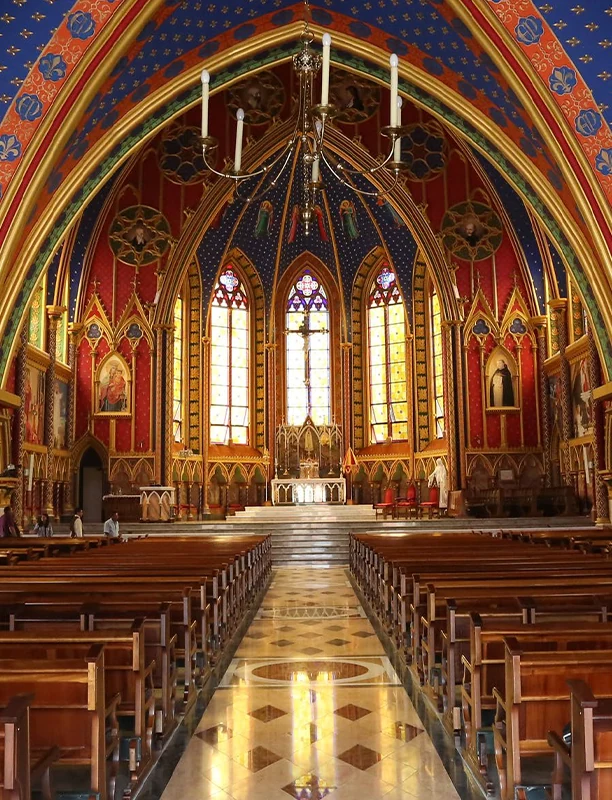
The author saw Dr. Plinio moved to tears for only two reasons: on certain occasions, due to the remembrance of Dona Lucilia, especially soon after her passing away; and on others, with regard to the Holy Church. Of these, the three most striking moments were, undoubtedly: when, at the end of the 1950s, he withdrew to a small room at the back of the house where he habitually gathered with his followers, and wept long and copiously, foreseeing with his discernment of spirits, the difficult times that lay ahead for the Church; during Holy Week of 1966, speaking once again on the sufferings afflicting her; and, finally, on June 7 of 1978, the anniversary of his Baptism, on hearing himself referred to as a son and fruit of the Holy Church, “vir catholicus, et totus apostolicus, et ‘totissimus’ romanus.”4 This tribute enraptured his heart, for it was, in his estimation, what could most cause him honour, joy and glory. The celebration of Holy Mass in the Basilica of Our Lady of the Rosary, Caieiras (Brazil)
Taken, with minor adaptations, from: O dom de sabedoria na mente, vida e obra de [The Gift of Wisdom in the Mind, Life and Work of ] Plinio Corrêa de Oliveira. Città del Vaticano-São Paulo: LEV; Lumen Sapientiæ, 2016, v.I, p.211-222
Notes
1 Cf. ROYO MARÍN, OP, Antonio. Teología de la perfección cristiana. Madrid: BAC, 2006, p.741; ARINTERO, OP, Juan González. La evolución mística. Madrid: BAC, 1952, p.481, nota 1.
2 The essential element of mystical marriage is the permanent and indissoluble union with God, which has as its principle the simple possession of the state of grace (cf. ROYO MARÍN, op. cit., p.741-743).
3 Cf. ST. THOMAS AQUINAS. Summa Theologiae. I, q.8, a.3.
4 From the Latin: “A Catholic man, entirely apostolic and fully Roman.”