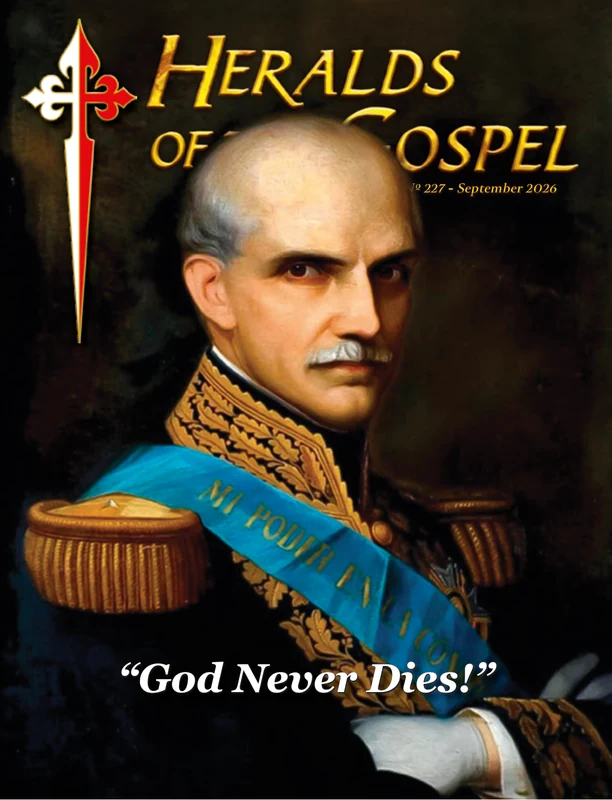
 Heralds of the Gospel Magazine, Vol. 20, nº 227, September 2026
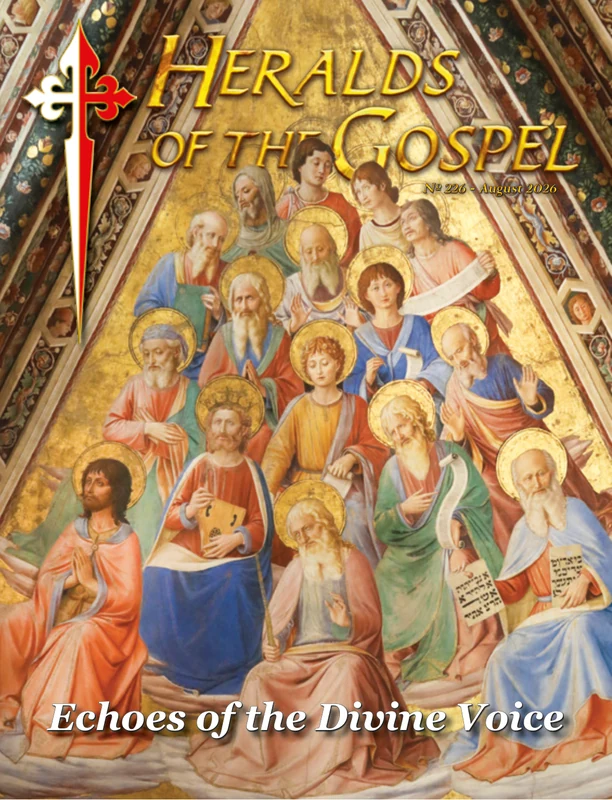 Heralds of the Gospel Magazine, Vol. 20, nº 226, August 2026
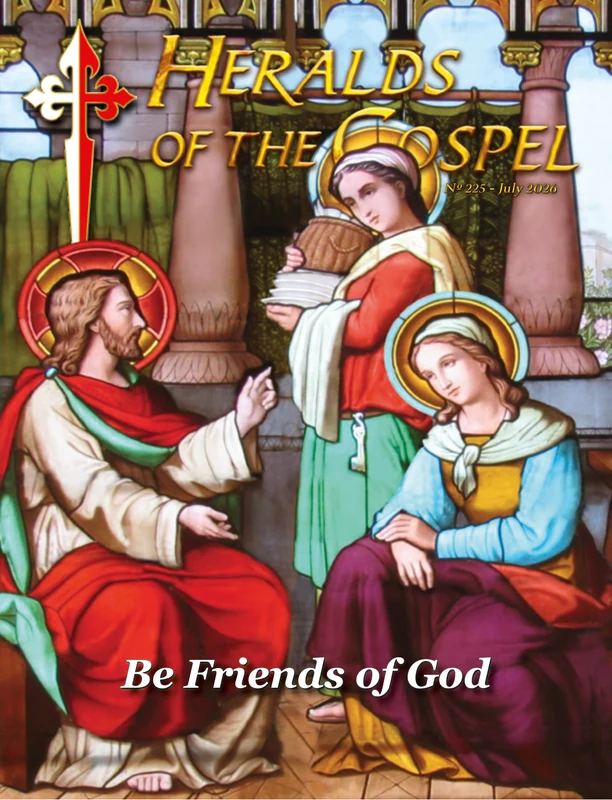 Heralds of the Gospel Magazine, Vol. 20, nº 225, July 2026
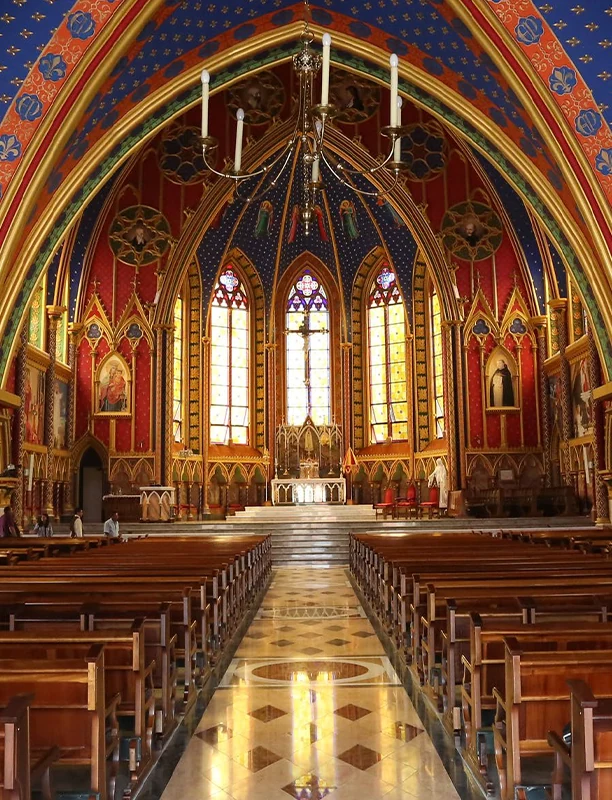 Who are the Heralds of the Gospel?
 Help of Christians
 Christmas Carols









Two conceptions of the heart
First of all, I would like to analyse two distinct, but not contrary, conceptions of what the heart represents. One is the modern conception, according to which the heart symbolizes pure sentiment, divorced from reason. In this view, one’s heart should thrill at the sight of something that creates a good impression, causes endearment, and produces a feeling of goodness and affinity. Dr. Plinio in the early 1980s
Different aspects of the same scene
Let us imagine how someone who knew Our Lord Jesus Christ during his earthly life should love Him to the point of being able to recognize the majestic and gentle timbre of His voice. Scenes from the life of Our Lord, by Giotto di Bondone - Cappella degli Scrovegni, Padua (Italy) - The expulsion of the moneychangers from the Temple
What might Our Lord’s mentality be like?
Having adopted this conception of the heart, we can ask ourselves what the mentality of Christ must be like. The answer proves to be very difficult, because the theme is so lofty that, being here below, one is afraid to ascend. On the other hand, when one has reached the top there is no desire to descend. If we consider the human nature of Our Lord, we can try to make at least something explicit, but when it comes to His divinity, the subject reaches such heights that it becomes impossible for man to reach it. Faith teaches us that Jesus Christ is the Word of God incarnate who came to dwell among men. In His Person, the human and divine natures are united hypostatically, in a way unsurpassable and unattainable by any human creature. Not even Our Lady, to whom I believe the gift of Eucharistic permanence was given, can attain a union with God comparable to that of Jesus’ human nature. The relationship between humanity and divinity in the Person of the Word is something so extraordinary that St. Louis, King of France, had the beautiful custom, later adopted by the whole Church, of bowing down at the point in the Creed that says: Et Verbum caro factum est et habitavit in nobis.The greatest joy and the most terrible suffering
What joy must such a union produce in Jesus’ human nature? Without taking into consideration His divinity, by which Christ is the very source of all joy. Scenes from the life of Our Lord, by Giotto di Bondone - Cappella degli Scrovegni, Padua (Italy) - The Way to Calvary
A mentality composed of harmonious opposites
Now we must keep in mind those aspects of grandeur and fortitude of soul that we see in the last acts of the Passion of the Divine Redeemer as we analyse every moment of His life on earth. Indeed, He who suffered such a death is the same One who caressed the little children when they came to Him, and of whom He said: “Let the children come to Me, do not hinder them; for to such belongs the Kingdom of God” (Mk 10:14). There is no person, of whatever age, who, on hearing these words, is not affected by them – for who does not feel small before Our Lord? – and therefore thinks: “So there is also a place for me with Jesus.” Let us remember that these words, overflowing with tenderness, came from the lips of the One who, during the Passion, showed unequalled strength and resolution. Scenes from the life of Our Lord, by Giotto di Bondone - Cappella degli Scrovegni, Padua (Italy) - The Presentation of the Child Jesus in the Temple
The drawbacks of a unilateral vision
How then can we condense all these perfections of the God-Man into a single vision? They are so many that we would tend to be satisfied with the consideration of only one. Indeed, everyone worships Him in the way he feels called to do, but in my particular case, for by my way of being, I would never be satisfied to worship Him for just one of these aspects, without seeking to join them to the others, so as to form, even summarily, a notion of the whole. Therefore, if I could know Him in this life, what I would most like to admire in Him would be the transitions of states of mind, so that in these variations I might see the harmony they formed. On the ceiling of the Church of the Sacred Heart of Jesus1 there is a 19th-century-style painting that has the characteristic, typical of the tendency of the men of that century, to represent things exactly as they are in the practical reality. From this arose the school of art called Realism. To me this is not true art, because the value of a work is in reproducing something imponderable that only the eyes of authentic observers can capture. If reproducing things just as we see them has artistic value, the most perfect of the arts should be photography. Now, the greatest shortcoming of both Realism and photography lies in not portraying the transitions of soul that I mentioned above. For this reason, in the paintings of Jesus that follow this school, one can see that the artist chose a single aspect of Him and tried to represent it. And the attempt is generally made to represent the infinite mercy of Our Lord, which, though very right, is incomplete. In the Litany of the Heart of Jesus there is the invocation: Heart of Jesus, abyss of all virtues. This means that the depth of His virtues is such that it constitutes an abyss for men. We could even call it the firmament of all virtues, considering the firmament as being an abyss in ascension.Painting forgotten beauties
How good it would be if someone were to paint pictures representing other episodes in the life of Christ. For example, His meditation in the desert when He spent forty days there in fasting and prayer. We can even imagine Him standing by a rock in the middle of an arid landscape, with only commonplace and sparse vegetation in contrast to the grandeur of that scene; in the distance, vast expanses covered with beautiful sands that stretch all the way to the horizon, where we see a blazing sunset, punctuated by the profile of Jesus. Or, again, a painting could be made of Christ in an affectionate attitude towards Our Lady. If He took satisfaction in contemplating the universe, how much would it not please Him to gaze upon Her who was superior to the whole universe! So, to represent Him looking into the eyes of Mary Most Holy, who is filled with enchantment for Jesus. As Creator, He thinks: “My masterpiece!” and, as Son: “My Mother! What perfection!” What would we not give in exchange for contemplating a scene like that, even if through a keyhole? After seeing it, why go on living? For if someone were to say to me, “Look at the sea, how lovely!”; I, who love the sea so much, would think, “What is it to see the sea after having seen Mary?” All in all, I would like to see the attempt made to represent each of His states of spirit, for I am not content to adore and adhere only to His mercy.Consideration of all that resonated and pulsated in the Sacred Heart of Jesus
Another thing that I would very much like to do would be to make a collection of the timbres of Our Lord’s voice, for example, while He was teaching. He being the Divine Master, what clarity, wisdom, depth, vastness of horizons and simplicity must have shone forth in His timbre of voice! The Sacred Heart of Jesus - Church of St. Simon and St. Jude, Deudesfeld (Germany)
Taken, with adaptations from: Dr. Plinio. São Paulo. Year XIV. N.155 (Feb., 2011); p.10-15
Notes
1 Shrine located in the Higienópolis neighbourhood in São Paulo.