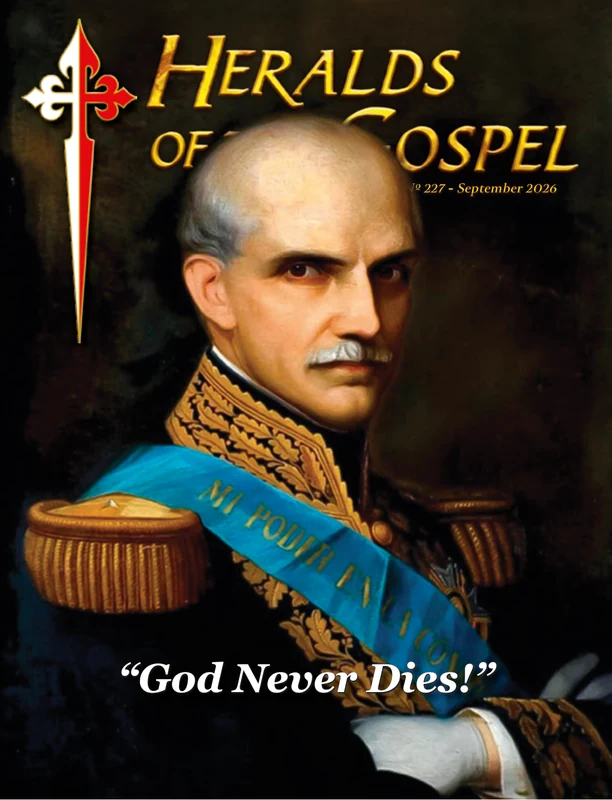
 Heralds of the Gospel Magazine, Vol. 20, nº 227, September 2026
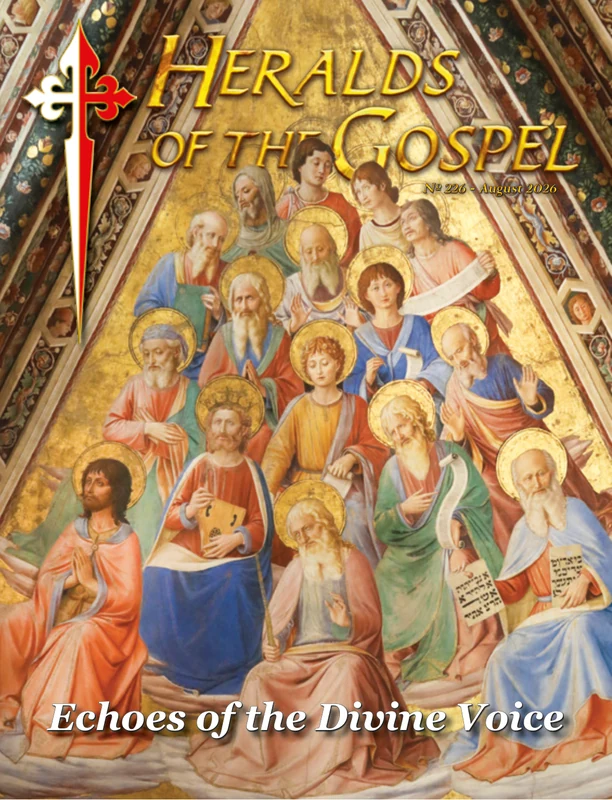 Heralds of the Gospel Magazine, Vol. 20, nº 226, August 2026
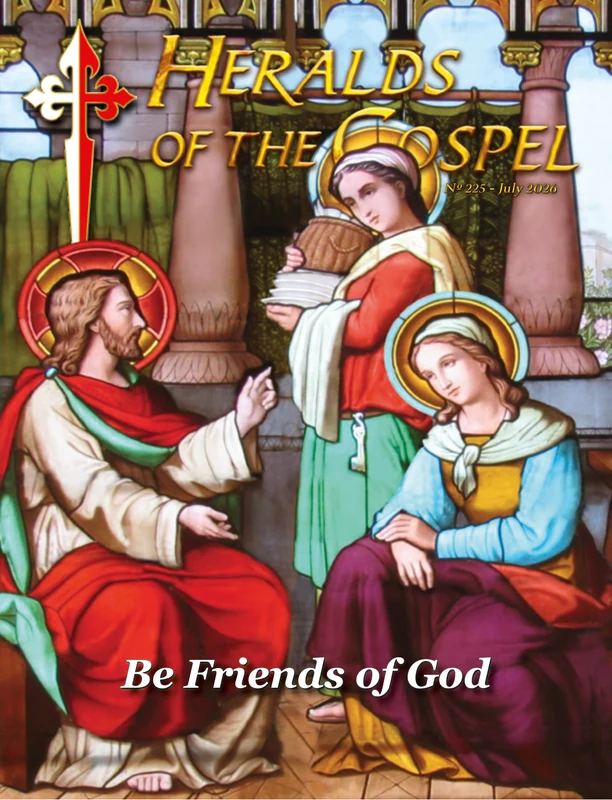 Heralds of the Gospel Magazine, Vol. 20, nº 225, July 2026
 Who are the Heralds of the Gospel?
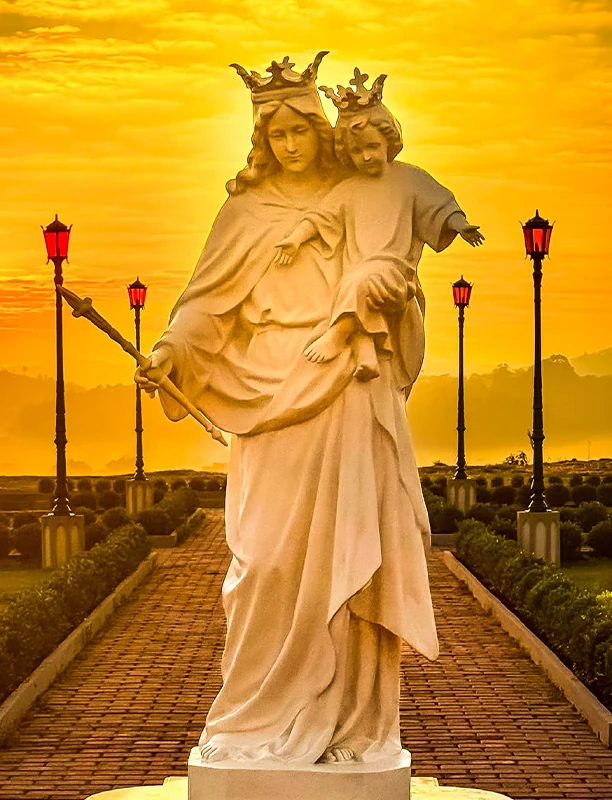 Help of Christians
 Christmas Carols







The duty to intervene, not merely to claim a right
I would like to share some simple reflections concerning, first of all, the preliminary and more general question about the right of the Magisterium to intervene in the political arena when the life and dignity of the human person are at stake. I will then try to apply this thesis to the law on abortion, which unfortunately has long been part of the legislation of many States. It is increasingly seen by public opinion as “definitive” and a fruit of modernity and civilization – legal and therefore licit in the moral sphere. On the first point, it would be opportune for all, Catholics and non-Catholics alike, to re-read the enlightening content of n.76 of the Pastoral Constitution Gaudium et Spes, from the Second Vatican Council. In it the Council Fathers recall with great clarity and balance the true and sound relationship that should exist between the Church and the political community. Starting from the presupposition that each is independent and autonomous in its respective field, albeit in the sole service of the same human persons, it affirms at the same time, with crystal clarity, the Church’s right to preach the faith always and everywhere, as well as to teach her social doctrine, and in a special way “to pass moral judgement in those matters which regard public order, when the fundamental rights of a person or the salvation of souls require it.” As can be seen from this passage, the Council Fathers only manifest a specific requirement of the Church’s mission, which does not, properly speaking, demand from the political community the right to present the deposit of the Faith and to teach the right way to live it, but reminds her of her duty to do this, in order not to betray the mandate entrusted to her by her Founder. In so doing, the Church limits herself to proposing the saving message of evangelical truth, without seeking absolutely to impose it on anyone – which, today more than ever, would be counterproductive. However, this does not mean that, in the appropriate forms and at the appropriate times and places of political and social life, those who exercise authority in the Church do not have the duty to affirm the importance of certain choices. In carrying out this specific task, the Magisterium does no more than remind everyone of the intrinsic and irrevocable demands of human nature, demands which obviously, in the light of Revelation and in view of eternal salvation, are binding in a very special way upon those who profess to be Christians.Human law must safeguard the rights of all
In this context, let us now examine, almost by way of example and application of the above, the issue of the legalization of abortion in many juridical systems today, presented by contemporary “culture” as a conquest of civilization, an “inviolable right” of the modern woman, even if it always objectively remains an abominable crime3 passed off as a right, since it consists of the murder of the innocent by antonomasia – the poorest of the poor, because unborn! Thus, the attempt to legally legitimize abortion sidesteps the intrinsic juridical contradiction on which abortion rests. In effect, if the idea of the “rule of law” arose and was established over time as the safeguard of the rights of everyone against all anarchy or totalitarianism, how can a law be admitted into the legal system that makes of a fundamental and primary right, the right to life, an arbitrary concession? If any of us came to life because our mother did us this “favour”, we can no longer speak of an authentic and personal “right”; then the concept and the consequent structure of the modern rule of law crumble catastrophically, since precisely its first and fundamental right has been reduced, at best, to a favour! Therefore, if the Magisterium, even at the cost of unpopularity and accusations of interference, ceaselessly reaffirms in every forum and on every occasion the supreme and inviolable value of life from the moment of conception, it does so in the awareness of fulfilling a strict duty. A duty which, although arising from and enlightened by faith, cannot be relegated to it. This has a specific meaning for parliamentarians, politicians and leaders of countries who declare themselves Catholic. The defence of life is not a confessional issue, so that it is enough to proclaim oneself a “non-believer” to justify choices and attitudes contrary to reason, truth, law and justice. When we address questions of life and the dignity of the human person, we are dealing with decisions that are not subject to the mere consensus of the majority in order to be morally adopted. This requires of the Magisterium, and in a particular way of baptized persons who exercise positions in public administration, the duty to intervene in the political sphere, avoiding that inferiority complex which so often plays a considerable role, with harmful results, in the political engagement of Catholics. Dialogue is important and necessary, provided it does not impede the search for truth and justice, which can never be sacrificed on the altar of compromise, opportunism or cynical utilitarianism, especially when innocent persons are sacrificed on that altar.Conclusion
These simple and brief reflections give us hope and, above all, encourage us to pray to the Lord so that the Catholics of our day may become ever more aware of the need to develop a mature faith, which is indispensable for announcing and witnessing to today’s world the beauty and the fascination of our Faith. A Faith that is the fruit of the relationship lived with the One who loved us to the point of giving His life for us on the Cross, and who is never against man, but always entirely in favour of him. ◊Notes
1 FRANCIS. Regina Cœli, 22/5/2022.
2 For further insights on the current issue, see: MOLINARI, Elena. Aborto, la Corte Suprema può revocare il suo “sì”. Poi parola agli Stati. In: www.avvenire.it [available in Italian].
3 Cf. SECOND VATICAN COUNCIL. Gaudium et spes, n.51; ST. JOHN PAUL II. Evangelium vitae, n.4. Considering its current relevance, the entire encyclical of St. John Paul II calls for meditation, but I draw special attention to n. 22 and 23.