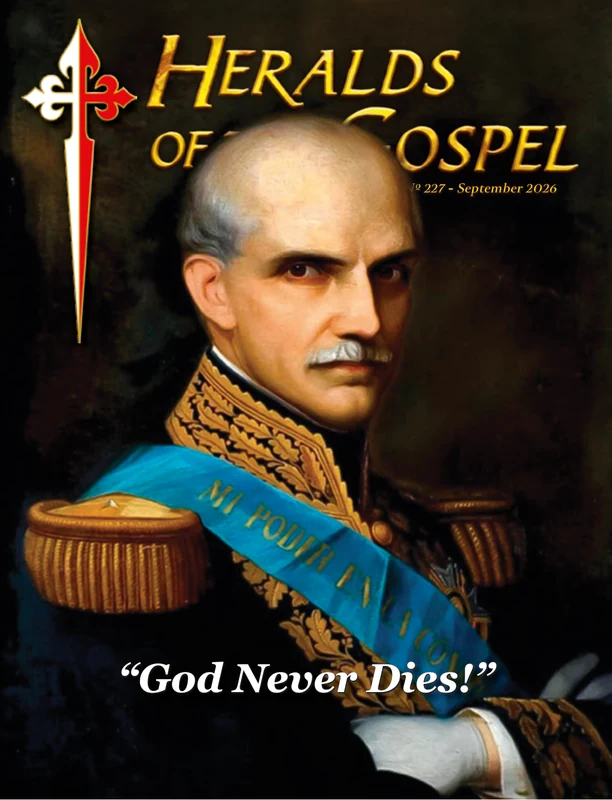
 Heralds of the Gospel Magazine, Vol. 20, nº 227, September 2026
 Heralds of the Gospel Magazine, Vol. 20, nº 226, August 2026
 Heralds of the Gospel Magazine, Vol. 20, nº 225, July 2026
 Who are the Heralds of the Gospel?
 Help of Christians
 Christmas Carols







It was raining heavily in Recife, the capital of Pernambuco, Brazil, in 1968.
Some followers of Dr. Plinio had travelled to that city to carry out a campaign, a term used by members of the movement he founded to refer to the organisation’s public demonstrations, always in defence of the values of the Church and Christian civilization.
However, the group of intrepid youths found themselves unable to accomplish their plans, as the rain prevented them from taking to the streets. It was a disheartening situation…
But that was not what saddened them; rather, it was their concern for the countless souls who would be deprived of their apostolic activity.
Above all, the leader of that group, whose name was João Scognamiglio Clá Dias, could not resign himself to the prospect that the skies would impede such a noble undertaking.
A man of outstanding faith, convinced that great solutions can only come from above, he decided to seek help there.
He remembered Dr. Plinio’s mother, who had died a few months earlier, and with whom he had spent much time during the last period of her life, thereby becoming convinced of her goodness and exemplary virtues.
Acting on inspiration, he proposed to the others that they make a simple promise to her in order for the rain to stop: if the weather cleared up, they would pray a Rosary at the tomb of their intercessor in the Consolação Cemetery in São Paulo.
It was the first time that a collective petition had been made to Dona Lucilia – always in the context of private devotion.
In a matter of moments, the rain stopped, making it possible to carry out the mission. In the distance, the clouds withdrew, seeming to be driven away by a luminous force, gradually turning into small spots on the horizon.
If Elijah’s little cloud (cf. 1 Kgs 18:44), coming from the sea, foreshadowed a storm, these clouds, spreading out over the whole world, could well be said to herald the approach of a flood, not of water, but of heavenly favours.
Torrents of graces
Returning from Recife, Mr. João Clá and his companions immediately went to the cemetery to fulfil their promise. But they were not the only ones to express their gratitude; after them came others, many others…
To cite a few examples,1 there was a housewife in difficulty who, in 1998, even went without food for a time, but was comforted and fed by a mysterious lady, and who, twenty years later, discovered the identity of the person who had helped her so much.
There is the very young student whose parents, in financial difficulty, cannot afford to buy her a suitcase to transport her belongings back and forth, and who inexplicably finds one at her doorstep.
There is a mother whose son had disappeared in a suspicious place and who, after a night of anguish, finds him safe and sound; or another who recuperates not her son, but her honour, as he had been unjustly accused of theft and is finally cleared.
Yet another – it is clear that mothers enjoy special attention from Dona Lucilia – who went through a risky pregnancy and was advised to have an abortion to save her own life, but did not do so, and now, alive, gives thanks to her benefactress, together with her daughter.
There are also children who already counted themselves as orphans, because their parents seemed to be beyond hope, but who saw them emerge from a serious condition, recover from a stroke, find a donor for a damaged organ, or be spared from undergoing a risky operation.
And how many others! They are debtors who suddenly obtain the exact amount to maintain their dignity; paralytics who now walk; barren women who carry their children in their arms.
Uunbelievers who find the path to conversion; sufferers who continue to be rewarded with their cross, but learn to carry it with Christian resignation.
Life in a cemetery
Many of those favoured by Dona Lucilia’s intercession also materially follow in the footsteps of those young disciples of Dr. Plinio, flocking to her grave in at the Consolação Cemetery in São Paulo. And what do they find there?
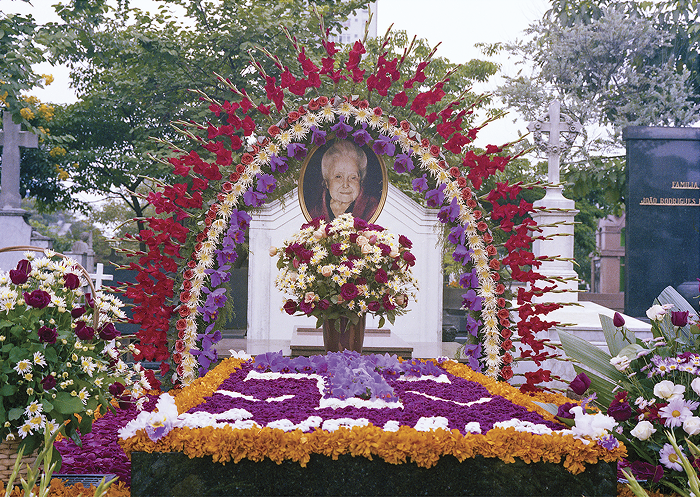
Having crossed the threshold of the necropolis, they see a living monument, a simple tomb, transformed by gratitude into a flourishing garden, adorned with roses, carnations, or lilies, but above all with a marvellous aura that attracts and comforts at the same time.
We would dare to say that, almost six decades after her death, tens of thousands of people have already visited that grave – by far, the most frequented in the cemetery – forming a kind of family that has something of the evangelical about it.
Yes, for its members are similar to those in the parable of the banquet of the Kingdom of God: they are poor, crippled, blind, and lame (cf. Lk 14:21), in both body and soul.
These are people who, however great they may perhaps be in certain aspects, seek refuge in the shadow of this lady because in some sense they feel that they are little ones.
In life, Dona Lucilia always exerted an enormous attraction on children, who sought her patronage with eagerness.
Perhaps this quality was a preparation, or a foreshadowing, of the task she would have in eternity over those who, recognizing that they are not self-sufficient, feel drawn to ask for her intercession.
This irresistible force, although it always remains a mystery, can perhaps be described at least in some of its aspects.
Ribbon that draws us closer to the mercy of Our Lady
If the Blessed Virgin Mary is the Mother of Mercy, it does not seem implausible for her to appoint “auxiliary advocates” – not for small causes, because no cause can be considered small if it is capable of reaching Heaven, but for the causes of little ones – by granting them a special representation, in the form of a pure reflection, of something of her own mercy and goodness, like a ribbon that symbolically links the faithful to an image of Our Lady that reigns from a high niche.
“But what an exaggeration!”, someone who has never experienced the maternal devotion of Dona Lucilia might hastily think.
To this objection, typical of a certain spiritual narrow-mindedness, it is necessary to respond that celestial accounting is governed by principles different from ours: the things of Heaven, like the Eucharist, do not diminish when shared; on the contrary, they multiply.
Moses lost nothing of his spirit when it was distributed among the seventy elders of Israel (cf. Nm 11:25); nor did Jesus Christ lose His Sacred Heart when He exchanged it with that of St. Catherine of Siena, among others, in a surgical intervention so physically perceptible that it even left a scar.
Similarly, the Blessed Virgin will not be deprived of her mercy in endowing anyone She chooses to act in the capacity of her “trailblazer”.
“This Spanish lady!”
However, it is not only kindness, nor only generosity that make Dona Lucilia irresistible. There is more.
First of all, holiness can manifest itself in doing ordinary things in an extraordinary way.2
The concept seems to apply very satisfactorily to Dona Lucilia, who in life acted heroically as a daughter, mother, spouse and housewife, as we hope will one day be officially recognized by Holy Mother Church.
Of course, after her death, one might say that the picture was reversed: she began to do extraordinary things ordinarily.
Be that as it may, the protagonist remains the same. Therefore, it would seem interesting to look for elements in her psychology during her pilgrimage in this world that help us understand her actions in the next.
Dona Lucilia was a lady of firm convictions. Especially when it came to Catholic maxims, she defended them in a calm but unyielding manner, so much so that she would even seem like a “stubborn” person.
Dr. João Paulo, her husband, used to joke at such times, alluding to one of the branches of her ancestry: “Oh! … This Spanish lady!”
There is a photograph in which she somehow expresses this state of mind.
It is one of her last pictures, part of the series for which Dona Lucilia sat at the request of Msgr. João, who photographed her already prepared for eternity, as it were, and even adorned with her silver halo, woven with her hair by nature and time.
In it we find her portrayed almost in a position of contention and – a very rare attitude in her portraits – with her brow furrowed. This was undoubtedly requested by the photographer, inspired by the idea of also immortalizing an analytical Dona Lucilia for future centuries.
Her gaze seems to be looking symbolically beyond the roses, towards something that stirs her concern. She has a goal, the achievement of which mobilizes her whole being, as can be detected from the position of her hands, which are nobly clenched. But what does this lady desire?…
In pursuit of her children
The Gospel tells us that if a woman has ten coins and loses one, she immediately lights a lamp, sweeps the house and searches diligently until she finds it.
“And when she has found it, she calls together her friends and neighbours, saying, ‘Rejoice with me, for I have found the coin which I had lost’” (Lk 15:9).
Dona Lucilia appears to have lost some coins – not those stamped with the face of Caesar (cf. Mt 22:20-21), but with the image of each child entrusted to her by Mary Most Holy. And there are many!
Thus, her mission is an arduous one… But that does not matter: she will go after them all. And her method is very simple.
It will always be at a crossroads, where her lost coins roll, that Dona Lucilia will be waiting patiently, persistently, and with a holy “stubbornness”.
If they have recourse to her, they will be gathered. If not, they will end up in some hole, which will effectively serve as a teacher, and perhaps this will be the moment for her to act.
We cannot resist recalling one more incident that occurred with a lady from outside Brazil. When her husband lost his job, her mother recommended, in the terms she saw fit to use, that she pray to a certain lady with a reputation for “performing miracles”.
The daughter did not take it seriously, merely asking jokingly: “And does she give money? I hope she appears to me one day and gets me some money!”
In reaction to her mother’s insistence, she became increasingly closed to the idea of turning to Dona Lucilia. The coin had resisted at the first crossroads.
Some time later, however, her son fell ill. The child had contracted mucormycosis, a deadly fungus that could affect the brain. In addition, he was suspected of having leukaemia.
The doctors had already decreed his death when his mother had a dream. She saw a white-haired lady who spoke words of confidence to her.
The next day, the boy’s grandmother returned to the charge, recommending that her daughter pray to Dona Lucilia. This time, at least she agreed to see the face of the lady who “performs miracles”. Needless to say, it was the same face she had seen in her dream.
It is true that much suffering still lay ahead.
Her son suffered cardiac arrest and underwent several surgeries, but finally, in April – a month especially dear to the devotees of Dona Lucilia – he was discharged from hospital: a new jewel now shone in the crown of this benevolent intercessor.
This is the great miracle of Dona Lucilia: from the depths of the abyss of their own failure, these wayward souls finally recognize their defeat. And, defeated, they cry out. And, crying out, they triumph.
This dear mother, so “stubborn” in doing good, wins over even her most obstinate children!