 Heralds of the Gospel Magazine, Vol. 20, nº 227, September 2026
 Heralds of the Gospel Magazine, Vol. 20, nº 226, August 2026
 Heralds of the Gospel Magazine, Vol. 20, nº 225, July 2026
 Who are the Heralds of the Gospel?
 Help of Christians
 Christmas Carols









In a previous article,1 we were able to consider the heroic virtues of St. Joan of Arc.
We recalled her feats of arms, her military genius inspired by Heaven, her audacity guided by “voices,” and her unwavering courage – seen, incidentally, as presumption and recklessness by cowards.
She disconcerted both the most knowledgeable in the art of war and the greatest sages in theological learning. For a short time, her tragic end seemed to assert that her life had been in vain, before the facts attested to the glorious success of her mission.
Prophet, counsellor, general, harmonizer, apologist, warrior – always sublime, whether in victory or failure – she became a prodigious model for all men of action.
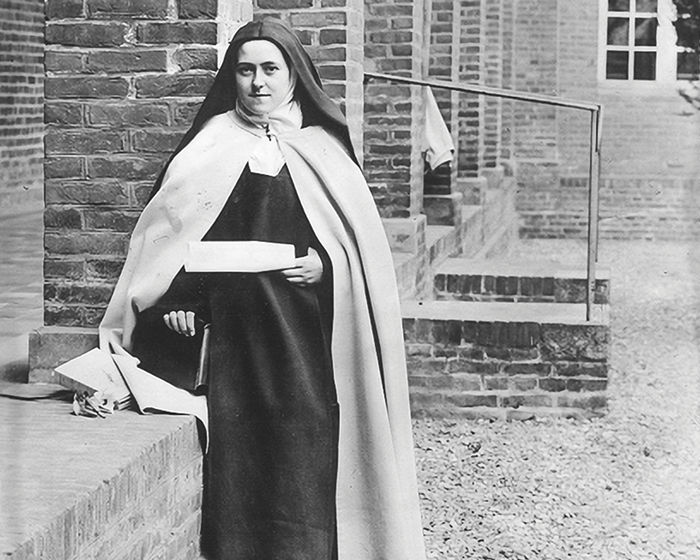
In apparent contrast we have St. Therese of the Child Jesus, the sweet and serene Doctor of the little way, struck down by illness in the solitude of Carmel.
Except for the fact that they were both taken at a very young age, everything about them seems antithetical: the austerity of the cloister against the splendour of court life; the silence of the chapel against the clamour of the battlefield; the calm recollection of divine contemplation against the sharp-wittedness of decision-making; the long agony of illness as opposed to the sudden brilliance of martyrdom…
Nothing seems more opposite than the Saint of Lisieux and the Saint of Orleans. Above all, nothing is further from St. Therese than the ideal of the man of action. But… is that really so?
In fact, it cannot be forgotten that this nun was proclaimed by Pius XI as the universal patroness of missions. Was it a mistake or unfounded arbitrariness? For how can this patronage be justified if St. Therese never went on a mission?
First of all, it is known that the Carmelite Saint spiritually guided two missionaries and, from her letters, it is clear that she understood the missions better than both of them, and with more depth than many others.
In the second place, her love for God and her zeal for souls made her throb with apostolic desire, which she converted into intentions, prayers and sacrifices, and which in turn were rewarded by abundant fruits of conversion.
Thus, although physically confined by her religious cloister, the vehemence of her soul knew no boundaries or limits.
As a consequence, there is no land so remote today that there is not to be found in it a church, a convent, a hospital or a school dedicated to her.
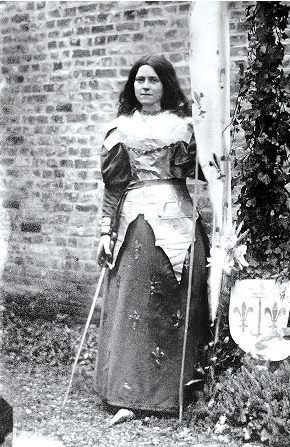
Joan of Arc in 1895
But in the end, what relationship can be established between St. Therese and St. Joan of Arc?
Just as St. Therese of Lisieux can be considered, in her own way, a soul of action, St. Joan of Arc should also be understood as a soul of contemplation.
Indeed, her voices proved never to have lied: they were, therefore, supernatural. Now, mystical contact with the supernatural is a characteristic fruit of contemplation, without which there is no authentic mysticism.
The very flexibility of St. Joan of Arc towards the promptings of the voices is a demonstration not only of the strength of her faith, but of her keen supernatural sense, trained in constant spiritual relationship with God, a communion that shapes the essence of contemplation.
Moreover, the wise answers that the Pucelle delivered to her judges came from a characteristically meditative spirit.
We come upon eloquent symptoms of the deep-seated affinity between the two Saints, not only in the role played by St. Therese in a theatrical piece performed at the Carmelite convent, but above all in the reference to St. Joan of Arc as “my dear sister,”2 recorded in her writings.
Each in her own way, both of these Saints demonstrated that true action is born from contemplation. Indeed, considered from a higher vantage point, to act means to carry out something planned by God for us to accomplish.
Man must, therefore, scrutinize this divine design, and he is only able to do so through inner communion with the Creator, in a state of contemplation. Rightly did Dom Chautard3 attribute all apostolic fruit to the fervour of one’s interior life!…
However, long before the abbot of Sept-Fons, our Divine Model gave us the supreme example.
As He was about to begin His public life, Our Lord Jesus Christ spent forty days in retreat in the desert; during the three years that He preached in Israel, before every great action He withdrew to the solitude of the mountains to pray to the Father; finally, about to begin His redeeming Passion, He first directed His steps to the Garden of Olives to meditate and pray.
No one could ever act as the Redeemer did, nor with greater fruits; nor could anyone’s contemplation ever compare to His.
Modern man thinks he is entirely made of action and for action, together with much agitation. Will he remember that the success of action depends – as heat depends on fire – on having deepened his roots in contemplation, in the soul’s relationship with God?