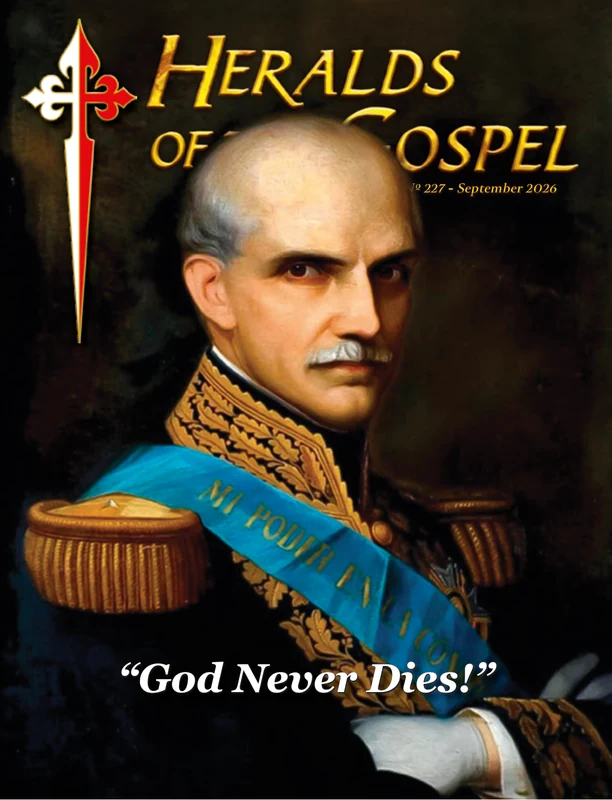
 Heralds of the Gospel Magazine, Vol. 20, nº 227, September 2026
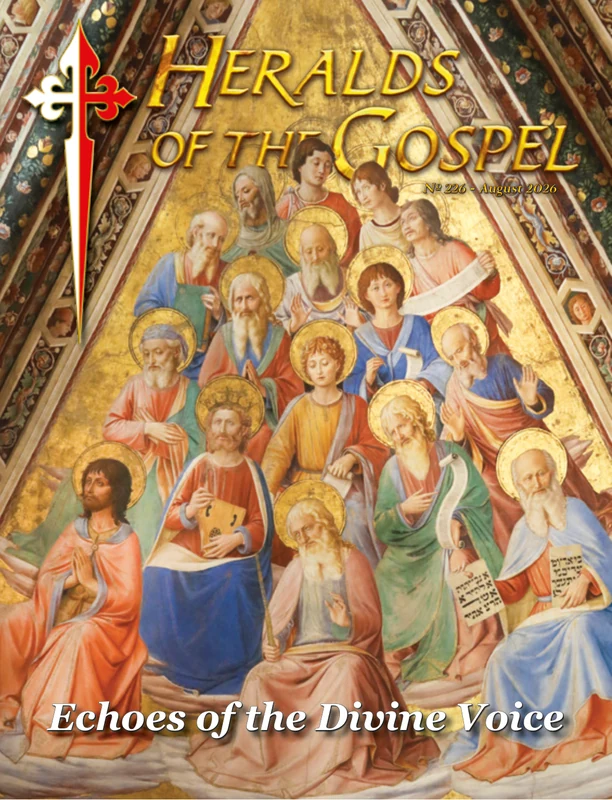 Heralds of the Gospel Magazine, Vol. 20, nº 226, August 2026
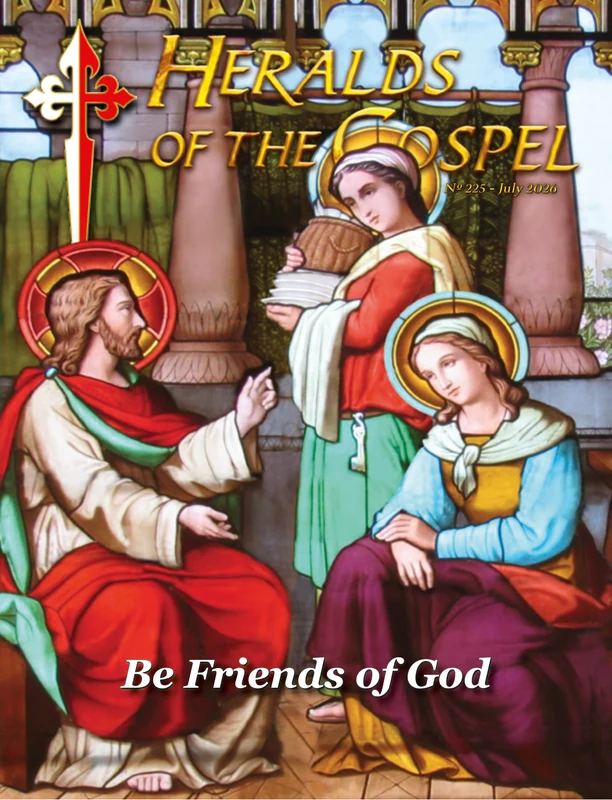 Heralds of the Gospel Magazine, Vol. 20, nº 225, July 2026
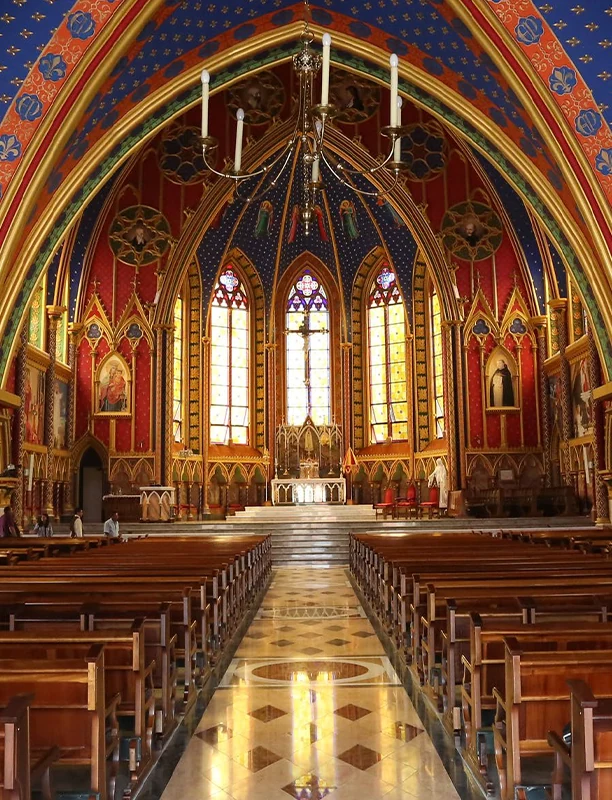 Who are the Heralds of the Gospel?
 Help of Christians
 Christmas Carols








Saladin, one of the most powerful leaders of the 12th century, leaves Egypt for Jerusalem, at the head of twenty-six thousand elite knights.
The Holy City has as its only help a leper king of only sixteen years old, Baldwin IV, who summons all the forces of the kingdom: no more than four hundred knights, most of them second-rate…
From the top of Mount Gisard, the young sovereign contemplates the invading horde and realizes that, for every soldier of his, there are seventy Egyptians. He takes the initiative. He attacks!
Impulsiveness?
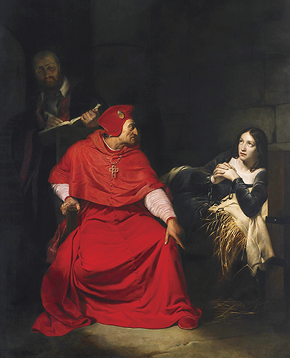
Joan of Arc, the maiden who commands all the armies of France in the Hundred Years’ War, is tried for alleged revelations and supposed miracles.
The judges accuse her of witchcraft and test her with a question that almost induces a compromising answer: “Are you in the state of grace?”
If she denies it, her wonders could not be the work of God; if she affirms it, she would confess to being proud, unworthy of receiving Heaven’s support.
Joan, however, gives an immediate reply that would become a touchstone for Moral Theology regarding personal awareness of the state of grace.
Rashness?
A goup of monks board a boat, led by St. Brendan the Navigator.
The Irish mists of the 6th century envelop them. On this fragile vessel, they launch themselves into the unpredictability of the ocean, without a map, without a compass, without any instruments other than continuous psalmody, the crucifix, and the desire to evangelize the lands west of the Atlantic.
However, they do not even know if these lands really exist…
Imprudence?
Neither impulsiveness, nor rashness, nor imprudence. The truth is, dear reader, that these are three strokes of prudence, and in its most perfect and audacious form, which is the gift of counsel.
Yes, because this gift consists not so much in giving good advice, but in being impelled by irresistible promptings of the Holy Spirit.
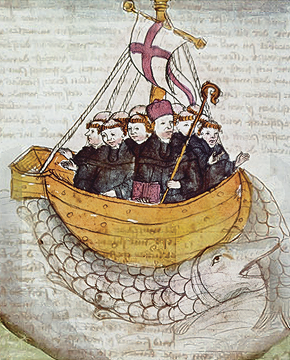
Heidelberg (Germany)
The seven gifts
There are seven gifts of the Paraclete: wisdom, understanding, knowledge, counsel, fortitude, piety, and fear of God. These divine favours are defined as “supernatural operative habits infused by God into the powers of the soul, in order to receive and follow with ease the motions of the Holy Spirit in a divine or supernatural way.”1
This is a lot of information… Let us analyse it in parts, highlighting the most relevant expressions.
They are operative habits, that is, qualities that dispose the soul to follow the motions of the Holy Spirit with ease, readiness and delight, as something entirely natural.
But what distinguishes gifts from virtues, since both are good operative habits?
The main difference lies in their modus operandi: virtues are exercised in a human way, with man as the driving force and reason enlightened by faith as the rule; the gifts, on the other hand, are put into practice in a divine or supernatural way, with the Holy Spirit as the driving force and norm.
Gifts are, therefore, a perfection of virtues.
Faith, as a supernatural virtue, enables us to believe in the Trinity.
But the gift of knowledge, which perfects faith, led St. Augustine, for example, to see images of the Trinity in creatures; it is a super-excellence of faith! Under the influence of the virtues, we act discursively; under the gifts, by supernatural instinct.2
The gift of counsel
Each gift of the Paraclete is closely linked to one of the seven principal virtues: the three theological virtues – faith, hope, and charity – and the four cardinal virtues – prudence, justice, fortitude, and temperance.
The gift of counsel, which we are discussing here, is linked to the virtue of prudence.
According to Aristotle’s definition, taken up by St. Thomas Aquinas, this is “right reason applied to action,”3 that is, the virtue that leads us to choose the appropriate means to achieve an end.
Through it, we judge whether a specific act is lawful or not, whether it is fitting, useful, measured…
The doctor who decides to use a scalpel is prudent, as is the nurse who decides on a drug treatment, provided that these means are in conformity with the cure of the patient.
In the supernatural realm, the man who breaks off a friendship that leads him to sin performs an act of prudence as beautiful as the priest who treats the repentant sinner with gentleness.
Everything boils down – we repeat – to paving the way towards the right purpose, by lawful and appropriate means.
This virtue, which rises above nature when the end is supernatural – such as the glory of God and the good of souls – is the one with the most human demeanour.
When, however, it is united with the gift of counsel, it takes on surprising airs, almost to the point of apparent recklessness: it ceases to be practised in a human way and is instead exercised in a divine way.
Those who, being in the state of grace, finds themselves under the influence of this gift “judge rightly, in particular cases, what is appropriate to do in order to achieve the supernatural end,”4 instantaneously and infallibly.
That is, in the face of the greatest unforeseen events and the most complex dilemmas, they are guided by an inexplicable certainty.
In intricate circumstances, how to reconcile gentleness with firmness? How to keep a secret without failing to tell the truth? How to combine the interior life with the apostolate, or affectionate tenderness with the most refined chastity? Through the gift of counsel.
It was guided by this gift that the three protagonists of the episodes narrated in our introduction acted. Baldwin IV dispersed Saladin’s twenty-six thousand men with his four hundred knights, of whom he lost only five.
St. Joan of Arc, illiterate, answered the cunning question like a scholar: “If I am in a state of grace, I ask God to preserve me; if not, I ask Him to grant it to me.”
The Irish monks reached Iceland, Greenland, and possibly America.
This gift of the Paraclete is, in effect, the gift granted for holy “adventures” and which leads the faithful to ever greater “Christian daring.”5
The Patroness of Good Counsel
Never in history have Catholics experienced such “adventures” as today: at every turn, unexpected dangers, malevolent suggestions, persecutions, and the snares of the devil and his henchmen surprise us.
Never, therefore, have we needed the intercession of the Mother of Good Counsel so much.
How can we not suppose that She is the Patroness of great and holy “adventures”?
She, who guided the two Albanian soldiers across the waters of the Adriatic Sea,6 will also lead us, through the gift of counsel from her Divine Spouse, to triumph over all difficulties.
Following Our Lady of Good Counsel, the Barque of Peter will cross any ocean unscathed.