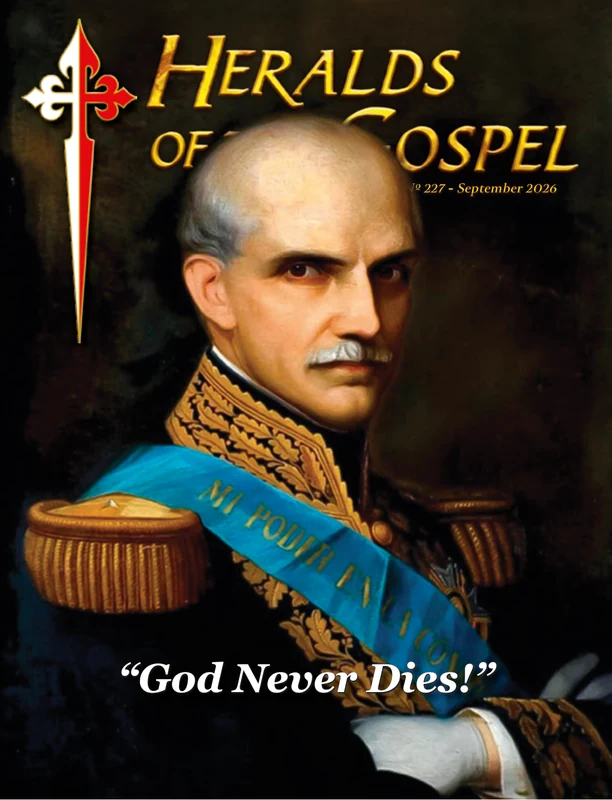
 Heralds of the Gospel Magazine, Vol. 20, nº 227, September 2026
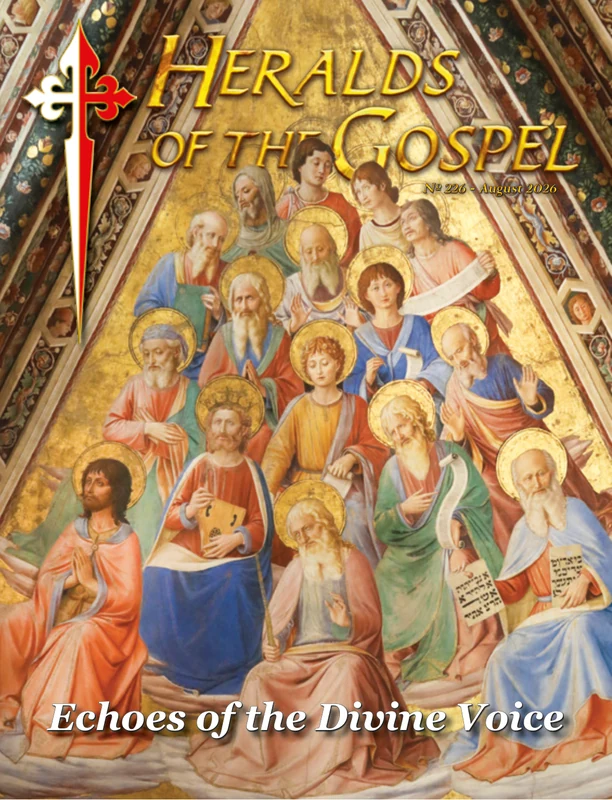 Heralds of the Gospel Magazine, Vol. 20, nº 226, August 2026
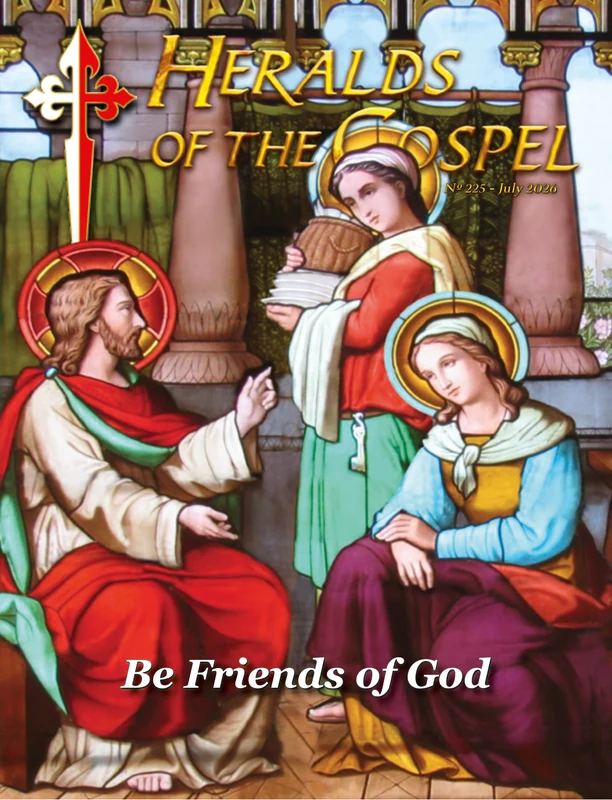 Heralds of the Gospel Magazine, Vol. 20, nº 225, July 2026
 Who are the Heralds of the Gospel?
 Help of Christians
 Christmas Carols






In our filial relations with the Mother of God, understanding the fundamentals of Mariology undoubtedly plays an important role in this relationship; however, this is not everything, nor is it the most relevant aspect.
The primordial factor in our relationship with the Blessed Virgin always consists in a sensible grace of a mystical nature, a supernatural experience that helps us “savour,” in the depths of our soul, the ineffable, compassionate and overflowing goodness that emanates from her maternal gaze.
This grace is frequently manifested in connection with the perplexities and uncertainties afflicting us throughout life, or in the midst of a terrible spiritual trial.
It could even be said that, when people nurture a certain reticence regarding devotion to Our Lady, it is a sign that they have not yet experienced a great hardship…
The realization of how much Mary loves us and desires to help us in resolving our concerns, makes a sentiment of indescribable gratitude blossom within us for benefits so undeservedly received.
The mystical experiential perception of such goodness, such capacity to forgive, to heal wounds and blot out sins, such a welcoming disposition toward any poor unfortunate who presents himself before her, however grave his state of soul, gives rise to a personal, intimate and filial bond with the Blessed Virgin.
It is a tightly fixed bond, since it is rooted in the very fabric of our lives, and involves all aspects of our existence; whether afflictions, trials and failures, or joys, hopes and successes.
The genesis of a devotion
During 1967, filial love for Our Lady, and the very bond of Sacred Slavery, had already taken deep root in my soul.
Nevertheless, grace would take yet another initiative, which would mark my life forever: the “encounter” with the Mother of Good Counsel.
In December of that year, Dr. Plinio suffered a serious diabetic crisis, which culminated in an emergency surgery at the Syrian-Lebanese Hospital, and the amputation of four toes of his right foot.
On that occasion, I received the enormous grace of personally assisting him. This lasted from the onset of the illness, when he was still in a regimen of repose in his apartment, in the company of his loving mother Dona Lucilia, until the final phase of convalescence.
A few months before the symptoms of the illness appeared, Dr. Plinio had providentially come upon a book on Mater Boni Consilii by Monsignor George Francis Dillon, an Irish missionary who had lived for some time at the shrine of Genazzano.
Written in English, the publication had been translated into French, the language in which he read it.
He was greatly impressed by the extraordinary facts that the book narrated about the history of the fresco, and the supernatural phenomena observed in it, especially the continual changes of colour and facial expression.
However, although he had attentively followed the gentle and discreet movement of grace in his soul, it was not clear enough for him to discern any sign of a change of phase therein, or of a new course in his relations with Our Lady.
In addition to the discomfort and suffering that his diabetes and the postoperative phase entailed, Dr. Plinio was experiencing a terrible dark night of the soul, related to the innumerable disappointments he faced within the closest circles of his apostolate, as well as to the continuity of his work.
Years later, he would affirm that this spiritual trial caused him much more suffering than his physical illness.
On December 16, while still convalescing from the operation in his room at the Syrian-Lebanese Hospital, Dr. Plinio received a visit from a group of disciples, some of whom were from the State of Minas Gerais.
One of them had asked a friend, travelling through Italy, to bring him a picture of the Madonna del Buon Consiglio di Genazzano, and now wanted to present it to Dr. Plinio.
They unwrapped the framed print of the Madonna and rested it on his lap. He was at that moment reclining in the hospital bed, supported by several pillows.
He took it in his hands and, visibly moved, contemplated her in silence for a period of twenty minutes, interrupted only by brief exclamations:
“What a magnificent image! Impressive, extraordinary! Look, She seems to want to speak. her colours change. How kind, and motherly! She is smiling, desiring to help!”
As Monsignor Dillon1 comments in his book, the printed copies of the fresco in Genazzano are sometimes miraculous.
As he beheld the picture, Dr. Plinio saw proof of the changes of colour and expression that are so frequent in the original.
And, as if by a caress from her, he understood that Mary Most Holy somehow told him: “My son, do not be troubled. Have confidence, for your work will be accomplished, and you will fulfil your mission entirely.”
Referring to this episode, Dr. Plinio would later reveal: “At the moment I looked at the picture, I had the full impression that the image took life, smiled and made me understand, by facial variation, that I should have complete confidence.”
Mater Boni Consilii’s smile was the affectionate response to the perplexities and questions that afflicted him.
Contemplating my spiritual father receive this mystical grace left indelible marks on my soul, opening a new horizon in my relationship with Mary Most Holy, which would gradually intensify over the years, becoming the very spinal column of my devotion to her, under the particular invocation of the Mother of Good Counsel of Genazzano.
Remote origin, and relationship shrouded in mystery
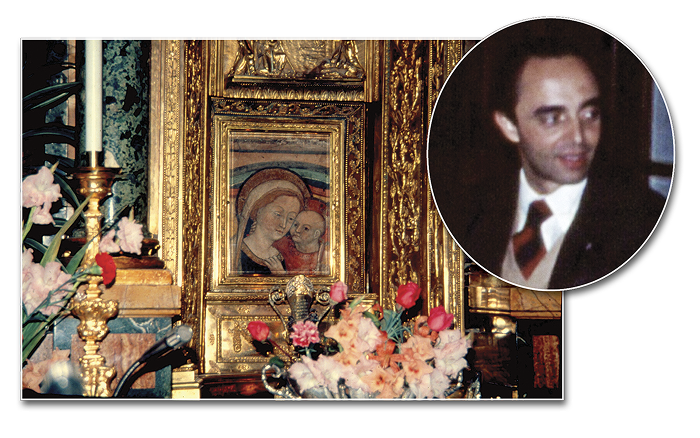
The fresco of the Madonna del Buon Consiglio is truly a “pilgrim” image full of imponderables, the remotest origin of which is shrouded in mystery.
We know that the image had already been in Scutari, Albania, for more than seven centuries prior to its migration to Genazzano, on the outskirts of Rome, in 1467.
What is its true origin? What ingenious artist painted it? Was it only the fruit of human talent, or did angelic contribution share an equal part? Did it emerge from supernatural inspiration, or an apparition of the Mother of God?
Is the enigmatic embroidery on the Child Jesus’ collar merely ornamental, or can words in an unknown language be read there concerning His mission?
These are some of the questions arising in the mind of a devout observer who analyses the fresco’s richness of detail, reflected in the posture, gestures and very garments of its august personages.
But nothing attracts our attention more than the heavenly relationship, there portrayed between Mother and Son, the contemplation of which has always delighted me:
In a gesture of intense affection, overflowing with love, He puts His right hand about His Mother’s noble and delicate neck, while, with His left, He vigorously holds onto the collar of her dress, as if to say: “You are all mine!”
This moving and divine embrace is so categorical that His right eye seems to stray slightly from its normal alignment due to His emphatic manner of pressing His cheek against that of His Most Holy Mother.
Despite having a truly childlike expression, the Divine Infant is nevertheless devoid of the least sign of superficiality, so typical of that life phase.
On the contrary, there shines forth from Him, like an ocean of seriousness, the entire depth and breadth of the understanding, the entire force of the will, and entire elevation and nobility of sentiments. Moreover, He has the highest awareness of what His Mother represents, of the interior paradise that She offers Him. […]
By His attitude, the God-Child seems to say to all: “If you want something from Me, ask for it through My Mother, and you will be attended to.”2
Our Lady’s head rests lightly on that of the Child, seeming to indicate the total union – one would almost say, unity – existing between them, above all expressed in the exchange of gazes.
And how they look at each other! Theirs seems to be one and the same gaze! She appears to confide to us:
My child, the Most High has placed wonders in Me, never imagined by the Angels or Saints of Heaven. For this reason, there are mysteries of God that the blessed spirits only come to know by penetrating my gaze.
And there are mysteries that they will only understand in contemplating this exchange of gazes between Mother and Son.
Of the countless images or paintings known to me, depicting the Blessed Virgin with the Divine Infant in her arms, none displays this union as much as the Genazzano fresco.
There is something in the scene that seems to suggest to those who admiringly analyse it: “If you want to know the Child, you must see Him in her gaze; likewise, to know her completely, you must see her in His gaze.”
No one shall penetrate this exchange of gazes without allowing himself to be attracted by the sacred and divine intimacy between Mother and Son. So many marvels are contained therein, that eternity will be insufficient to reveal its secrets!
It is precisely this overflow of love and affection that I experience every time I approach Mater Boni Consilii.
To be before the sacred fresco, to allow myself to be pervaded by this exchange of gazes between Mother and Son, to feel myself somehow included in this ineffable exchange, is a kind of “beatific pre-vision” for me, which fills my soul with consolation and revives all my inner hopes.
What joy, what support, what spiritual sustenance I receive there, in those long conversations with my Mother!
An unforgettable encounter
The first time I visited the miraculous fresco was in November 1978, during a stay in Rome. The European autumn was well advanced and, accustomed to the mildness of this season in Brazil, I did not yet know its rigours.
I did not even know the way to the charming little town of Genazzano, so I asked a friend from the Eternal City to accompany me.
We took a bus from Stazione Termini, stopping at all the picturesque medieval towns along the way, until finally reaching Genazzano. Directly after lunch, we entered the sanctuary.
Upon seeing the fresco, I felt great joy. Our Lady received me very maternally, and completely enraptured my soul, confirming my yearnings regarding her victory over the Revolution.
I availed myself of the chance to take several photographs, and extended, as much as possible, those blessed moments in her company.
At a certain moment, however, when the sun had already set, a priest began to jingle his keys, letting us know that it was time to close the church.
This first contact marked the starting point of a relationship with the Mother of Good Counsel, replete with intimacy and affection, with confidences and guidance as to which paths to follow.
On the return trip, I was shivering with cold, as I had failed to bring my coat and the bus windows were open.
Nevertheless, inundated with consolation, I remained absorbed in my reflections on the physiognomy of the image, its attractiveness and its colours.
The benefits of this brief encounter with Mater Boni Consilii were immense, and led me to make a resolution: insofar as my apostolic duties permitted, I would not allow a long while to pass before returning to Genazzano, for I would no longer be able to live far from the heavenly company of the Mother and Child of the blessed fresco.
And, in the decades that followed, Our Lady would, in fact, give me numerous opportunities to visit her.
“Hold me tightly in thy maternal arms!”
I could narrate countless other episodes; but how to fit within a few brief lines, a relationship that began in 1978 and has extended over more than four decades, to the present day?3
Our Lady constantly invites me to live in abandonment to her care, to her solicitude and to her refuge, enveloping me in the same love in which She enfolds her Divine Son.
In fact, every time I pray before the fresco of Mater Boni Consilii, or even a replica, I feel my soul, so to speak, anointed with a balm that brings me new strength for my fight, new courage for each day and new graces for my life.
The Lady of Good Counsel is, for me, a smile from Providence, a beacon amid the storms, a shining star in the dark nights!
There is something mysterious in the picture, making the interaction with Our Lady so sublime and elevated that it excludes any form of human or even angelic communication.
She speaks directly to our hearts. How? By conversing with us through her gaze. The good counsel She brings us is imprinted in her gaze, which manifests itself now affectionate and maternal, now serious and grave, now inexorable and just…
We could spend days and days, even whole eternities, commenting on this gaze, for who could encompass the vastness of the gaze of Mary Most Holy? No one… or rather, solely the Child She holds in her arms.
Nevertheless, before the holy fresco, no one can remain excluded from the scene, as a mere spectator. No! With Mater Boni Consilii, there is only one position to take: to unite oneself to that Child and let oneself be carried by Our Lady. That is, to make oneself a son!
A son is one who fully understands his mother, and knows how to discern her attitudes of soul through simple gestures or looks.
But when there is a perfect correspondence of love between mother and child, there arises an even more sublime relationship: they come to share one single heart.
Thus, if asked to represent the hearts of the celestial Personages of the fresco, the Author would place just one, rather than two hearts… That is what it is to be her child, and that is the degree of union with Our Lady to which each of us is called.
But that is not all. No one can be a true child of Our Lady without his soul having reached the pinnacles of confidence… What pinnacles are these?
Let us behold the image once again, and there we will find the answer: these pinnacles are the maternal arms of Mary! Whoever does not have the confidence to approach her, and throw himself into her arms, cannot be called her child.
Therefore, in closing this succinct account of my relationship with the Mother of Good Counsel of Genazzano, I turn to her, in spirit, to beg her: “My Mother, think of me, and hold me tightly in thy maternal arms, for only in them will I learn the marvels of thy love!”