 Heralds of the Gospel Magazine, Vol. 20, nº 227, September 2026
 Heralds of the Gospel Magazine, Vol. 20, nº 226, August 2026
 Heralds of the Gospel Magazine, Vol. 20, nº 225, July 2026
 Who are the Heralds of the Gospel?
 Help of Christians
 Christmas Carols









Of course, I did not know Dona Lucilia as a girl, but I can easily reconstruct how her mentality was formed when I consider her way of being in her mature years.
Her spirit was characterized, in a certain respect, by an admirable uprightness, which consisted of seeing things head-on, whether painful or promising.
She considered suffering in its entirety, in all the bitterness it could bring; she also saw joy as it was, without exaggerating its advantages, understanding well that everything on this earth is random and therefore subject to sudden collapse.
For this reason, she took a very calm and stable position in facing life, without turmoil, or great anxieties or depressions.
This did not make her an apathetic person in any way, as she lived all events deeply, but always with a certain detachment.
There was a layer between her and the facts that the noise of circumstances could not breach or penetrate. And beyond concrete things, Dona Lucilia retained her serenity, psychological detachment and stability.
Two ways of considering life
This state of mind gave her recollection, strength and meekness in all situations. No matter how much circumstances changed, she always maintained the same interior stance, behind which lay a deep sense of duty.
She did not conceive of life as a certain French writer defined it: “A long, delectable cigar that one must smoke to the end.”
She did not believe, therefore, that man’s main purpose was to achieve honours, pleasures, glories or money in order to enjoy himself as much as possible and then die foolishly.
For her, existence was something different. There were pleasures and sorrows; it was even a matter of benefitting from the joys in order to endure the pains.
But the goal of life was to fulfil a mission, acquire a certain state of spirit and do one’s duty.
Affable and discreet influence at home
Within the confines of her family, Dona Lucilia considered it her duty to provide formation, well-being and spiritual elevation to the domestic environment, so that her children would become perfect Catholics and fulfil their duties.
She sought to mark the home with affability and affection, to make it attractive and to diminish the influence that harmful places might have on her family.
She wanted to accustom her children to this way of being, so that they, in turn, would raise their descendants in the same school indefinitely, as she understood that this was the true way to live.
Perhaps someone might ask: Did not Dona Lucilia prepare her children for the struggles of life? Did she not encourage them to pursue brilliant careers and make their fortunes? Did she not instil in them a desire to progress?
Above material goals, serving God
The answer is affirmative. Dona Lucilia did so, but always as a duty, which she conceived as follows:
We have a duty for our honour never to lower ourselves, unless it is necessary to do so in order not to sin, and therefore we have an obligation to work, to strive to maintain the family at the level proper to it and to the tradition of our elders, for that which is elevated must retain its dignity.
Such an undertaking, however, should not be carried out with a view to enjoying the pleasures or advantages of our social status, but rather out of reverence for the ideal of honour as a principle established by God. To this end, it is necessary to live and strive.
Now, it is part of good conservation, if possible, to rise to even better conditions, without ever using unseemly manoeuvres for this purpose, but progressing through honest and gradual work.
This is an onus that exists and must persist in order to uphold the family name.
However, all this was not the most important aspect. Being a true Roman Catholic and serving God was the main thing. Thus, all obligations to the family name, as well as to its tradition, became secondary.

Where is happiness?
Such concerns were a duty, not a joy. In Dona Lucilia’s view, happiness consisted in having an elevated, pious and tranquil soul, enjoying the simple, unpretentious and normal pleasures of existence.
It was not found in big parties, but in the good order of daily life; not in great trips, but in enjoying common leisure activities; not in great fortunes, but in the balanced use of one’s resources.
It was a well-being above all of the soul, temperate, peaceful and modest, present even in misfortune, because when misfortune befalls us and a downfall begins, as long as we are not to blame, nothing essential is affected.
If a pure conscience is maintained, life is worth living.
Fulfilling the family’s aspirations
Various aspects of Dona Lucilia’s life depended on this hierarchy between the aspiration for a happy life and consideration of the true meaning of our existence conditioned.
Like any good mother, she wanted her children to develop their talents and qualities and achieve something great.
She believed that I could be a great lawyer, perhaps even more renowned than her own father, Dr. Antônio Ribeiro dos Santos.
Furthermore, since I was the nephew of Councillor João Alfredo,1 our relatives also expected me to become a dignitary like him.
However, when I was elected Federal Representative to the Constituent Assembly in 1932, Dona Lucilia reacted with impressive calmness and serenity.
I remember that at no point did I see her overjoyed, even though I realized that this achievement was exactly what she had expected of her son at the age of twenty-four.
Duty beyond the intoxication of glory
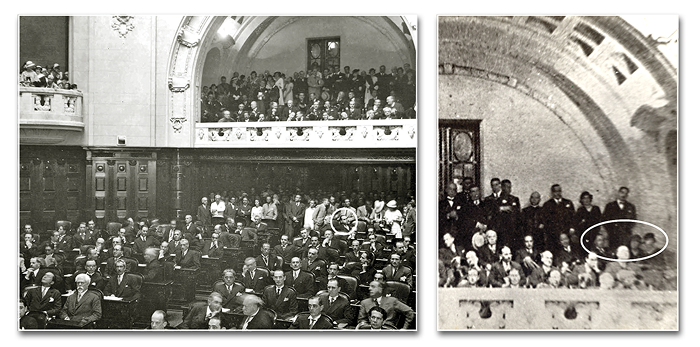
A touching episode occurred on the occasion of my investiture as a Congressman. The ceremony was to be held in Rio de Janeiro, and my mother, who had made so many sacrifices to raise me, more than deserved to be present.
Naturally, I invited my father and sister to go as well, and we headed to Rio.
On the day of the inauguration of the Constituent Assembly, we all went to attend the solemn event. Dona Lucilia, however, had foot discomfort due to rheumatism, which did not permit her to stand for long periods of time.
For this reason, we arrived early, and I took her to a balcony, a private area that the Congressmen could use for their guests.
The bell began to ring, indicating the beginning of the session. I had to leave her, rushing down to the official’s area.
I was then left wondering whether or not she had managed to be seated where I had planned.
When I arrived at the area designated for the Congressmen, even before entering the section reserved for the delegation from São Paulo, which was the first to the right of the president’s table, I positioned myself in the middle of the hall and began to look for Dona Lucilia to check if she was comfortably seated.
I noticed that she was in a good seat; I waved to her and took my place.
Some time later, Dona Lucilia made the following comment:
My son, I was very happy with your election as Federal Representative. However, what meant much more to me was your gesture of waving to me on the day of the inauguration, from the assembly floor below.
At that moment, when you could have been intoxicated by vanity, the fact of remembering your mother and wanting to check if she was comfortably seated indicated a kind soul and a sort of affection far more valuable to me than your position as Congressman.
Her underlying thought was:
If possible, become a Congressman, strive for this; however, this is not the centre of life. It is more important to have a sense of duty that transcends the intoxications of glory.
And, consequently, to have for your mother the recognition that you know by the Law of God that it is necessary to have.
The essence of life: knowing and loving one another
Many years later, on the advice of some friends, I ran for office once again. When the news finally came that I had not been elected, I said to her:
“My dear, I have been defeated.”
She remained impassive. I pondered:
“It seems you are not sorry.”
She replied:
“No, I am not sorry. What is essential in life, my son, is not to be a Congressman, but to be a person of worth, and to know and appreciate one another.”
These episodes clearly demonstrate Dona Lucilia’s character. Furthermore, I saw this way of being undergo trials and develop on other occasions, during great misfortunes she endured.
Constancy of spirit in the vicissitudes of life
When she married, she received a generous dowry from her father, which helped to support the family; later, her inheritance was added to these assets.
However, due to various circumstances, as she entered middle age, she suffered an enormous financial setback, a collapse so severe that we were threatened with having to live in conditions incomparably inferior to those we had enjoyed until then. I remember her saying:
“My son, you are very young, you have no idea of the kind of house we will end up in. Now we have to prepare ourselves for this because, if God permits it, it is His will and so it will be.”
But she made this comment with complete calmness and dignity, without ever ceasing to be herself, always with temperance and normality, revealing the perfect balance between the external event and its impact on her interior.
Therefore, Mama responded to situations with the intensity and scope that was appropriate.
At certain times, due to shortage of funds, her dresses were very worn, although impeccably clean, like everything else that belonged to her.
She was so poorly attired that she only went to Mass because she did not consider herself prepared to appear anywhere else. She went, however, with tranquillity and distinction, poised, and without agitation.
Once again, we see here a serenity of soul that placed her above the ups and downs and vicissitudes of life and made her a person who was always true to herself, even when the paths of life became barred, sometimes in a frightening way.
A duty taken to its ultimate consequences
When she reached an advanced age, Dona Lucilia began to have difficulty hearing and, at the same time, vision problems, at a time when cataract surgery was not recommended.
Seeing less and less and almost deaf, she was heading towards complete isolation; on the other hand, since her heart was in good condition, she still had a few years of life ahead of her.
My conversations with my mother were shouted so that she could follow something of what was being said, but few people had the patience for this.
So, when there was a family gathering, she, who had been so communicative, was left completely alone: very sad and melancholic, but without any bitterness or complaint, walking with that same steady step, forging ahead.
Finally, I obtained the means and decided to try a modern hearing aid to improve her hearing. I bought it, she started using it, and it was a revival. She was very happy, but it was not at all an intemperate joy.
The tone of her life continued in the same vein, with the same tranquillity, the same dignity. Knowing herself to be increasingly different from everything and everyone else, she did not change at all, out of a principle of fidelity.
If she was the way she should be, even if others were otherwise, she continued, because that was her duty. Even if it meant isolation or misunderstanding, she would remain true to herself until her encounter with God.
A mindset marked by constancy in the face of suffering
Her way of being and her mentality were forged by suffering everything she had to suffer, losing everything she had to lose, going through the great and small vicissitudes of a turbulent family life, and seeing it through to the end with complete naturalness.
When the end came, she realized she was going to die, she made a large Sign of the Cross and died. It was the end of her journey, it was over.