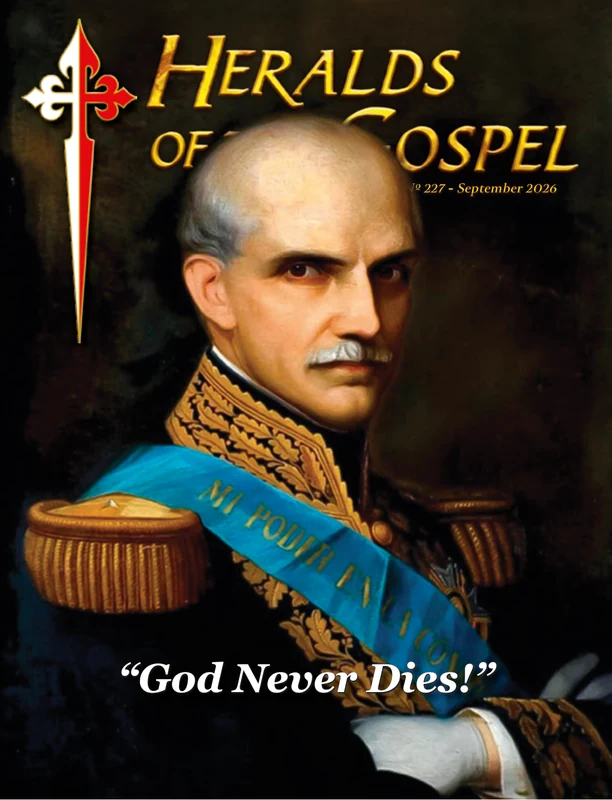
 Heralds of the Gospel Magazine, Vol. 20, nº 227, September 2026
 Heralds of the Gospel Magazine, Vol. 20, nº 226, August 2026
 Heralds of the Gospel Magazine, Vol. 20, nº 225, July 2026
 Who are the Heralds of the Gospel?
 Help of Christians
 Christmas Carols






We are in Genazzano. Located on a hill in Lazio, the town enchants us with its medieval architecture, winding alleys, and houses that over the years – to the amazement of engineers – continue to be built up with rooms and floors.
Every corner seems to have been artistically planned: here an alleyway that becomes the staircase of a house, there an “avenue” where three friends stop to chat, causing heavy traffic…
But for Europe, what is Genazzano? What is Genazzano compared to Venice, a city where the sky kisses the waters?
What is Genazzano compared to Paris, where such wonders as Notre-Dame and Sainte Chapelle compete in beauty? A simple village, like many others.
However, it was to this unknown corner that Pope Leo XIV wanted to make his first visit as Pontiff.
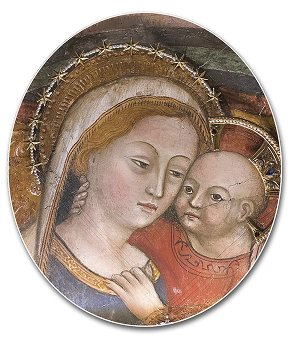
What drew him there? A simple fresco of the Blessed Virgin, already marked by time and located in a side chapel of a certain shrine. Now, what is so special about this painting?
In Scutari, the first battles
The first reports of this devotion come from Scutari, a small town in the Albanian hills.1
An ancient tradition tells that in the mid-13th century, a fresco of Our Lady, with fine, maternal features, mysteriously appeared there, brought from the East by angelic hands at the same time that the Holy House of Nazareth was transferred to Loreto.
A sanctuary was built on the site, which quickly became the largest pilgrimage centre in the country. Numerous Albanians went daily to the feet of their Patroness2 – Our Lady of Scutari or of the Annunciation, as she was called – to beseech or to give thanks for favours.
However, when the city was taken by the Turks of Sultan Murad II in 1423, a new prayer was added to the pilgrims’ requests: liberation from the yoke that oppressed them.
Our Lady wished to test the perseverance of her children for two decades, until, in 1443, she raised up a liberator for the nation: George Castriota.
Known as Scanderbeg,3 an Albanian prince kidnapped in the 1423 attack and forcibly made a Janissary,4 who took advantage of the planned invasion of Hungary to return, with three hundred other Catholics – also involuntary Janissaries – to the Christian ranks.
Fighting under the banner of the cross, he quickly reconquered the territory that belonged to him by inheritance, and Albania, free from Turkish oppression, was able on November 13, 1443, to hear the church bells break their long silence.
Twenty-four years of arduous victories followed until, in January 1467, after having fought for the last time on this earth against the enemies of Christ, Scanderbeg, sword and shield of Christendom,5 slept the repose of the just.
A long journey
Shortly after the death of the valiant prince, the Faith entered a period of decline.
Customs deteriorated; schism spread throughout Albania, including in Scutari, where flowers no longer adorned the altar of the Patroness, nor did the faithful pray at her feet as before.
Moreover, the threat of a new Turkish domination hung over the people.
In this context, De Sclavis and Georgio, two soldiers of Scanderbeg, found themselves facing a terrible dilemma: flee the country and abandon their Patroness or fall into Muslim hands.
Tormented by this doubt, they rushed to the holy image and asked for a solution.
That same night, while sleeping, Georgio dreamed of the Mother of God: She ordered him to prepare to accompany her on a long journey.
Awakening the next day, he hurried to tell his companion what had happened, receiving a similar account from him.
Filled with unspeakable joy, they both went to the sanctuary to thank their Lady, and behold, while they were praying, the fresco gently detached itself from the wall and, enveloped in a white and luminous cloud, began to move out of the church.
The soldiers accompanied it for thirty kilometres to the shores of the Adriatic. As the image continued its journey by sea, they realized, astonished, that the water remained solid beneath their feet.
Thus, they travelled – it is not known in how much time – the more than five hundred kilometres that separate Scutari from Rome, without suffering from thirst, hunger, heat, cold, or fatigue.
Arriving at the gates of the Eternal City, the fresco disappeared from sight, leaving the two foreigners distressed, thinking it was a punishment for some fault. But they would later reencounter the image in a small village near Rome.
In Genazzano, the Queen’s throne is being prepared
Meanwhile, in the small town of Genazzano, separated from Rome by just under fifty kilometres, lived Petruccia Nocera, a widow and Augustinian tertiary very devoted to Our Lady of Good Counsel.6
Distressed by the desolate state in which Christendom found itself – Europe softened by Humanism, the flame of the crusading ideal extinguished by sensuality in the souls of Catholic princes and corrupted morals – she constantly pleaded with Heaven for divine intervention.
One day, she received a magnificent revelation: the Blessed Virgin Mary, in the miraculous fresco of Scutari, would abandon Albania and choose Genazzano as her new fiefdom.
As for Petruccia, she should rebuild the ancient temple dedicated to the invocation of Our Lady of Good Counsel to house the holy image.
The devout widow quickly set to work. She employed the few means she possessed, even giving up her own house to fulfil the heavenly commission.
However, when the walls of the Chapel of St. Blaise, the first to be rebuilt, reached only one metre in height, the money ran out and the works were interrupted.
Petruccia, already eighty years old, soon became the target of scorn and mockery from the other villagers, who ironically applied to her the passage from Scripture: “This man began to build, and was not able to finish” (Lk 14:30). But the Comforter of the Afflicted would not delay in helping her faithful servant.
An unexpected visit
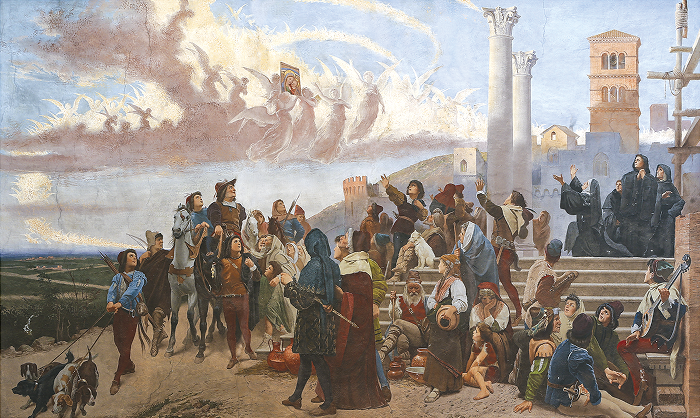
On April 25, 1467, Genazzano was celebrating. A municipal fair had been organized there to commemorate the town’s patron saint, St. Mark.
The liveliness typical of the Italian people painted such a rich scene that it would be difficult for an artist to accurately depict it without missing several of its aspects…
However, amidst the popular music, the lively conversations, the bustle of children playing, and the voices of vendors crying out, an unexpected sight filled the people with astonishment.
Everything went silent, and a luminous cloud slowly descended upon one of the unfinished walls of the small Chapel of St. Blaise.
To add to the general surprise, the bells of all the churches in Genazzano miraculously began to ring.
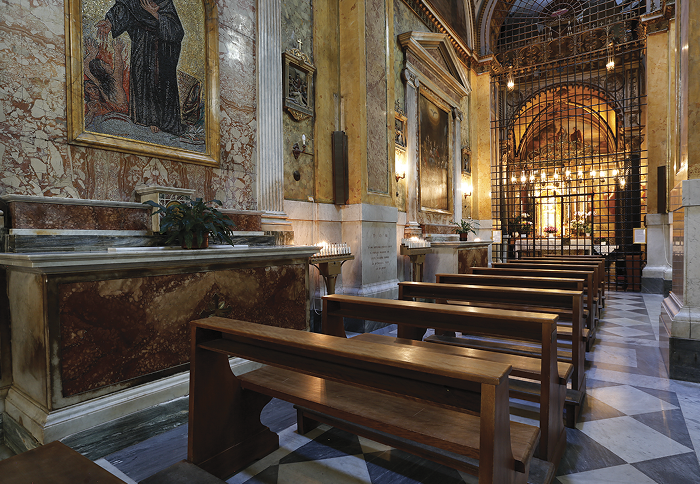
The population quickly crowded into the chapel and, as the rays of light began to diminish in intensity, they were able to contemplate a beautiful fresco of the Blessed Virgin with the Child Jesus in her arms. During that night, the crowd remained there, on their knees, in tributes of love and gratitude.
The news soon spread, and numerous pilgrims from all parts began to visit the holy fresco, asking for graces, giving thanks for favours recieved, and leaving donations for the renovation of the church, which was soon resumed and completed.
Such was the flow of miracles worked through the intercession of the Blessed Virgin that, in the first 110 days alone, 167 were recorded, some of which deserve special attention.
The dead rise
Antonietto of Castelnuovo had a faithful servant, Constantine of Carolis, whom he greatly esteemed. Constantine was struck by a serious illness and, after receiving the Sacraments, gave his soul to God.
His master, shaken by the loss of such an esteemed servant, prostrated himself beside the corpse and promised that, if Our Lady restored him to life, he would take him to the altar of Genazzano to thank her.
A bold prayer, no doubt, but one that the Virgin received with pleasure. To the astonishment of all those present, the servant opened his eyes and sat up, asking for something to eat.
Upon being informed of the promise made by his master to the Mother of God, the resurrected man set out together with him, to give thanks at the foot of the sacred fresco for such a wondrous miracle.
The demons flee
However, more than for the health of the body, the Blessed Virgin Mary watches over the health of her children’s souls. In this vein, there are numerous accounts of miraculous cures of one of the most terrible spiritual illnesses: demonic possession.
One such case involved Niccola Greco, who, after drinking a bewitched liqueur, was possessed by a demon that made him delirious with rage, sometimes causing him to run around with a drawn sword.
His parents, disconcerted, heard accounts of some miracles performed by the image of Genazzano and decided to take their poor possessed son there.
As soon as the young man was brought into the chapel, the evil spirit left him and he recovered the health and peace he had lost so long ago.
Unbelievers regain their faith
There was also another terrible spiritual illness, this time a culpable one, which found a miraculous cure before Our Lady of Good Counsel: unbelief.
For the impious Antonio Cerroni, a resident of Pisciano, the marvellous prodigies performed by the holy fresco were nothing more than a ridiculous fantasy forged by religious people.
Accordingly, he laughed and mocked the new devotion that, as time passed, was spreading more and more.
One day, he had to travel to Genazzano to settle some business. Moved by curiosity, he decided to visit the church where the supposed miracles took place.
However, this was not possible for him because, as soon as he crossed the threshold of the sanctuary, he fell to the ground with his limbs paralyzed.
Recognizing that this turn of events was a punishment for his blatant impiety, he tearfully pleaded for mercy, publicly confessing his sin.
Upon finishing his supplication, he regained the use of his limbs and was able to make his way to the chapel, where he presented himself before the One who had just restored to him his mobility of body and, above all, granted him the priceless gift of faith.
Mother and Protectress of Christendom
If Our Lady of Good Counsel has always been solicitous in assisting each of her devotees in particular, she has dedicated no less attention to the Holy Church as a whole.
In the mid-16th century, by the mercy of God, a Saint was elevated to the Throne of Peter: St. Pius V, an ardent devotee of the Mother of Good Counsel.
“Zealous for the Lord” (1 Kgs 19:10), he perceived the urgent need to unite the Catholic nations in an attack against Islam, which was then threatening Christendom both by land and by sea.
Nevertheless, most Catholic monarchs, too absorbed with their own temporal interests, did not share the same conviction.
Faced with this difficulty, the Supreme Pontiff resolved to turn to his incomparable Counsellor.
After many prayers and countless efforts, he managed to unite Spain, Venice, Genoa and, of course, the Papal States, under the command of the young Don Juan of Austria and his lieutenant, Marco Antonio Colonna, prince of Genazzano and great devotee of Mater Boni Consilii.
Under the devotion of the Holy Rosary, the Catholics achieved victory in the famous Battle of Lepanto, on October 7, 1571, thus preventing Europe and, consequently, the newly discovered America, from falling under Muslim rule.
As an expression of gratitude for the aid received, Marco Antonio and other local combatants brought their war trophies and deposited them in the Chapel of Our Lady of Good Counsel. These ornaments of war remained there until the French Revolution.
The Siege of Vienna
Defeated at sea, the Turks continued to advance by land. Once again, the greatest challenge for the Christians was to gather fighters to confront Ottoman power.
It was then that, on November 17 of 1682, Blessed Innocent XI decided to crown the brow of Our Lady of Good Counsel with gold and precious stones, imploring Heaven for Catholics to unite in order to fight the enemies of Christendom.
Less than a year later, Leopold I, Emperor of Austria, and John Sobieski, King of Poland, joined forces and, on September 12, 1683, they fought against the Muslims who were besieging Vienna, achieving another miraculous victory, also under the protection of Our Lady of Good Counsel, a copy of whose image was venerated in one of the churches of the imperial capital.
Regarding these two great events in the History of the Church, Msgr. João comments:
Lepanto and Vienna. These are two of the most significant battles in which the future of Christendom was at stake. In both Lepanto and Vienna, the heavenly protection of Our Lady of Good Counsel was felt.
This is indeed one of the characteristics of the interventions performed by the holy image of Genazzano: She not only dispels the anxieties and removes the difficulties that afflict all men individually, but also protects them when, as a group, they find themselves threatened with destruction.
To these two historical examples, the stanza from the hymn of the Marian Congregations can well be applied: “He who fights in the shadow of the Immaculate does not fear the sword of a thousand soldiers.”7
Does history repeat itself?
Analysing briefly the history of Mater Boni Consilii, we notice a constant that manifests itself from the heroic conquests of Scanderbeg to the miraculous victories at Lepanto and Vienna.
A world weakened by a spiritual crisis and threatened by enemies; a handful – or sometimes a single soul – who, by remaining faithful and imploring help, becomes invincible; a miraculous intervention which crowns the perseverance of the good.
All this comes to mind when we see Pope Leo XIV, happily reigning, praying at the foot of the fresco moments after his election. A question then arises in our minds: does history repeat itself?