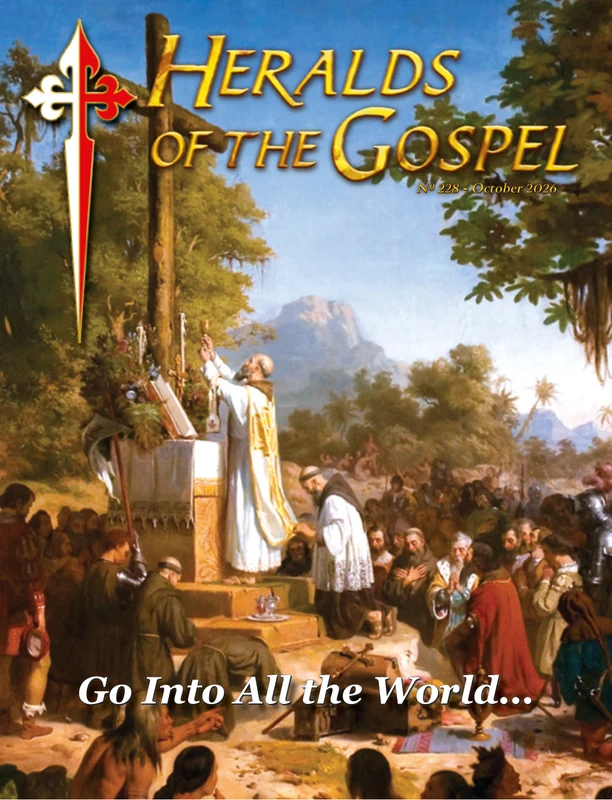
 Heralds of the Gospel Magazine, Vol. 20, nº 228, October 2026
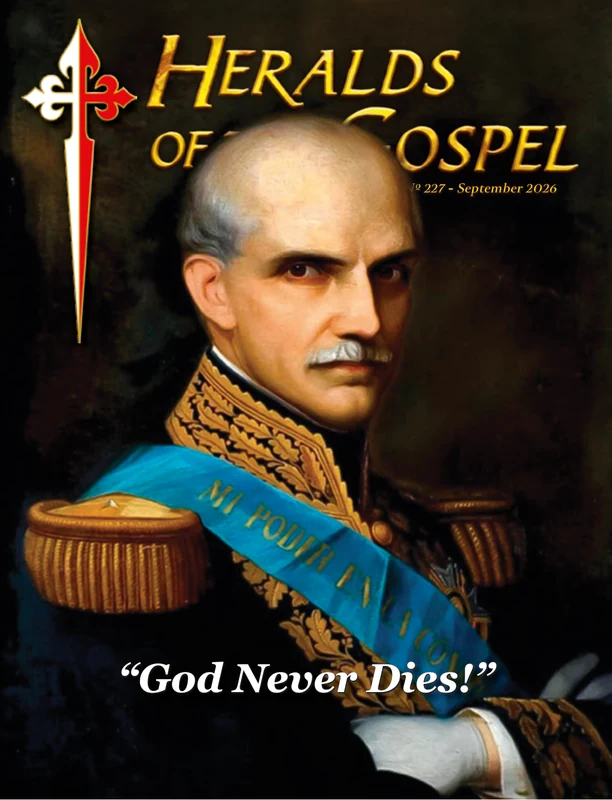 Heralds of the Gospel Magazine, Vol. 20, nº 227, September 2026
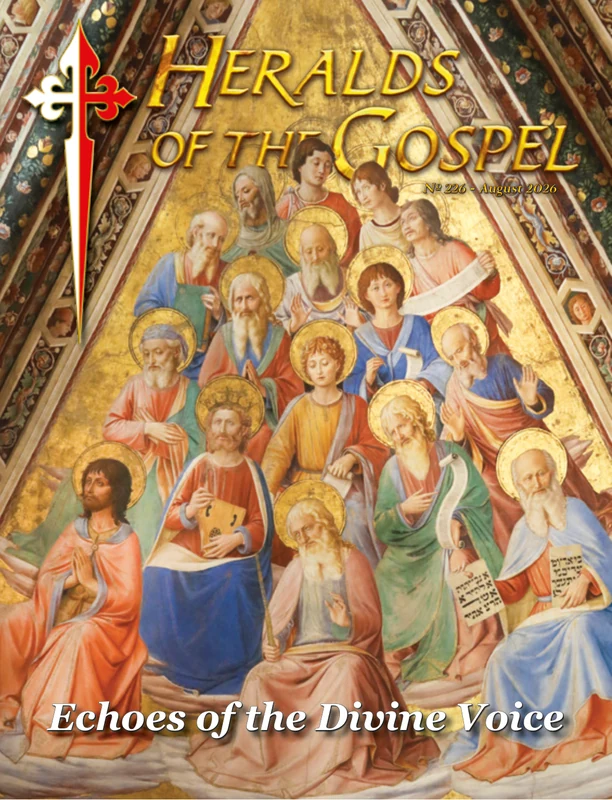 Heralds of the Gospel Magazine, Vol. 20, nº 226, August 2026
 Who are the Heralds of the Gospel?
 Help of Christians
 Christmas Carols








A young Italian lad, from an aristocratic family, had his heart set on a rather unusual dream. He aspired to nothing less than winning China over to the Lord! He envisioned that vast and mysterious empire, and his thoughts teemed with the physiognomies of the friendly Chinese people, whom he had perhaps only ever seen in engravings…
The Most High, who from His heavenly abode had inspired him with such longings in preparation for the future, would also provide for their realization.
Jesuit priests set out on a mission
Matteo Ricci was born on October 6, 1552. From an early age was eager to be a missionary and, at the age of eighteen, he joined the then-fledgling Society of Jesus. Shortly afterwards, he received the auspicious tidings: he and thirteen fellow members – amongst them the Italian Jesuit Fr. Michele Ruggieri, of whom we shall speak later – had been authorized to set off on a mission to Asia.1
In May 1577, the new missionaries received the blessing of Pope Gregory XIII and, after spending a few months at the Jesuit college in Portugal while awaiting a ship, on March 24 of the following year they set sail for the East Indies.
Ricci completed his theological studies in Goa and, in 1580, was ordained a priest in the city of Cochin, to which he had been sent for health reasons. Having returned to Goa, in April 1582 he received orders to set off for the Portuguese colony of Macao, where he would join Fr. Ruggieri, who had arrived previously, and would prepare himself to evangelize the country by learning the Chinese language and familiarizing himself with the local culture.
Early successes, with persecutions
Then known as “the Middle Kingdom”, China was reputed to be a vast and mysterious territory. Before entering it, Ricci and his companions decided to adapt their appearance: they shaved their beards and hair, and replaced their black cassocks with grey tunics reminiscent of those worn by Buddhist monks. Thus, they presented themselves as “Western monks.”
Gradually, the Jesuits’ apostolate began to bear fruit. The governor of the city of Zhaoqing, named Wang P’an, gave the “worshippers of the Lord of Heaven” – as they were known – permission to build a house and a chapel.
As expected, the event attracted the hatred and machinations of the infernal enemy. An accident involving a child – who fell from a wall while watching the construction of the chapel – ended up generating false accusations of kidnapping. When the priests were brought to trial before Wang P’an, it was Fr. Matteo Ricci’s masterful defence that led to their acquittal.
However, although the Jesuits emerged victorious in this battle, the war against them persisted. So numerous were the obstacles to the Jesuit apostolate that in two years only twenty people had converted to Christianity…
Two companions depart…
Fr. Matteo Ricci faced further tribulations. In 1588, a directive arrived from Europe determining the return of Fr. Michele Ruggieri to Italy. Ricci would lose a valuable missionary companion, with whom he had spent the first years of his arduous apostolate.
Fr. Ruggieri is remembered as one of the main evangelizers of China, largely due to the numerous books he published during his mission. However, he always had great difficulty with the local tongue, while Fr. Ricci had a better command of the spoken and written language. Thus, he actually had only a discreet, but essential, role in the writing of these texts.
To replace him, the Portuguese priest António de Almeida was sent, who fell ill and died not long afterward, at the age of thirty-four. His funeral, conducted with solemnity and with the honours due to the praise of one’s ancestors, so highly regarded by the Chinese, caused a deep impression and even led to conversions.
Change of tactics
After Fr. Ricci had established his residence in the city of Chaozhou, a young scholar named K’iu T’ai-sou, who had abandoned his career to study Confucianism – the system of ideas of Confucius (551 BC - 479 BC) that values social harmony, reverence for elders, family customs and duties, as well as virtues such as justice – one day approached him, asking to be his disciple, desirous, above all, of learning the mysteries of Alchemy.
The Jesuit, who had brought much knowledge from the West, acquiesced without great enthusiasm; but, as time passed, the pupil himself was attracted to Religion and ended up converting to the Catholic Faith, becoming a dedicated follower of Fr. Ricci.
K’iu T’ai-sou advised his master to differentiate his appearance from that of the Buddhist monks – who, although respected, were discredited by the decadence of some – and to adopt the appearance of the sages. Ricci was somewhat reluctant, but, considering the apostolic fruits at stake, he finally agreed. He replaced his grey tunic with a dark blue silk garment, let his beard and hair grow, and began to wear his characteristic black hat. And it was not just his attire that changed; from that time on, he changed his signature to Li Ma-teu, an adaptation of his name combined with the surname of an ancient Chinese family.
This adjustment was decisive: in interacting with Confucianists, Ricci found a basis for explaining the truths of the Faith with greater acceptance among the erudite, thus increasing the number of conversions.
“I am God”
Despite these consolations, the apostolate progressed at a slow pace. If such efforts were made, seeking solely glory of God, why did the Lord permit such difficulties?
During a river journey, travelling to Beijing to meet the Emperor, Fr. Ricci contemplated the panorama, immersed in aspirations and uncertainties, when a hand touched his shoulder and a voice spoke to him:
“So you want to travel this country and abolish the old religion to introduce a new one?”
Astonished, he turned to the one who touched him and asked:
“You know my secret! Are you God or the devil?”
“I am God!”
Father Ricci fell to his knees and exclaimed:
“Lord, if You know my desires, why do You not help me?”
Without uttering a word, the Almighty made the Jesuit turn back around and showed him the following vision: a dazzling portal, flanked by tall towers, and bushes covering the banks of a river.
Ricci realized it was a grace that foretold that this was the place where his mission would succeed.
A short time later, for health reasons, he was forced to go to Nanjing, literally capital of the south.
When he arrived at the entrance to the city, he could not believe his eyes: he recognized the portal from the vision! By inspiration, he understood that from there God would fulfil the promise, even though until that moment he had only one disciple.
A debate with Buddhist monks
In Nanjing, many already knew Ricci and were not surprised by his change in appearance, as they recognized him as a scholar. Even so, he faced debates, such as the one with Li-Pen-kiou, a renowned seventy-four-year-old Buddhist sage, accompanied by the famous Houang-San-hui and twenty-five other monks.
The elder invited Fr. Matteo Ricci to a banquet at his residence and, during the meal, proposed a debate on religion. The discussion alluded to the scriptural dialogues between Jesus and the doctors of the Law: despite their attempts to publicly discredit the Jesuit, the monks were unable to refute his arguments and withdrew humiliated after eight hours of debate!
There were also similar occasions in which, through divine protection and the inspiration of the Holy Spirit, Fr. Ricci always emerged victorious. Thus, his fame grew, providing the mandarins with an opportunity to accept the true Faith.
However, he had not yet achieved his main goal: to enter the Forbidden City – the complex of buildings of the imperial palace, located in the centre of Beijing, which no foreigner had ever entered – and speak with the Emperor.
To the royal palace, with a mechanical clock
Matteo Ricci was not only intelligent, but also very shrewd in achieving his goals. He then proceeded to commission several gifts from King Philip II of Spain, which would serve as a pretext to reach the Chinese sovereign.
After beginning their attempts, Fr. Matteo Ricci and his companion – a Spanish priest named Fr. Diego Pantoja – were detained for almost a year, victims of the envy of a eunuch. However, thanks to the intervention of friends, they finally managed to send the presents to the Emperor, who thanked them in writing.
Among the gifts, there was one that was unique. Fr. Matteo had perspicaciously devised a stratagem to guarantee an audience with the Emperor: aware of the Chinese fascination with the counting of time, he gave the monarch a valuable mechanical chiming clock, only wound sufficiently, however, to work for one day… When the clock stopped, as if by magic, the Emperor himself requested Ricci’s return to the palace to “repair” the mechanism.
The plans, inspired by grace, came to fruition. The Emperor was so impressed by the offering that he wished to meet the Jesuit priests personally. The monarch’s curiosity about the West, its customs, buildings, and landscapes was so great that he asked the priests to paint some European scenes for him.
These events promoted the missionaries’ apostolate and allowed Christianity to take root in the Middle Kingdom.
Churches were erected and several Jesuit houses were founded, intended both for the sons of St. Ignatius from Europe and for the new Chinese Jesuit recruits. To record the mission, Fr. Matteo Ricci wrote in his native language the work Della entrata della Compagnia di Giesù e Christianità nella Cina2.
Last years of life
At fifty-six years of age, Fr. Matteo Ricci’s hair and beard had already gone white; his countenance reflected the immense hardships he had undergone. Tireless, he never refused an opportunity to do good to souls, dedicating himself entirely to God, regardless of difficulties caused by age, fatigue, or illness.
Finally, on May 11, 1610, he uttered his last words, which proved to be a true prophecy: “I leave you before an open door with great merits, but not without many dangers and tribulations.”
His death inspired respect among the Chinese and, to the amazement of all, the Emperor allowed his burial in Beijing, which was strictly forbidden to foreigners.
The Catholic Church triumphed in China!
As we briefly review the life of Fr. Matteo Ricci and consider, for a moment, the current reality in China, a question may come to mind: “The story is fascinating, but what was the outcome of it all? China never truly became a Christian country…”
In fact, so much effort seems to have failed to yield the fruits that were envisioned at the beginning of that apostolate, unless we analyse history from God’s perspective. For Him, the value of Fr. Matteo Ricci’s apostolic labours – as well as that of the souls saved through his intervention – is unimaginable, as it constitutes the fulfilment of God’s will concerning them. Thus, the faithfulness of those few is, in the eyes of the Lord, more precious than the rejection of the unbelievers.
Furthermore, who knows if, in the future, China will not become a daughter of the Holy Catholic Church through the efforts of new missionaries? Perhaps Providence is simply awaiting the opportune moment to pour out a new torrent of graces upon the “Middle Kingdom”, reaping the fruits of the immolation of those who, in the past, gave of themselves without contemplating the flourishing of their apostolate.
Without hesitation, we can affirm that the Catholic Faith did indeed triumph on Chinese soil, through the sacrifice of those who bravely lived out the famous Jesuit motto: “Ad maiorem Dei gloriam”!
Notes:


 Rodrigo José Vilela Lira dos Santos
 Francisco de Assis Silveira
 Editorial team
 João Felipe Trevisan
 Salvador López