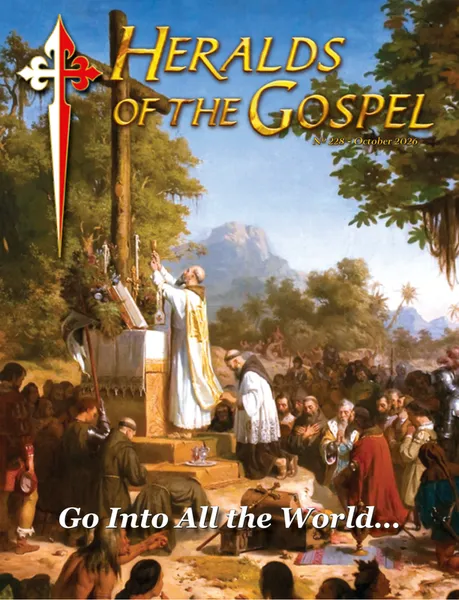
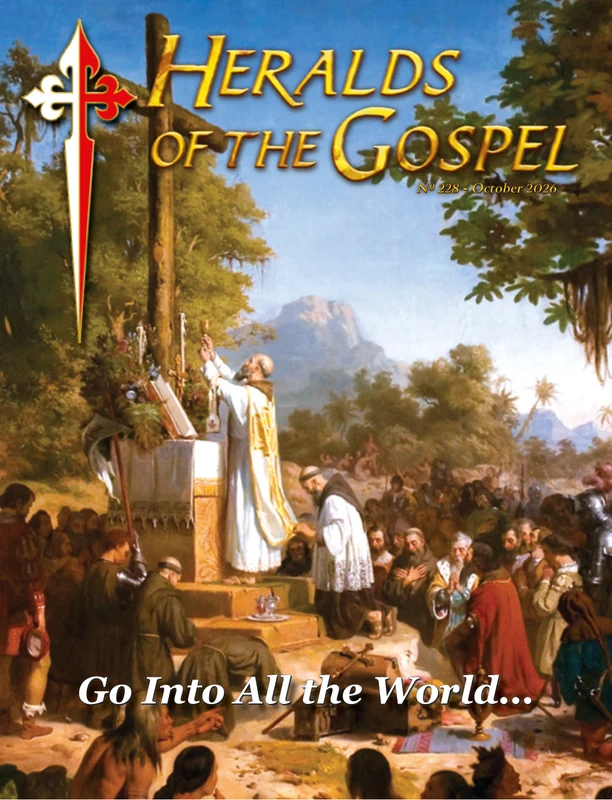
 Heralds of the Gospel Magazine, Vol. 20, nº 228, October 2026
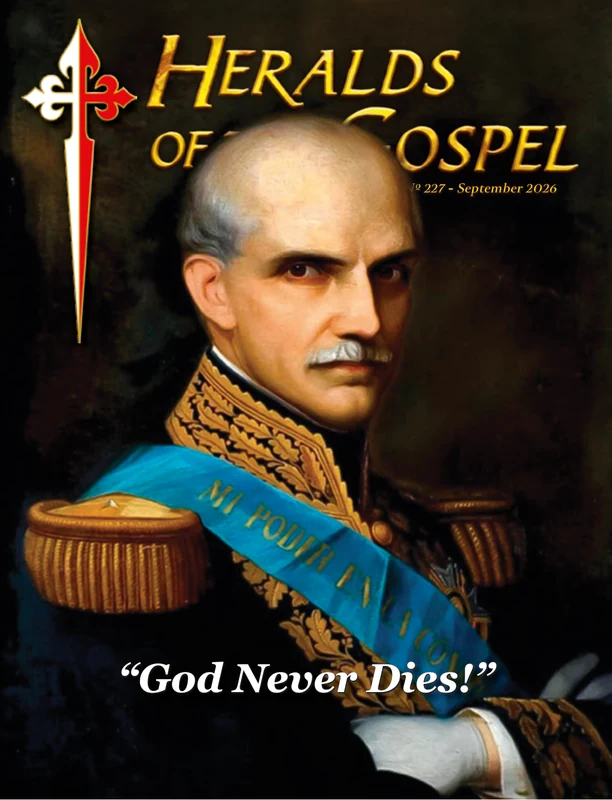 Heralds of the Gospel Magazine, Vol. 20, nº 227, September 2026
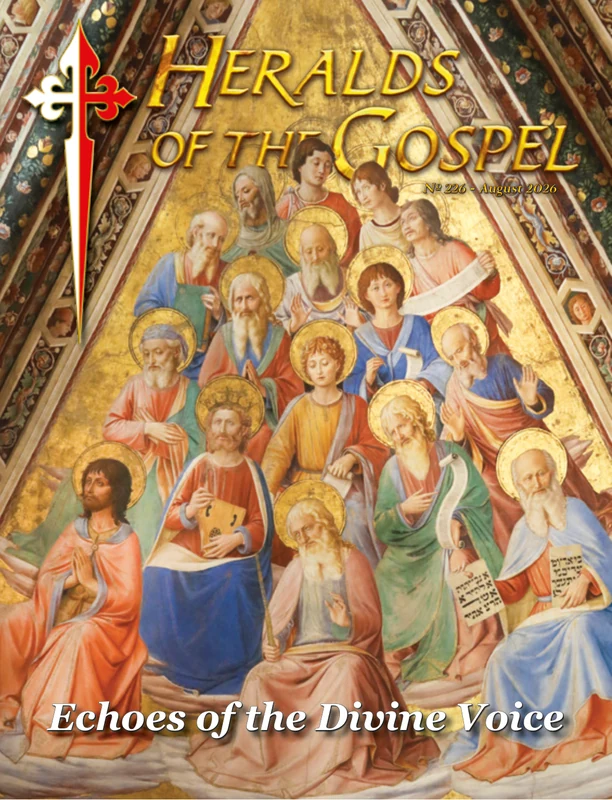 Heralds of the Gospel Magazine, Vol. 20, nº 226, August 2026
 Who are the Heralds of the Gospel?
 Help of Christians
 Christmas Carols







Traduttore, traditore – translator, traitor”: so jokes the Italian adage which, mixing irony and reality, has been confirmed so many times by facts and by book editions…
With good reason, the task of translation constitutes a moral challenge for many scholars; after all, it is not a simple matter of choosing words, but conveying concepts, a most valuable asset for those who know how to recognize their true meanings.
To translate does not mean to find a perfect match of dictionary definitions, but to preserve the homogeneity of the thought of the one who conceived it. This is the challenge, because “if there were perfect equivalence from language to language, the result would not be translation; it would be a replica. And if such replicas were possible on a regular basis, there would not be any languages, just one vast, blurred international jargon, a sort of late cancellation of the story of Babel.”1
The deeper, more complex, and nuanced the author’s thought, the greater the risks become for the traduttore… How, for example, can we glimpse the concerns that afflicted the wise men of Alexandria who translated the Old Testament from Hebrew into Greek? What about the responsibility that fell upon St. Jerome when he produced the so-called Vulgate in Latin, containing all the books of Sacred Scripture?
“For who has known the mind of the Lord” (Rom 11:34) to represent it faithfully? “Translating” the Holy Spirit is no easy task…
These dilemmas of rendering texts can help us to better understand the mission that Christ entrusted to His Church: to evangelize all peoples (cf. Mt 28:19-20), a responsibility incomparably higher than that of language interpreters.
And, while it is legitimate for us to resort to the phenomenon of translation to illustrate that of evangelization, it is well to consider that the Church’s mission consists in translating only one Word: the Eternal. He was pronounced by the Father from all eternity, as St. John recorded in the prologue of the fourth Gospel: “In the beginning was the Word, and the Word was with God, and the Word was God” (Jn 1:1).
Different cultures, but one same Church
Would it not be more perfect, though, if all men could learn of Him just as He is, without the resources of human language, which are always conditioned by times and contexts?
First of all, not everything that is most perfect is within the realm of our intellect, for the “vernacular” form of the Eternal Word is known only to the Father: “no one knows the Son except the Father” (Mt 11:27). We are incapable of understanding Him in Himself. Therein lies is the mystery of our Faith; and this is why we need a “translator” invested with this divine mission: the Church.
Furthermore, it pleased the Most High to make all things from nothing, based on the Word, for “He is the image of the invisible God, the First-born of all creation” (Col 1:15). Now, if everything that exists is modelled on Christ, creatures must reflect His perfections. And it was necessary, as St. Thomas Aquinas teaches,2 for multiple and varied beings to exist so that the divine likeness might be more perfectly manifested in them.
Now, if the diversity of irrational and inanimate beings is magnificent, man, the synthesis of the created universe, shines even more brightly. In the plurality of ethnicities and cultures, the infinite perfections of the Divine Craftsman shine with greater splendour. Different environments generate unique customs, behaviours, lifestyles, and ways of thinking, which form an immense and varied panoply of artistic and cultural expressions.
In short, all peoples are impelled by the Paraclete to “pronounce,” with their own customs and lights, the same Eternal Word that the Father sent into the world, restoring all things in Christ (cf. Eph 1:10).
This is the maternal mission of the Church: to welcome under her protective mantle all the peoples of the earth and to help them understand the Word of the Father and to pronounce it anew in their lives and works. The Catechism explains:
“‘The eternal Father, in accordance with the utterly gratuitous and mysterious design of His wisdom and goodness, created the whole universe and chose to raise up men to share in His own divine life,’ to which He calls all men in His Son. ‘The Father… determined to call together in a holy Church those who should believe in Christ.’”3
The only authorized interpreter of the Word
In the Divine Master’s mandate to the Apostles – “Go therefore and make disciples of all nations” (Mt 28:19a) – we find the divine principles that should govern the mission of the Church.
Before all else, we observe that the supernatural dynamism that motivates Christ’s disciples to the great adventure of evangelization also impels them to leave even their own origins to instruct those who have gone astray. This reveals the same method already applied by Jesus: transmitting the Faith through personal contact.
Considering this point, we recall the first steps of the Good News, as in the apostolate of the deacon St. Philip with the minister of Candace, Queen of Ethiopia. Her subject was reading the prophet Isaiah; he knew the words, but he could not grasp the message: “‘Do you understand what you are reading?’ And he said, ‘How can I, unless some one guides me?’ And he invited Philip to come up and sit with him” (Acts 8:30-31). To sit with and to explain… what a beautiful summary of the mission of evangelizing. Instruction alone is not enough for the Word of God to be understood and loved; it is necessary to develop a relationship, to draw near, and to teach by example the path that leads to Him.
But even this was not enough, for the aforementioned mandate of the Lord continues: “baptizing them in the name of the Father and of the Son and of the Holy Spirit” (Mt 28:19b). The effectiveness of evangelization depends eminently on the merits and grace of Our Lord, conferred, through the “stewards of the mysteries of God” (1 Cor 4:1), initially in the waters of Baptism, in which the soul receives divine life, but also in the reception of the Eucharist, in which the faithful partakes of Christ Himself, in Confirmation, in which he is strengthened by Him, and in the tribunal of Penance, where he is reconciled with God.
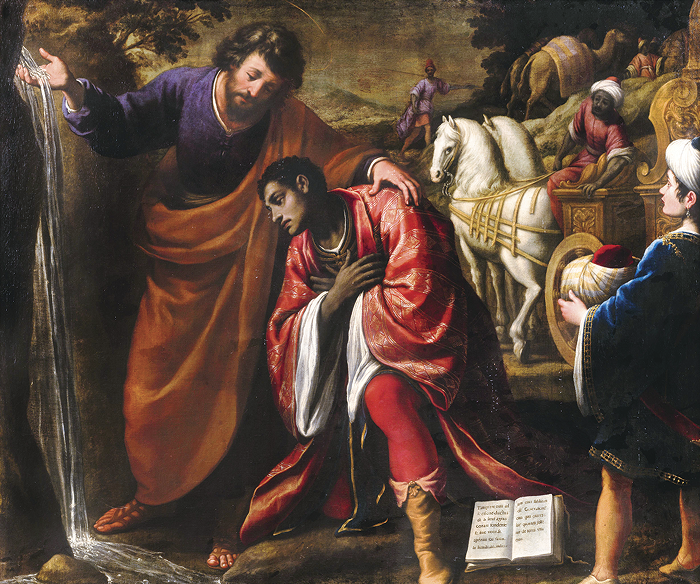
The goal of evangelization is conversion.
Our Redeemer further prescribes in the same passage: “teaching them to observe all that I have commanded you; and lo, I am with you always, to the close of the age” (Mt 28:20).
This passage reminds us that, to be worthy of the wonders of the Gospel, it is necessary to carefully observe the teachings received from Our Lord. It is through correspondence to grace and the Holy Trinity’s presence in the soul that the progressive, serious, and profound transformation of the Catholic takes place, which will be consummated in his full configuration with Christ.
Accordingly, accepting the Good News necessarily implies conversion, for Christ Himself summarized His mission by establishing the obligation of doing penance, converting, and believing in the Gospel (cf. Mk 1:15). Thus, after saving the adulterous woman from the evil intentions of the elders, Jesus told her: “go, and do not sin again” (Jn 8:11). He repeated a similar warning when he healed the paralytic by the pool of Bethesda: “See, you are well! Sin no more, that nothing worse befall you” (Jn 5:14).
Thus, the Second Vatican Council teaches that
“The Gospel of Christ constantly renews the life and culture of fallen man, it combats and removes the errors and evils resulting from the permanent allurement of sin. It never ceases to purify and elevate the morality of peoples. By riches coming from above, it makes fruitful, as it were from within, the spiritual qualities and traditions of every people of every age. It strengthens, perfects and restores them in Christ.”4
Evangelization and inculturation: synonyms or antonyms?
When we characterize the Church as Catholic, we affirm that She “is oriented towards the whole world, encompassing all times and addressing all cultures. Due to the universal nature of her mission, the Church must have the quality of adapting herself to different eras and cultural contexts.”5
In the last council, we also find the answer that guides the inculturation of the Church in the various nations. Far from adopting degrading customs unworthy of the Bride of Christ, she must insert herself into all peoples, impelled by the same movement that led the Eternal Word to subject Himself, in the Incarnation, to the social and cultural conditions of the men with whom He lived, in order to offer to all the mystery of salvation and true life.6
Far from being antonyms, evangelization and inculturation are phases of a the same grace granted to the people who have had the good fortune to receive the seed of the Gospel, to understand the Word of the Father, and to allow themselves to be penetrated by the life-giving light of the Holy Spirit, who works in the Church.
John Paul II explains the phenomenon of inculturation.
“In the face of all the different and at times contrasting cultures present in the various parts of the world, inculturation seeks to obey Christ’s command to preach the Gospel to all nations even unto the ends of the earth. Such obedience does not signify either syncretism or a simple adaptation of the announcement of the Gospel, but rather the fact that the Gospel penetrates the very life of cultures, becomes incarnate in them, overcoming those cultural elements that are incompatible with the Faith and Christian living, and raising their values to the mystery of salvation which comes from Christ.”7
When the message of the Gospel reaches the heart of peoples and cultures, it allows a new civilization to be born for Christ, based on a transformation of lives, of customs, and of mentalities.
In this sense, Pope Paul VI taught that “for the Church it is a question not only of preaching the Gospel in ever wider geographic areas or to ever greater numbers of people, but also of affecting and as it were upsetting, through the power of the Gospel, mankind’s criteria of judgement, determining values, points of interest, lines of thought, sources of inspiration and models of life, which are in contrast with the Word of God and the plan of salvation.”8
Pope Leo XIV corroborates this teaching when he affirms that “holiness is neither one option among many nor an abstract ideal, for it involves the very identity of every person who wishes to share in the life of the risen One.”9

When translation becomes treachery…
What discontent the Church, and Christ himself, feel when it can be perceived that activity labeled as evangelizing fails to “translate” the meaning of Revelation with purity!
Some examples of this regrettable fact can be found in the teachings of Dominus Iesus, which condemns the “relativistic attitudes toward truth itself, according to which what is true for some would not be true for others; […] the eclecticism of those who, in theological research, uncritically absorb ideas from a variety of philosophical and theological contexts without regard for consistency, systematic connection, or compatibility with Christian truth; finally, the tendency to read and to interpret Sacred Scripture outside the Tradition and Magisterium of the Church.”10
Now, if the mission of the Church is to evangelize, this is also the obligation of each of its members, especially those who hold the office of teaching, governing, and sanctifying.
To be another Christ through the laying on of hands means to be invested with the mission of being a “traduttore” of the Eternal Word, a task that makes the identification of the sacred minister with the merciful Heart of Jesus indispensable, as Pope Leo XIV exhorted in a recent message:
“The priest who has an upright, simple and pure heart can be contemplative in the midst of action, merciful and faithful in times of trial, and joyful in the gift of himself. The world greatly needs pastors who offer more than simply words or programs; it needs the living witness of a reconciled heart that exudes the sweet fragrance of Christ’s holiness.”11
Let us make these intentions of the Holy Father our own. After all, the world is already tired of “traditori”.
Notes:


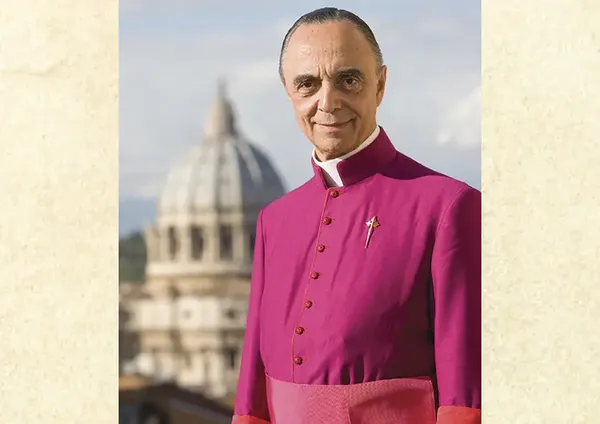
 Msgr. João Scognamiglio Clá Dias, EP
 Javier Antonio Vásquez
 Fr. Alex Barbosa de Brito, EP