 November 2026, No. 229
 October 2026, No. 228
 September 2026, No. 227
 Who are the Heralds of the Gospel?
 Help of Christians
 Christmas Carols







It is said that Rubens produced over two and a half thousand works1 – many of enormous proportions – addressing themes as complex as religious and historical subjects.
From this, it is deduced that this celebrated artist completed approximately one work per week, for fifty years without interruption. A prodigious feat, without a doubt, considering he lived only sixty-two years…
Yet, however fertile a man’s imagination may be, and however many years he lives to capture his impressions with pigments on canvases or panels, the magnitude of his creative output can never compare to that of the Supreme Artist, who surprises us each day with new wonders.
To illustrate this, one need only look out the window upon awakening. The majestic sun rises amidst clouds – now placid, now threatening; festive, pure white or sombre; or sometimes even suggesting mythical creatures – constantly evoking other realities and transforming by the second into unique moments that will never be repeated in history.
The infinitude of the divine work, reflected in a single aspect of creation such as the dawn, holds such richness that before this sublime spectacle, a soul thirsting for virtue can renew its strength each day and nourish the hope of eternity with Him who remains invariably the same, yet always distinct and surprising – inexhaustible and infinite.
Where does the truth lie?
A beautiful vista, however, can be viewed from various perspectives.
A scientist, for instance, referring to the clouds, would describe them as microscopic droplets suspended in the atmosphere, formed by the condensation of H2O. And we ask ourselves: is that all there is to it?
If, immediately after that definition, someone were to tell an innocent child that God builds magnificent crystal palaces every day for Angels to inhabit – and from which to gaze upon the sun – the little one, enchanted, would surely embrace the latter explanation with greater enthusiasm… Would he be deceived in doing so?
It is true that the scientist possesses more advanced technical knowledge, yet the child – incredible as it may seem – is closer to grasping the truth, which transcends the mere materiality of things in search of their higher causes.
Both contemplated reality, but the child took a sublime view of it.
The art of sublimating
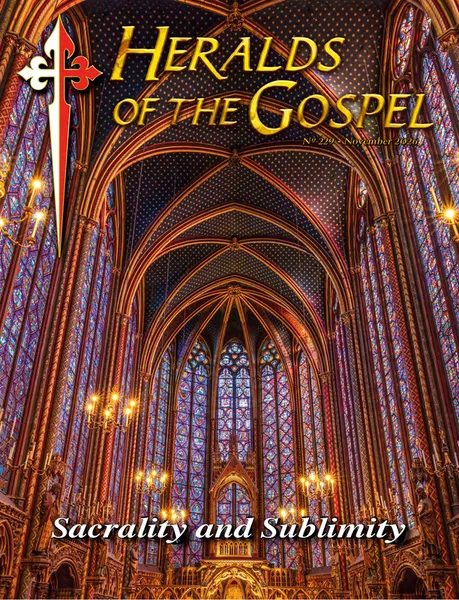
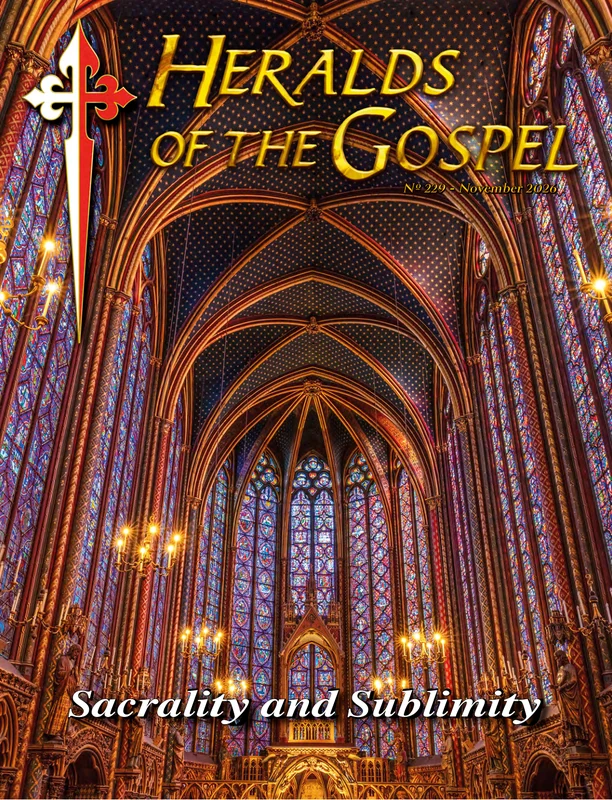
Dr. Plinio Corrêa de Oliveira2 explained that the sublime is a degree of beauty that bears no proportion to man, but rather to God. It is a kind of light that bathes reality, enabling us to discover its highest aspects – particularly those that lead us towards devout contemplation.
Thus, we can also understand the sublime as “the aspect of persons and things by which they most closely resemble God.”3 Indeed, the perception of sublimity – as a participation in divine wisdom – enables us to discern the beauty of all beings in the light of truth, regarding their original essence and ultimate purpose.
To “sublimate,” therefore, is to bring reality into greater conformity with the Creator, lifting it beyond a merely human scale to transcend towards the Absolute.
And since it is the divine design for man to complete the work of creation in the pursuit of perfection – with the aid of grace – the art of sublimating consists, ultimately, in fulfilling the First Commandment. It means engaging in a continuous movement of “theotropism” – a seeking of God – a supreme goal and mission that can only be attained when the temporal unites with the eternal.
One form of knowledge does not exclude the other
In an increasingly positivist world, choosing a sublime mentality – one that transcends the pragmatic view of reality – means swimming against the current in an epic battle and a true test of faith. For, in our society, this visualization appears to be “inaccurate.”
Human science alone, while offering us seemingly more precise knowledge of created things, leads us to a limited truth and to results that often change over time.
The sublime vision of things, by contrast, grants us knowledge that appears less exact but – grounded in faith – beholds the perfect, albeit in a mirror (cf. 1 Cor 13:12) and, guided by the Holy Spirit, becomes capable of penetrating the Absolute.
It is worth clarifying, however, that one form of knowledge does not exclude the other, for it is only when united that they reach their perfection.
Indeed, we can observe time and again across various branches of human knowledge – including the most modern ones – that the more truly precise our scientific knowledge proves to be, the more powerful become the springboards propelling the anagogical interpretation of reality.
The hope of our world
It is in the rapturous contemplation of creation – through which we rise to the supernatural – that we will find the solution to the crisis threatening to dehumanize humanity, severing it from its origin and abolishing its very purpose by depriving it of the sublime faculty of sublimation.
We have no grounds for justification, for if we perish, it will be for want of wonder, not for any want of wonders.4 We must relearn how to contemplate not only our material surroundings but also, and especially, the supernatural – which transcends us and to which we must always turn with a spirit of humility, admiration, and loving prayer.
A lack of attraction to the sublime is the clearest sign of the urgent need to seek virtue, for “holiness is the only full form of sublimity, upon which all other forms of sublimity rest.”5
Are the magnetic allure of screens – captivating our attention with torrents of narcissistic and superfluous information – along with hyper-connectivity, breakneck speeds, and the constant stimuli to which we submit ourselves – in short, our increasingly artificial, egocentric, and less reflective or contemplative modus vivendi – responsible for this decline? It is a complex question, one that would require a far more comprehensive study to answer.
What is certain is that every act born of contemplation – and, even more so, one imbued with sacrality and performed out of charity – contributes to building up the city where God and humanity dwell together. This stands in contrast to the “new Tower of Babel,”6 which prioritizes hedonistic practicality over the splendour of truth – that is, beauty.
Let us, then, ask the Most Holy Virgin, Mother of all sublimities, to help us always rise towards what is most sublime – and therefore to fly towards her, whose throne is set upon the clouds (cf. Sir 24:4).