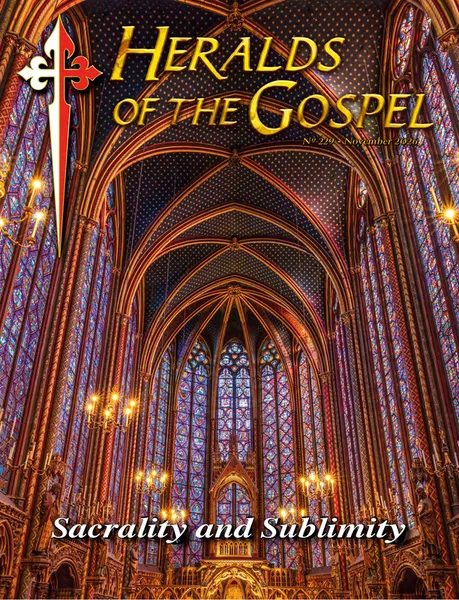
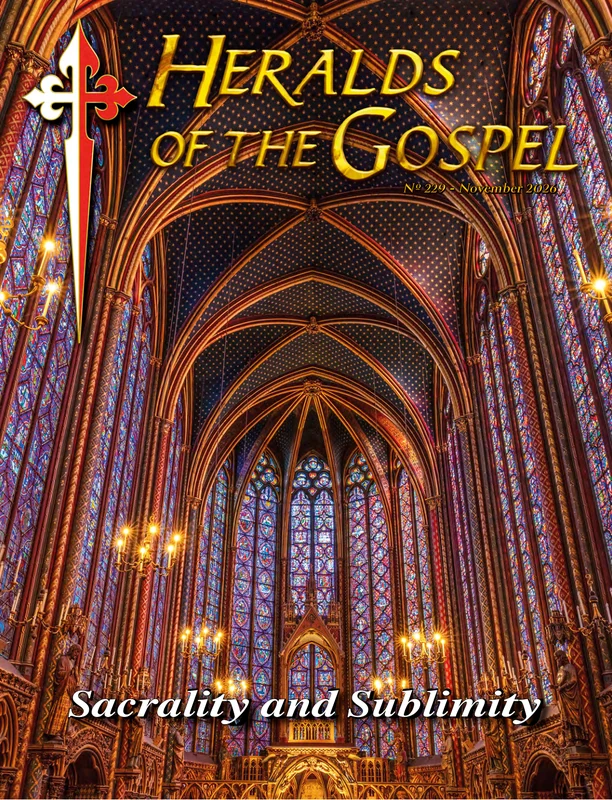
 November 2026, No. 229
 October 2026, No. 228
 September 2026, No. 227
 Who are the Heralds of the Gospel?
 Help of Christians
 Christmas Carols








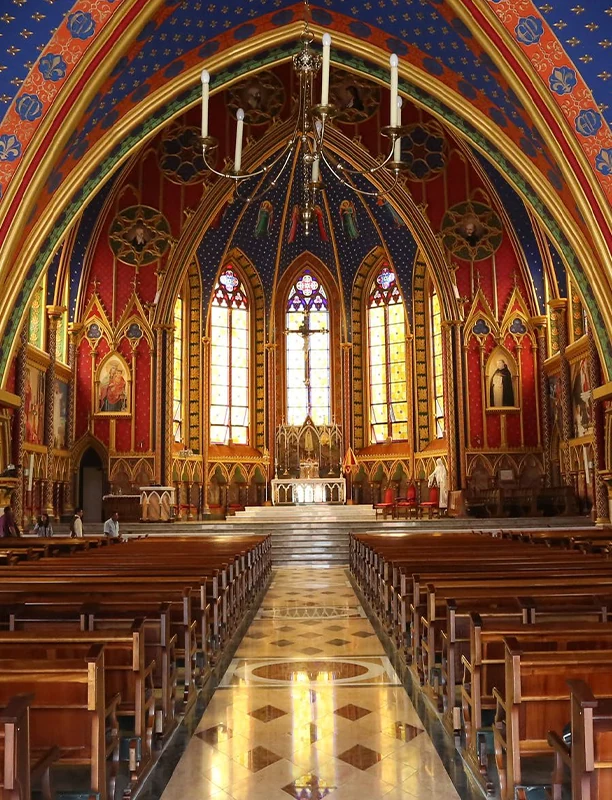
Looking at the photos illustrating these pages, we are immediately struck by a sense of exuberant, almost excessive magnificence. One might even say we are contemplating a civil war of colours!
Blue has scaled the ceiling and claimed dominion over it, yet polychrome ribs and golden stars rise up in rebellion, piercing it with numerous breaches. Further along, the colour of the sky retreats before the gold of massive medallions depicting sacred figures.
On the walls, the columns refuse to settle for a single hue, daringly blending indigo and red. Meanwhile, the frescoes – spanning from side to side, top to bottom – vie for every square metre, seemingly locked in a contest to see which one will come out as the most vibrant.
They avoid eclipsing each other only because they are all the work of Giotto, one of history’s greatest artists. Restless colours spill beyond the stonework to invade the windows: the stained glass, which both rivals and accentuates the splendour of the walls.
All this colourful clamour would, in fact, turn into a civil war were it not for the width of the nave and the height of the ogives, which create a clearing spacious enough to accommodate, in fraternal harmony, such profuse colour and beauty.
* * *
All this splendour reveals a truth to us: those who built this church sought to erect a stepping-stone to Heaven.
But… what about the poor? Would it not be better to strip the gold from the building and transform it into provisions for the needy? Why not turn those stones into bread for the hungry?
To the tempter who made Him a similar proposal, Our Lord Jesus Christ replied that “Man shall not live by bread alone, but by every word that proceeds from the mouth of God” (Mt 4:4). And proceeding from the mouth of God is not only the Revelation inscribed in the Bible, but also that which is embodied in created things.
Indeed, creation is a book that speaks of its Maker, and creatures are so many words of the Almighty. However mute they may seem to be, they “are telling the glory of God” (Ps 18:2).
That is why St. Francis of Assisi invited the material universe to honour the Invisible One: “Praised be You, my Lord, with all Your creatures, especially Brother Sun, who […] bears the likeness of You, Most High.”1
And since creation is thus a compendium of metaphors for God, the Poverello instructed his mendicant sons to build churches and adorn worship just as the Eternal One created the universe: beautifully, magnificently, and boundlessly.
The sacred space was to become a mirror of Uncreated Beauty and a fitting tabernacle for the Eucharist: “If anywhere,” wrote the Saint of Assisi, “the Most Holy Body of the Lord is kept in a very poor manner, contrary to the prescriptions of the Church, let it be placed by them in a prominent, precious place, carried with great veneration.”2 Therefore, “chalices, corporals, altar ornaments, and everything pertaining to the Sacrifice must be precious.”3
In short, he taught them to imitate the model already established by God – the Heavenly Jerusalem – whose splendour was compared to “a most rare jewel, like a jasper, clear as crystal” (Rv 21:11).
Honour and credit go to the Franciscans who heeded their father and erected this temple! They spared themselves the effort – the foolish effort, one might add – of giving the impoverished the one thing they do not need: a wretched ambience. They already have that at home…
On the contrary, they built a splendid church for the poor.
* * *
Yes, for the poor! First and foremost, for the man who became the personification of poverty – St. Francis – whose body rests in his home, here in this Basilica in Assisi. And beside him, there is room for all the rest.
For the church is the palace of the King of kings, open alike to the noblest prince and the poorest pauper. It welcomes all the faithful, great and small. But – we insist – it is a palace, for it is a space designed to express something of Heaven, serving as a privileged place to encounter God.