 November 2026, No. 229
 October 2026, No. 228
 September 2026, No. 227
 Who are the Heralds of the Gospel?
 Help of Christians
 Christmas Carols







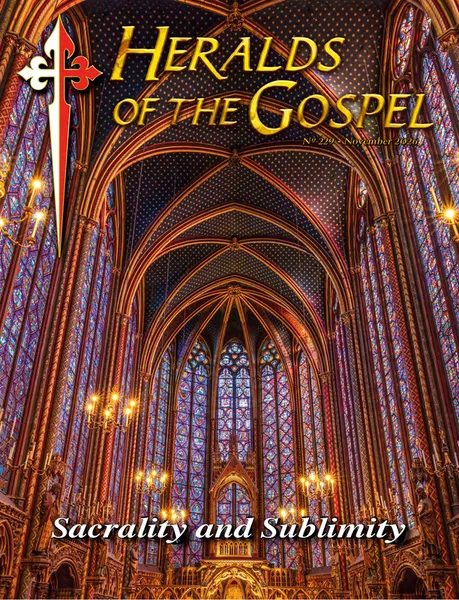
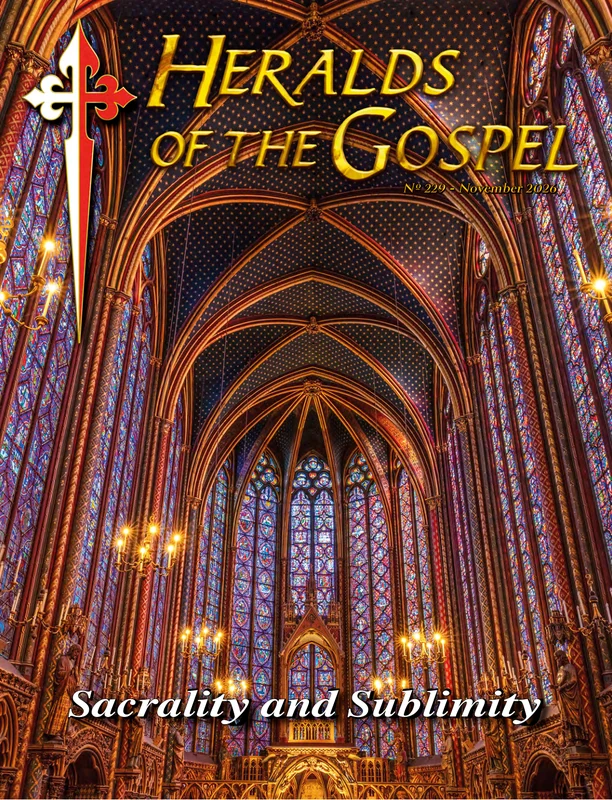
Why is it that, when we think of Christendom, we can find common elements in the towers of a cathedral, the traditional attire of a people, or heraldic symbols? Is there a certain confluence between the Benedictine habit, the practice of courtesy, and the refined cuisine of a civilization?
How can we define that sort of aura which permeated Catholic society – an aura that remains, to this day, both the glory of Europe and the object of nostalgic longing for it? What is its name?
Dr. Plinio Corrêa de Oliveira called it sacrality.1
Reminiscences of the divine
For Dr. Plinio, “the sacral is anything that possesses special qualities capable of recalling the supreme attributes of God.”2
It is not difficult to find these reminiscences of the divine around us. The Creator made the task easier for us by leaving behind a world filled with His “fingerprints.” Who does not glimpse the immensity of God in the vastness of the oceans?
Who does not encounter the strength of the Almighty in the lion, and the everlasting nature of the Eternal in towering mountains? How can one fail to discover the Invisible One in the radiant light of the sun?
The man with a sacral spirit knows how to ascend these metaphors of the Most High and find Him above them. Moreover, he imitates the Almighty by building a world that aims to reflect divine perfections.
Thus, in that Christendom evoked earlier, the tolling of bells resonated as an echo of the divine voice, rather than merely serving as a signal to gather for assemblies.
A king shone as a ruler, yet was much more than that: he was a kind of constable for the Lord of Hosts. A fine delicacy served as nourishment for the spirit even more than for the body.
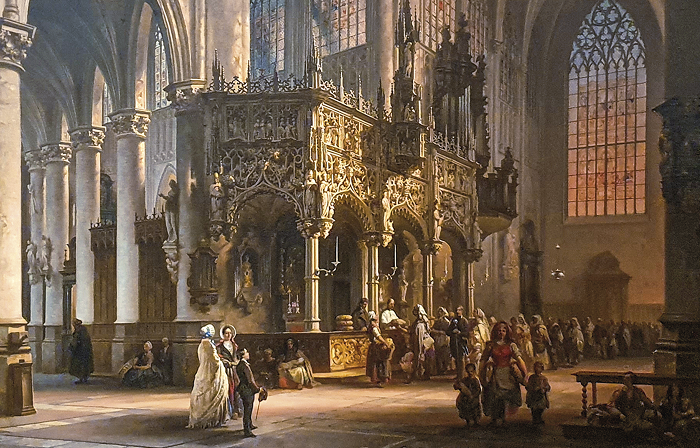
The crowns clearly proclaimed their highest mission, namely, to uphold the cross of Christ. And the naves of the Gothic church rendered expressions of sacrality in stone: their arches and ribs came together to point towards Heaven.
Marvellous, too, were the ceremonies that accompanied every sphere of human activity. The buying and selling of land was conducted with solemnity – and even pomp.
Even the imposition of prison sentences was carried out with ceremony, and the knighting of a warrior followed a rite rich in symbolism. What, then, of weddings, the acclamation of kings, and papal enthronements?
All this pageantry was intended to highlight the grandeur of the act being performed, underscoring to the onlookers that it was taking place in the presence of God.
The two wings of enthusiasm
The brief sketch outlined here so far may seem, to some, a bit ethereal… How, then, to characterize a person filled with this sacral spirit – what distinguishing mark sets him apart?
For Dr. Plinio, that mark is enthusiasm: a kind of transport of admiration and love in view of the hierarchy of the created order and its magnificence.
Now, hierarchy implies superiorities and, consequently, inferiorities… Well, a soul pervaded by enthusiasm overflows with veneration when contemplating what is superior to it; yet, when it lovingly stoops toward what is similar or inferior, it unfolds in tenderness.
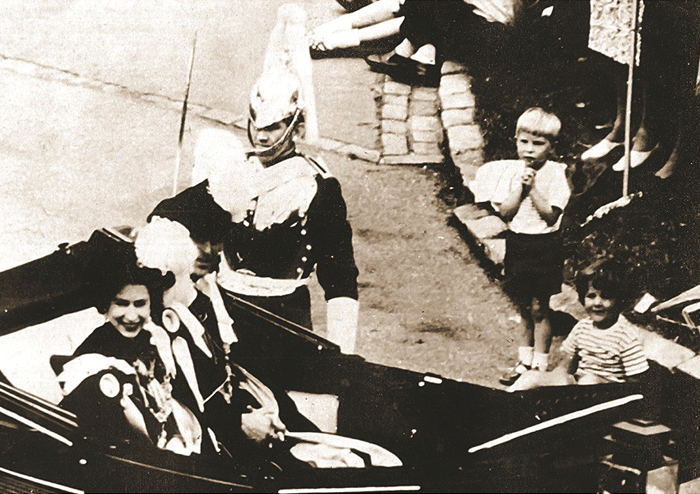
Let us illustrate this with a photograph from the last century. The image shows Queen Elizabeth II in a carriage, smiling at her subjects. One detail, however, catches the eye: a little boy gazing – rapt and almost in an attitude of prayer – at the passing of the English sovereign.
The scene captivated Dr. Plinio. A beautiful image of a soul filled with sacral veneration, that “golden boy” – as he called him – “came to see that there is something in life that vastly transcends the immediate surroundings, the vulgarity of everyday existence, […] it is a manifestation of the highest metaphysical values, expressed in the pomp of royalty.”3
That boy, an image of unpretentious enthusiasm, was “capable of being utterly enchanted by the greatness of something other than himself.” 4
Such are sacral souls: they know how to love both the sublimity of their superiors and their own smallness. In the presence of what transcends them, they give thanks for being lower and for the joy of being able to admire.
They live on the joy of veneration – a sentiment that led St. Thérèse of the Child Jesus to exclaim, in a burst of enthusiasm: “O Mary, if I were the Queen of Heaven and You were Thérèse, I would want to be Thérèse, so that You might be the Queen of Heaven.”5
Conversely, superiors feel tenderness toward those beneath them and lavish care upon them as if they were their own children. A classic example of this tenderness can be found in countless episodes from the Ancien Régime – an era decadent in many respects, yet still strongly influenced by the Church and, as a result, imbued with a sacral spirit.
The renowned historian Lenotre6 recounts an incident that took place at Versailles. An expectant lady, having travelled from afar and grown exhausted from walking, was looking for a place on the terrace to rest.
The young man accompanying her, spotting a stone bench where two distinguished ladies were conversing, hastened to secure a spot there. Moments later, however, he discovered he was in the presence of the King’s wife, Marie Antoinette!
Flustered, the visitor tried to apologize for his presumption but was immediately interrupted by a kind gesture from the queen; she insisted that his companion take a seat, but not before ordering a footman to bring a cushion, which she herself arranged on the bench, saying: “This marble is too cold for you right now, Madame; your condition requires the utmost care.”
A symphony of admirations
Thus, another aspect of the sacred relationship emerges: the reciprocity of admiration. Superiors respect and honour their subordinates, just as they are respected and honoured by them.
As St. Thomas Aquinas teaches us,7 every person possesses unique qualities that make him, in some respect, worthy of admiration. Our Lord left us the supreme example of this; though He was the God-Man, He also admired the centurion’s faith and the innocence of little children (cf. Lk 7:9; Mk 10:14).
This symphony of admiration – the ascending and descending stairs of human relationships – is also readily perceived when crossing the threshold of a home where God’s Law is observed.
A good mother marvels at the innocence of her little ones, just as they, in turn, discern the first image of the Creator in the matriarch’s kindly smile.
An upright father, in whom virtues such as purity and honesty shine, will be a source of delight to his children, just as they will bring him joy with their candour and rectitude.
Enthusiasm ascends Calvary
Enthusiasm, veneration, and tenderness naturally unfold into acts of service and obedience; when carried to their ultimate consequences, these constitute a true holocaust of love – the final and most precious fruit of the sacral spirit.
Indeed, sincerity of heart is proven in suffering. The love of one unwilling to sacrifice oneself is a parody, hypocrisy, or perhaps mere sentimentality.
Souls that ascend Calvary for the sake of an ideal spread the flames of their enthusiasm to the rest of the world This explains why the dawn of the Church was stained with the blood of martyrs.
“How was it possible,” Dr. Plinio asked, commenting on the martyrdoms of early Christianity, “for a lion to pounce upon a young woman or a young man – tearing those creatures full of life to shreds – and for an onlooker to say, ‘I shall do the same’?
How could this happen without enthusiasm, veneration, and tenderness?” And he concluded: “The driving force behind the expansion of Christianity was an immense conflagration of sacrality at the very heart of the Roman Empire.”8
The sacred, the profane and sacrality
Sacrality, however, is not limited to the realm of social relations. It must extend its beneficial influence over every aspect of life, whether in the spiritual or the temporal order.
It is easier for us to understand the presence of sacred objects in the religious sphere. Majestic churches, golden chalices, fine linen vestments… although in certain circles these are regarded as superfluous luxuries, such pomp and ceremony are an inseparable part of the Church’s practices.
It is more difficult, however, to conceive of these realities permeating everyday life in their own way. How, then, are we to understand the use of the best tableware, beautiful decorative objects, elegant furniture, and, especially, refined manners in the twenty-first century?
Shaped by so many utilitarian views of human life, all of this strikes us as waste, vanity, and affectation. Yet this is far from being the truth.
A platform for the flight of the soul
Dr. Plinio9 pointed out that the arts and ambiences possess a special quality for vividly influencing mentalities, leading families and entire peoples to adopt certain states of mind – whether good or bad.
If the sensory stimulus of the colour red, as psychological studies attest, can stir up certain passions; if the serene rhythm of ocean waves favours reflection; and if a dirty, neglected street fosters crime, then it is clear that material elements can influence the body as well as the soul, inextricably united to it.
Thus, the sacralization of earthly realities prepares a springboard for the soul to soar toward God. Music, cuisine, architecture, painting, and clothing become supports for the practice of virtue. This what it means to preach “the Gospel to the whole creation” (Mk 16:15) – even the inanimate parts.
In this way, sacrality extends its influence to the most ordinary actions. It is what turns the home into a sanctuary and offers man a standard of conduct, helping him, even in the privacy of his own life, not to forget that he is a child of God.
For what good will it do us to admire a beautiful church while leaving our own home in disorder? And with what disposition would we receive the Son of God in Holy Communion if we were to subsequently scandalize our children with vulgar gestures and words?
What use, ultimately, is it to converse reverently with the Lord in prayer, only to speak of base matters when among friends?
To be one and the same before God and men: this is the ideal of sacrality.
Steering the helm of history
And what is the result when someone strives to live in this way? Holiness – for, as Dr. Plinio explains, this “is the state of soul in which a person has infused sacrality into all things,”10 including – and above all – within himself.
Persons captivated by sacrality and borne by holy enthusiasm to the point of sacrifice are the true driving force of history. What moves it is not mere theory, but orthodoxy that is lived out and, as it were, embodied.
When, however, humanity drifts away from this spirit, crises erupt: individuals withdraw into themselves, social interaction turns into a hollow contest for prestige, ceremony loses its savour and its reason for being, and existence sinks into emptiness.
Yet there is a ladder by which to return to the light. Thus did Isaiah prophesy regarding the Messiah:
“For to us a Child is born, to us a Son is given; and the government will be upon His shoulder” (9:5).
What did Jesus Christ bear “upon His shoulder”?
The Cross – the final fruit of sacrality; the Cross – the helm of history which, resting upon our own shoulders, will guide us unscathed through the dark sea of our times.