 November 2026, No. 229
 October 2026, No. 228
 September 2026, No. 227
 Who are the Heralds of the Gospel?
 Help of Christians
 Christmas Carols









Throughout history, man has sought in many ways to represent the nature of his surroundings through art, transcending mere reality and enriching it – whether through splendour, proportion, or colour – with something of his own perception and desire for the marvellous.
This tendency to elevate earthly realities took on different nuances after man lost, through sin, the Paradise of delights and incomparable beauty he had received from God – a place for which he harbours a deep longing.
In this land of suffering, he feels like a dethroned king, a prince exiled from his true homeland, and in this painful situation, he will either seek to recuperate something of Eden’s sublimity or mar and destroy what remains to him, surrendering to disordered passions and degrading himself in an act of rebellion akin to that of Lucifer.
In seeking the paradisiacal aspects of things, the human soul ultimately searches for divine perfection – albeit gropingly – and in this act of praise, it fulfils the purpose for which it was created.
Moreover, through art, we poor exiles possess an assurance that the Lord is and will remain with us until the end of time (cf. Mt 28:20) and that, after this life, we may attain perfect happiness in the Kingdom of Heaven: the Paradise of God’s children – incomparably superior to the Earthly Paradise.
For these and other reasons, the Holy Church has throughout the ages been the teacher, promoter, and guardian of all that is marvellous in the world; under her care, the most diverse artistic expressions have flourished to a superlative degree.
Let us, then, with a spirit of prayer, admire in these pages the works of the painter Claude Gellée – better known as Claude Lorrain – a luminous example (in the full sense of the word, as will be seen) of man’s attempt to elevate earthly realities.
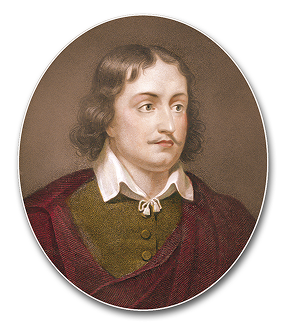
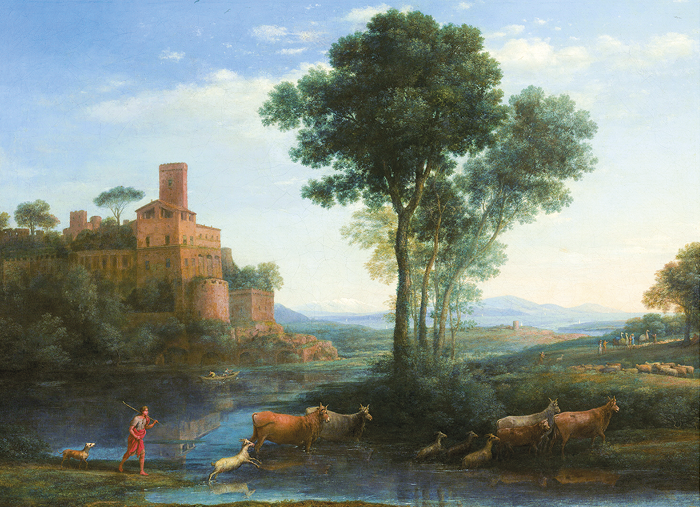
above, “Rural landscape” -
Art Institute of Minneapolis (Minnesota)
The painter of the sun
Among the countless artists of the 17th century – some of whom remain anonymous – Claude Lorrain stands out for the beauty and meticulous craftsmanship of his works.
Hailing from Lorraine in eastern France, he – like so many others – advanced his artistic skills by apprenticing with renowned masters of Italian painting.
After settling in Rome, he drew inspiration from the trends flourishing at the time – tendancies that were, unfortunately, almost universally characterized by moral laxity.
Nevertheless, within his own studio, Claude bequeathed to posterity a kaleidoscope of concepts regarding nature and, above all, an admirable and unique depiction of the effects of sunlight on landscapes, buildings, ruins, and figures.
Commenting on his works, Dr. Plinio Corrêa de Oliveira observes:
“His style is diaphanous and enchanting, revealing a unique ability to reproduce on canvas that element without which – in the words of a French poet – things would be nothing more than what they are: sunlight. Lorrain is the painter of the sun.”1
On another occasion, he noted:
“The best of Lorrain lies in the fact that he paints everything in a land envisioned as an earthly paradise. In other words, the light emanating from his palette lends a paradisiacal quality to the world and to earthly life; from this perspective, it awakens in man a certain longing for an order of things that transcends the tangible, temporal reality we encounter every day. Indeed, just as Fra Angelico knew how to imbue the faces of his figures with a sense of the supernatural, so too did Claude Lorrain convey something celestial in his works.”2
Life in its ideal splendour
Indeed, the way this painter pours warm sunlight – in countless hues – over every detail his imagination has placed upon the canvas is remarkable.
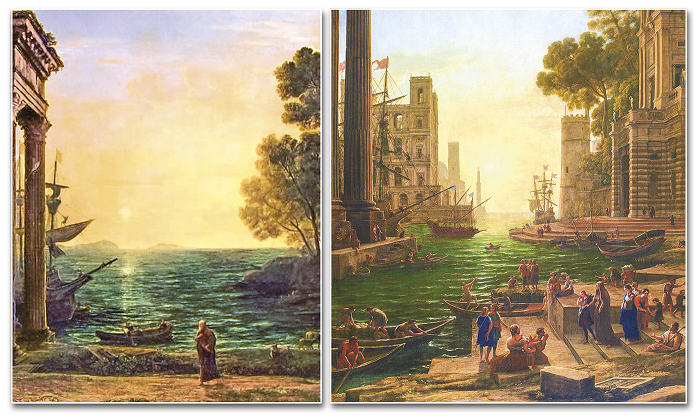
This is evident, for instance, in The Embarkation of St. Paula. Gilded mansions bathed in the rays of the setting sun, ships ready to weigh anchor as soon as all are aboard, the gentle, slender figure of the Saint with her entourage, and the liveliness of devotees imploring her for a favour or alms… Everything converges into a profound and serene contemplation of life and what it would be like in its ideal splendour.
With true creative genius – like a brilliant musician capable of composing the various melodies of a symphony through counterpoint, progression, and modulation – Lorrain’s paintings exude a harmonious blend of figures and motifs, comparable to the verses of a poem.
“Claude Gellée painted the serene beauty of the Latin countryside and the play of light upon harbour waters. In such carefully ordered compositions […], he managed, through simple colour gradations, to evoke the poetry of nature and the infinity of space. Claude Gellée was a man of intuition and a poet.”3
Gravity, exuberance, and peace
Some of his works convey a certain melancholy. In Seascape with Ezekiel Crying on the Ruins of Tyre, for instance, we see the glow of twilight – in vivid gold – casting a shaft of light across the sombre, dark turquoise sea; this highlights the poignant scene of the prophet lamenting the ruins of a cursed city, upon which the sun sheds its rays like a swan song.
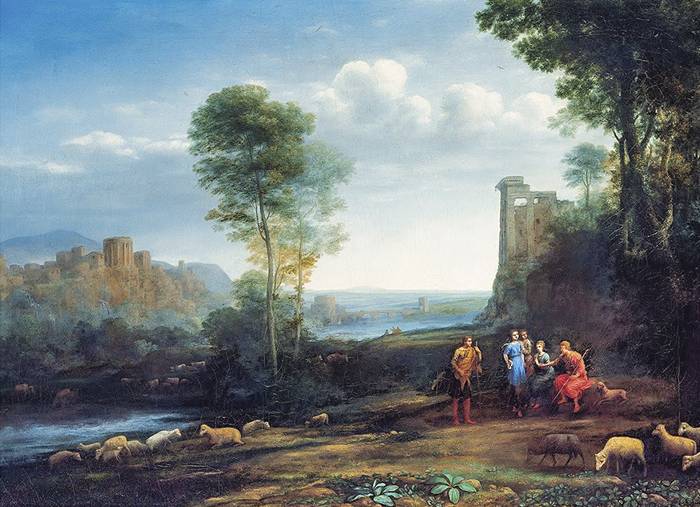
In rural scenes, such as Landscape with the Voyage of Jacob or Pastoral Landscape, one observes the lively, bounding energy of the goats and oxen led by Jacob, alongside the serene grazing of sheep tended by expressive, solemn shepherds. In the latter painting, the animals’ tranquillity stems from the simple presence of their keepers, who provide the assurance that no harm will befall them while under their watchful gaze. It is the perfect representation of the verse: “The Lord is my Shepherd, I shall not want” (Ps 23:1).
May the Holy Spirit inspire new talents!
There is something that encapsulates the almost exclusive allure of Claude Lorrain’s landscapes – a mythical, surreal, and wondrous quality, as Dr. Plinio describes: his works “envelop one in a certain degree of ‘dream.’ For all those historical reminiscences hinted at a dream more beautiful than the scenes themselves.
And that is the very essence of art. It was necessary, therefore, to know how to dream a little about all this in order to penetrate to the heart of reality.
A dream is not necessarily an escape from reality; rather, depending on the case, it is a way of delving more deeply into it. […] In this regard, the element of the dream was brilliantly illustrated by Claude Lorrain.”4
For these “dreams” on canvas – the works of the French painter, which are among the thousands of fruits of the Creator’s inexhaustible love for humanity – let us give thanks to the Holy Spirit through the intercession of Our Lady, and ask Him to inspire new talents who will enrich the panoply of the fine arts: reflections and mirrors of the Infinite God!