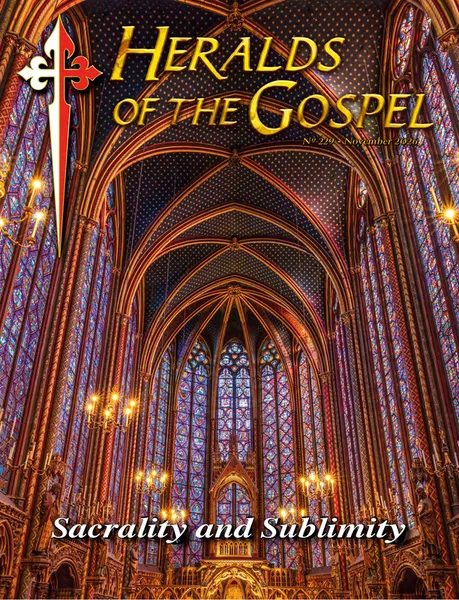
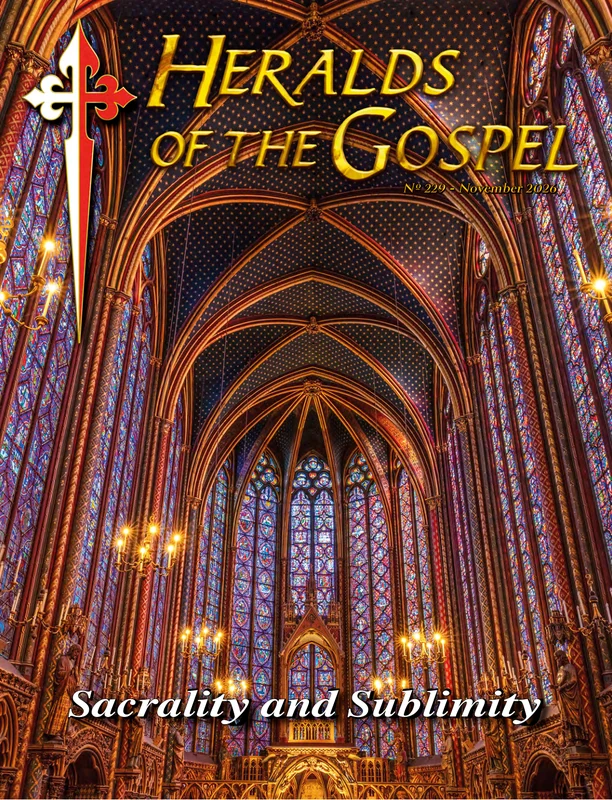
 November 2026, No. 229
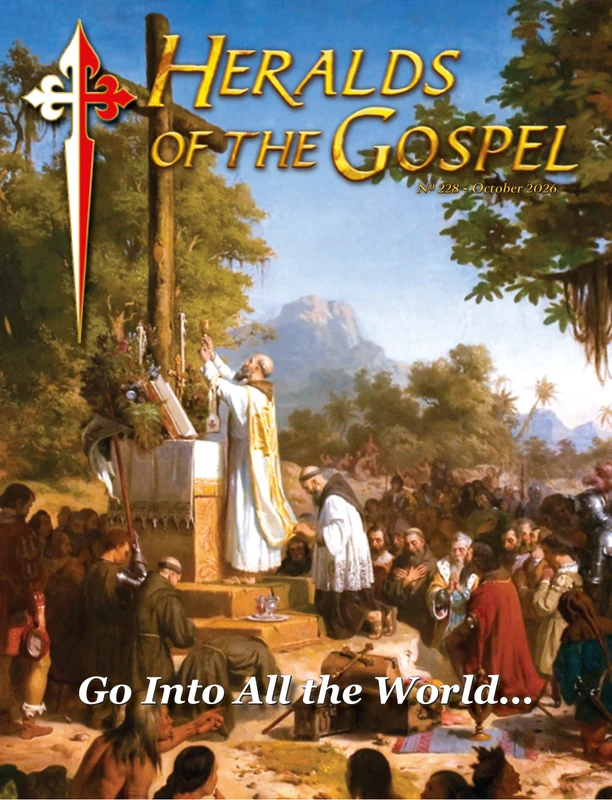 October 2026, No. 228
 September 2026, No. 227
 Who are the Heralds of the Gospel?
 Help of Christians
 Christmas Carols







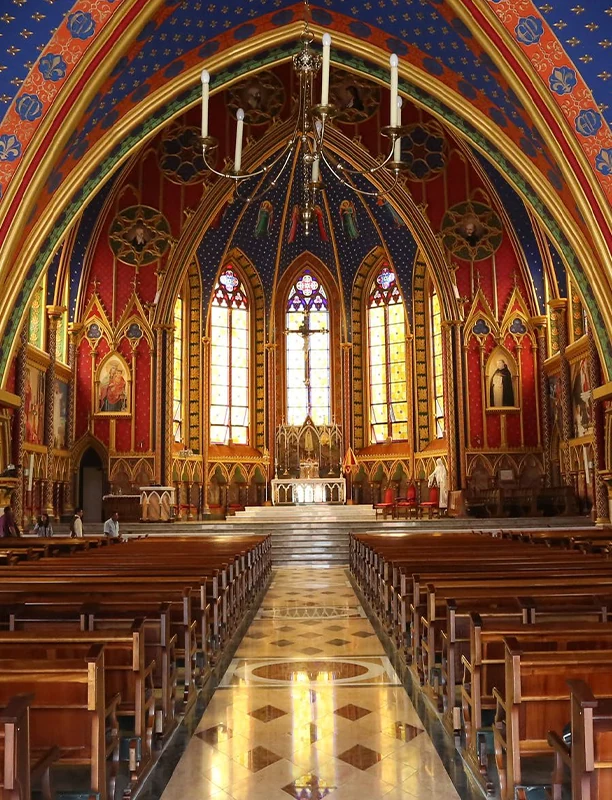
Tourists in a medieval cathedral. The scene aptly represents the paradox in which Western man lives. A child of progress, he cannot detach himself from tradition. He would never build a Gothic-style home for himself.
He lives in the present and plans for the future, yet he takes his vacations in the past. The cathedral – like so many other ancient monuments – dazzles, captivates, and fascinates him; yet it fails to convince him that it was erected in a real world by real men of flesh and blood – those medieval people who did not merely spend their leisure moments visiting monuments, but lived in them.
Our tourists, however, do not pause for such reflections. They are too pressed for time. They content themselves with a few fleeting photographs – captured on ephemeral smartphones – of that eternal masterpiece.
For their days off will soon end, and there they will be, leaving behind this dream of stone to return to a reality of concrete. Until the next vacation, when they already plan to visit other beautiful monuments – ruins of Christendom.
Christendom. The mere sound of the word evokes happy times, an age of light rather than darkness, when “States were governed by the philosophy of the Gospel.”1
Indeed, the spirit of the Catholic Church was once the very lifeblood of civilization. Medieval Christendom blossomed magnificently, standing as one of the finest fruits produced by the Mystical Spouse of Christ.
Today, we live on the memory of it. Its ruins awaken an inexplicable nostalgia that draws thousands of visitors every year.
Above all, the cross reigned
When did Christian Civilization come into being? It would be futile to attempt to establish a precise date. Some might say it emerged when Clovis was born to grace, or with the promulgation of the Edict of Milan, which granted freedom to the Christian faith.
In truth, its baptism was that of the blood and water flowing from the open side of the Saviour hanging upon the Cross, and the edict that gave rise to it was the Word of Truth Himself, who “became flesh and dwelt among us” (Jn 1:14).
Although the Church – and her Divine Founder – already held within herself, like a vigorous shoot, the entirety of that civilization in all its splendour, centuries were required for that flower to bloom and spread its perfume over all the earth.
At the dawn of the ninth century, on a cold night that vividly recalled the one when the Eternal Light came into the world, the foundations for the formation of Europe were laid.2
When Charlemagne – known as Pater Europæ3 – received the crown from the hands of the Supreme Pontiff, the union between the spiritual and temporal power shone forth as never before. The orb was represented in the emperor’s diadem: above all, the cross reigned.
Such was the most august meaning of Christendom: to give substance to the teachings of the Incarnate Word, to translate truth into ways of life, and to give visible form to the intangible beauty of the supernatural world, that gold, silver, crystal, and stone be shaped by the teachings of the Gospel. And so that man, made of clay, upon beholding them, might become ever more God’s image.
Using matter to praise the Creator
It would be a mistake to think that the spirit of the Church rests upon pure asceticism or the denial of the material. Although it preaches mortification as a path to virtue, the Church has never condemned matter itself – such a denial belongs to pagan and Gnostic heresies.
Indeed, on the sixth day of creation “God saw everything that He had made, and behold, it was very good” (Gn 1:31), and the Church holds that sensory knowledge can offer elements for our benefit. Admiration for the marvels of creation is a gift from the Most High and should be used to glorify Him.
In this sense, Christendom is eminently realist – and real comes from the Latin res, meaning “thing” – such that, employing techniques that still astonish modern engineering, it erected towers over a hundred metres high.
Medieval people did not aim, as contemporaries do, merely to scrape the sky; they sought to transcend the limits of the celestial vault to touch the throne of God.
This realism aimed to turn earth into an antechamber of the Heavenly Palace: not content with merely contemplating sunlight, it devised the stained glass we know today. Walls were transformed into crystal, and light was perceived through the colours of Paradise.
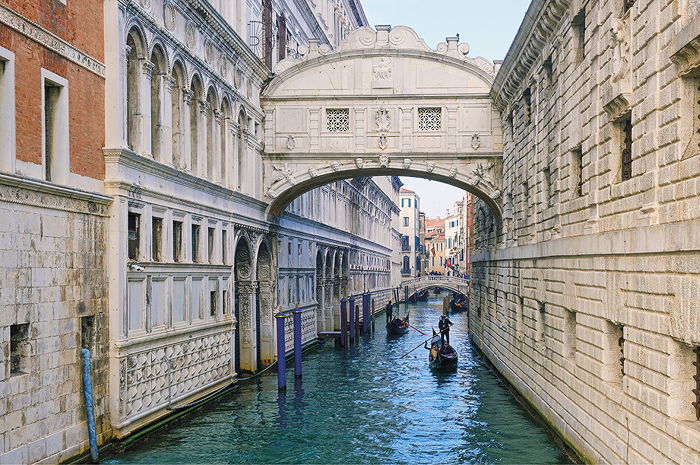
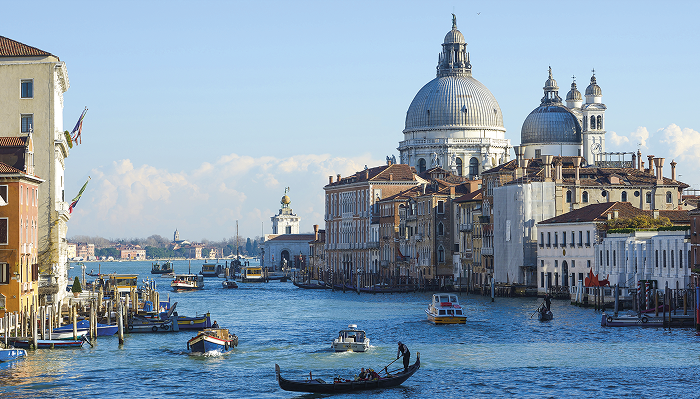
This same realism saw in the sea the perfect pavement for the streets of a fabled city. Thus, Venice was born. And this realism, applied in this way, can be given a specific name: sacrality.4
Even after the luminous era of the Middle Ages had passed, Christian Civilization – already in decline from many perspectives – continued to bear fruit beyond all expectation.
In its death throes, it revealed splendours hitherto unknown to man, like a dying swan that, at the very limit of its existence, intones its most beautiful song.
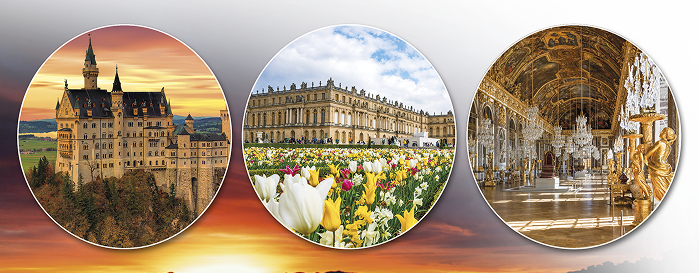
Thus, Christendom would go on to produce the Palace of Versailles – with its magnificent halls and galleries, its perfectly symmetrical gardens, and a grandeur of design befitting the reign of a monarch who dared to liken himself to the sun.
And what of Neuschwanstein? A fantastical castle set in a landscape as wondrous as the building itself, it stands as enduring proof that the unreal can exist, and captivate.
Can Christendom die?
Today, all of this survives only in inert monuments, uninhabited by the men who gave them life. Such is the current state of what was once Christendom: a body seemingly devoid of soul.
But has Christendom truly died?
The question is as difficult to answer as it is uncertain to define the moment when twilight turns into night. Often, the most beautiful colours appear in the firmament only after the sun has vanished.
A moment later, the stars emerge, still shy. Warm hues blend with the deep blue. Soon, the sky is nothing but a black veil where diamond fragments shimmer. The scene holds its own splendour, yet the king of stars is no longer there. Darkness has taken hold…
We are living through the night of Christian Civilization. After centuries of de-Christianization, the customs, influence, and spirit of the Church have faded in the West. Crises of every kind have erupted, leading us into the present gloom.
Yet, following this apparent death, what lies ahead is not eternal night, but the dawn of a more brilliant era.
Christendom will endure through the ages, rising again with greater splendour – like a dawn triumphing over shadows or a rainbow painted against the black clouds of a receding storm – to remind us that in this world, storms do not last forever, but the sun shining above them does.