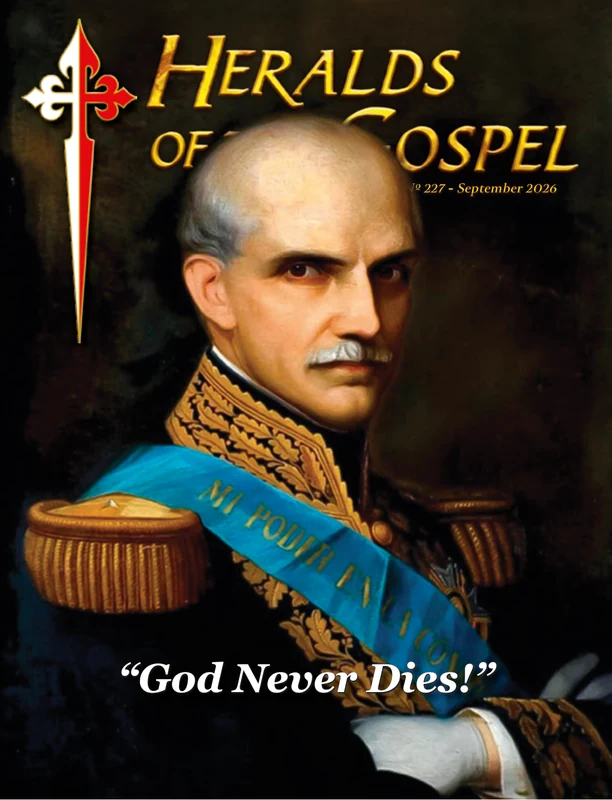
 Heralds of the Gospel Magazine, Vol. 20, nº 227, September 2026
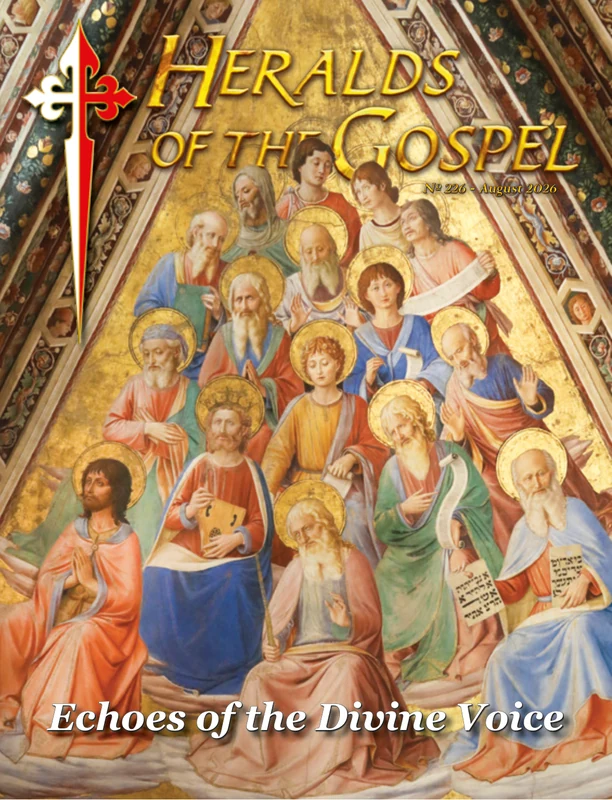 Heralds of the Gospel Magazine, Vol. 20, nº 226, August 2026
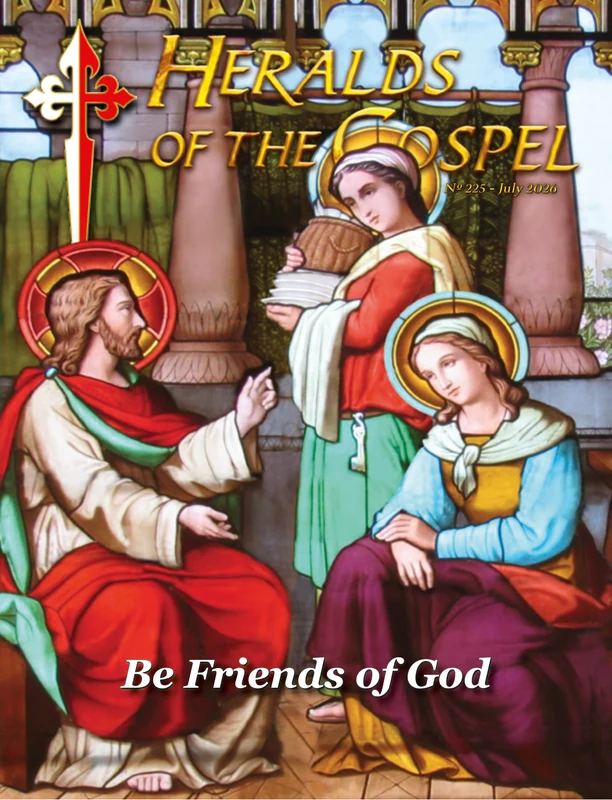 Heralds of the Gospel Magazine, Vol. 20, nº 225, July 2026
 Who are the Heralds of the Gospel?
 Help of Christians
 Christmas Carols





In a few days—specifically on November 1—we will observe the Solemnity of All Saints, and the following day, the Commemoration of All Souls.
Both of these occasions have been influenced by the Anglo-Saxon custom of celebrating Halloween on the night of the 31st of this month—originally All Hallows’ Eve, meaning “the eve of All Saints’ Day.” An eve, as we shall see, that is anything but holy…
A night of witches, ghosts, and terror, reflecting an ancient pagan custom that strips these special occasions of their religious meaning. Behind all this lies the supernatural workings of the devil.
Sorcerers, magicians, and seers
In this pseudo-celebration, the ancient Celts—who inhabited Central and Western Europe as early as the 6th century B.C.—practiced obscure rituals, worshiped nature by attributing supernatural qualities to it, and performed sacrifices.
Not all Celts, upon embracing the Christian faith, underwent a genuine conversion; many retained their customs and held on to superstitions. Among these was the worship of the “lord of death” or Samhain, invoked to ask for prosperity, health, and insight into the future. This influence degenerated into a celebration that perpetuates the festival of death.
The Celtic priests, the Druids, who wielded great influence, were sorcerers, magicians, and seers.
The festival honoring the god of death took place on October 31, with animal sacrifices and, on special occasions, human sacrifices, in order to divine the future.
As we can see, the origins of Halloween are grim.
From the United States to Latin America
Irish immigrants were the ones who introduced this grotesque custom to the United States, where it is now a major non-religious holiday.
It has spread to some countries in Spanish-speaking America; in Mexico, a massive parade of the dead is held on All Souls’ Day, complete with altars and traditional foods.
Consumerism, of course, could not be absent. Quite a few schools require students to celebrate Halloween, encouraging children to go door to door reciting rhymes, dressed as devils, the dead, monsters, and vampires, saying: “Trick or treat?”
Hollywood has contributed greatly to its spread through films featuring violence and murder and by promoting the sale of costumes, masks, makeup, candy, etc.
The Devil’s Birthday
Anton LaVey, founder of the first Satanic church in the U.S., said that one of the most important holidays for them is October 31.
The quintessential night for the occult, witches refer to it as Satan’s “birthday.”
As we can see, it is a holiday steeped in darkness and one that does not glorify God. In the days leading up to it, reports emerge from various parts of the world of missing children and cats that are killed in rituals. It is a celebration during which, we might say, the doors are opened for the devil to enter.
Holywins: Holiness Wins!
In contrast, in the Diocese of Alcalá de Henares, Spain—as well as in many other places—children are encouraged to dress up as saints, commemorating their lives through testimonies and songs. This is what they call Holywins, a play on words meaning “holiness triumphs.”
According to the diocese’s statement:
the aim is to support the Christian feast of All Saints, in the face of the growing eclipse it is suffering due to the powerful spread of the pagan festival of Halloween.
A unique controversy that reveals to us the increasingly intense clash between good and evil.
Patriarchs, Prophets, Apostles, and Martyrs
Let us now turn our gaze to All Saints and our Faithful Departed.
The veneration of All Saints encompasses the veneration of all souls in Heaven—even those who have not been canonized—praying to them for protection, especially, of course, those with whom we have a more special connection. It is an opportunity to entrust ourselves to them on this day.
We also remember the patriarchs, who were the seed; the prophets, who, inspired, tore away the mysterious veil of the future; the innocent souls, who join the choir of the Angels; the Apostles, who laid the foundations of the Holy Church; the martyrs, who earned their palm by shedding their blood; the monks, who fought in silent cloisters; the Doctors, from whose pens rich treasures of knowledge have come to us; the soldiers of Christ’s army; in short, all the saints.
What a wonderful host of intercessors to whom we may pray on the Solemnity of All Saints!
Terrible suffering, with the hope of Heaven
The following day, the Church commemorates the Faithful Departed, the holy souls in Purgatory—those who, having died in a state of grace, must undergo a temporal punishment, this final purification that is entirely distinct from the punishment of the damned. Terrible suffering, with the hope of Heaven.
Those who die in God’s grace and friendship, but are not yet perfectly purified, undergo a purification after death in order to attain the holiness necessary to enter into the joy of Heaven (Catechism of the Catholic Church, 1030).
On this day, these souls benefit from the Holy Masses celebrated everywhere, especially in cemeteries, and from our prayers.
St. Augustine recounts that the only thing his mother, St. Monica, asked of him before she died was: “Do not forget to offer prayers for my soul.”
What a joy it is for our departed loved ones, who died in God’s grace, to receive our prayers! Upon reaching Heaven, they will intercede for us.
Let us pray for the souls in Purgatory!
If we reduce the human person exclusively to his horizontal dimension—as Pope Emeritus Benedict XVI told us—which can be perceived empirically, life itself loses its profound meaning.
The human person needs eternity, and any other hope for him is far too brief, far too limited.
Humanity can only be understood if there is a love that overcomes all isolation—including that of death—in a wholeness that transcends even space and time.
Humanity can only be understood and find its deepest meaning if God exists (November 2, 2011).
Let us pray for our departed loved ones; let us also pray for the souls in Purgatory who are most abandoned and for whom no one prays.