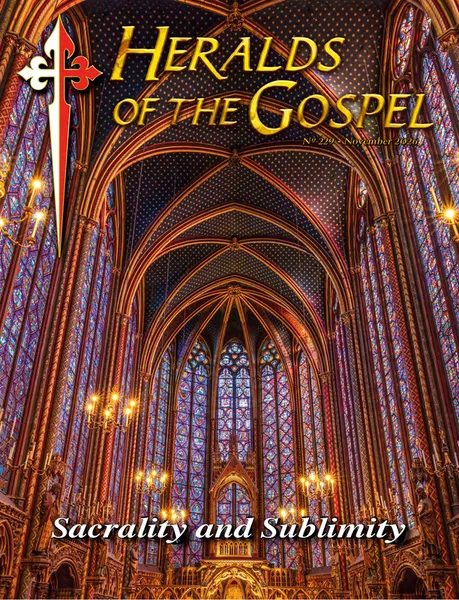
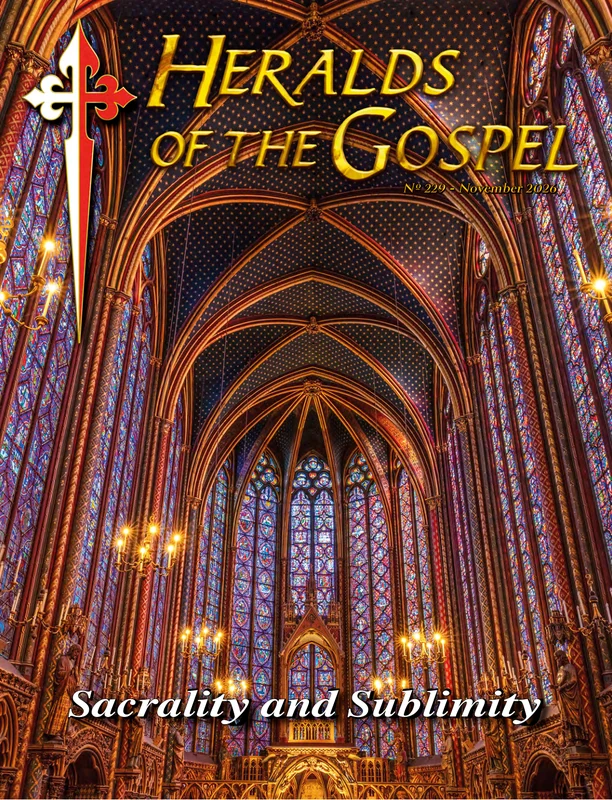
 November 2026, No. 229
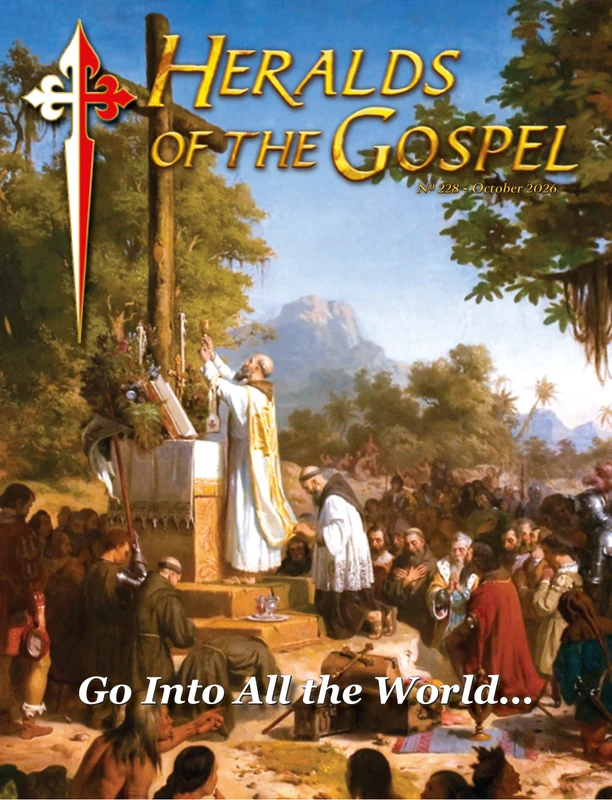 October 2026, No. 228
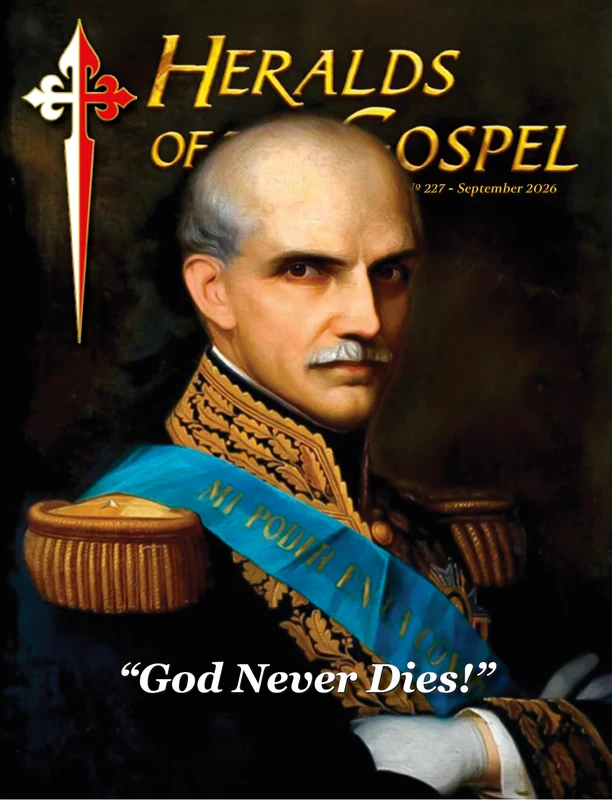 September 2026, No. 227
 Who are the Heralds of the Gospel?
 Help of Christians
 Christmas Carols







Beyond what the senses perceive
Beauty is the visible form of the good, just as the good is the metaphysical condition of beauty. This was well understood by the Greeks who, by fusing the two concepts, coined a term which embraces both: kalokagathía, or beauty-goodness.
On this point Plato writes: “The power of the Good has taken refuge in the nature of the Beautiful” (Philebus, 65A). […]
Every genuine artistic intuition goes beyond what the senses perceive and, reaching beneath reality’s surface, strives to interpret its hidden mystery.
The intuition itself springs from the depths of the human soul, where the desire to give meaning to one’s own life is joined by the fleeting vision of beauty and of the mysterious unity of things.
ST. JOHN PAUL II. Letter to Artists, 4/4/1999.
Reflection of the infinite divine beauty
This eternal and unchangeable law commands that man himself and all his actions should manifest and imitate, so far as possible, God’s infinite perfection for the praise and glory of the Creator.
Since man is born to attain this supreme end, he ought to conform himself and through his actions direct all powers of his body and his soul, rightly ordered among themselves and duly subjected to the end they are meant to attain, to the divine Model.
Therefore even art and works of art must be judged in the light of their conformity and concord with man’s last end. Art certainly must be listed among the noblest manifestations of human genius.
Its purpose is to express in human works the infinite divine beauty of which it is, as it were, the reflection.
PIUS XII. Musicæ sacræ disciplina, 25/12/1955.
Participation in the creative power of God
God therefore called man into existence, committing to him the craftsman’s task.
Through his “artistic creativity” man appears more than ever “in the image of God”, and he accomplishes this task above all in shaping the wondrous “material” of his own humanity and then exercising creative dominion over the universe which surrounds him.
With loving regard, the divine Artist passes on to the human artist a spark of His own surpassing wisdom, calling him to share in His creative power.
ST. JOHN PAUL II. Letter to Artists, 4/4/1999.
Sacred art: the foundation of all art
Finally, the arts modelled on the supreme exemplar of all beauty which is God Himself, from whom is derived all the beauty to be found in nature, are more securely withdrawn from vulgar concepts and more efficaciously rise towards the ideal, which is the life of all art.
And how fruitful of good has been the principle of employing them in the service of divine worship and of offering to the Lord everything that is deemed to be worthy of Him, by reason of its richness, its goodness, its elegance of form.
This principle has created sacred art, which became and still continues to be the foundation of all profane art.
ST. PIUS X. Iucunda sane, 12/3/1904.
Nourishment for faith, embellishment of the Liturgy
Art has a unique capacity to take one or other facet of the message and translate it into colours, shapes and sounds which nourish the intuition of those who look or listen. It does so without emptying the message itself of its transcendent value and its aura of mystery. […]
How many sacred works have been composed through the centuries by people deeply imbued with the sense of the mystery!
The faith of countless believers has been nourished by melodies flowing from the hearts of other believers, either introduced into the liturgy or used as an aid to dignified worship.
ST. JOHN PAUL II. Letter to Artists, 4/4/1999.
Faith: condition for the life of culture
Culture, the whole of our great Christian culture, is born from this contact of the heart with the Truth who is Love.
Nor, if faith stays alive, will this cultural inheritance die; rather, it will remain alive and present.
To this day, images still speak to the hearts of believers, they are not relics of the past. Cathedrals are not mediaeval monuments but rather houses of life in which we feel “at home” and where we meet God and one another.
Nor is great music – Gregorian chant, Bach or Mozart – something of the past; rather, it lives on in the vitality of the liturgy and in our faith. If faith is alive, Christian culture can never become “obsolete” but on the contrary will remain alive and present.
BENEDICT XVI. General Audience, 21/5/2008.
The Gospel is the source of inspiration for art
Artists are constantly in search of the hidden meaning of things, and their torment is to succeed in expressing the world of the ineffable.
How then can we fail to see what a great source of inspiration is offered by that kind of homeland of the soul that is religion?
Is it not perhaps within the realm of religion that the most vital personal questions are posed, and answers both concrete and definitive are sought? […]
It remains true, however, that because of its central doctrine of the Incarnation of the Word of God, Christianity offers artists a horizon especially rich in inspiration.
What an impoverishment it would be for art to abandon the inexhaustible mine of the Gospel!
ST. JOHN PAUL II. Letter to Artists, 4/4/1999.
“Via pulchritudinis”, a journey of faith
What is capable of restoring enthusiasm and confidence, what can encourage the human spirit to rediscover its path, to raise its eyes to the horizon, to dream of a life worthy of its vocation – if not beauty? […]
Precisely because it opens up and broadens the horizons of human awareness, pointing us beyond ourselves, bringing us face to face with the abyss of Infinity, [beauty] can become a path towards the transcendent, towards the ultimate Mystery, towards God. […]
In this regard, one may speak of a via pulchritudinis, a path of beauty which is at the same time an artistic and aesthetic journey, a journey of faith, of theological enquiry. […]
The way of beauty leads us, then, to grasp the Whole in the fragment, the Infinite in the finite, God in the history of humanity.
BENEDICT XVI. Speech, 21/11/2009.
The answer to humanity’s greatest concerns
The desire for goodness, beauty and truth is rooted in the very DNA of humanity.
It is on the basis of this profoundly human aspiration and our centuries-old experience that the Church proposes paths toward a life of dignity and the common good. […]
With humility and conviction, the Church shares what she has discovered through the experience of faith: that Jesus Christ provides the answer to the great questions concerning human life and its fulfilment, both in this world and ultimately in eternity. […]
Precisely since “culture” calls to mind “cultivate,” just as the etymological roots that both words share suggest, we are rightly called to ask ourselves what it is that we are sowing today, what exactly is flourishing and what is silently withering in our society; what values are we preserving and which are we allowing to die.
These are profound and necessary questions that cannot be ignored.
LEO XIV. Speech, 7/6/2026.