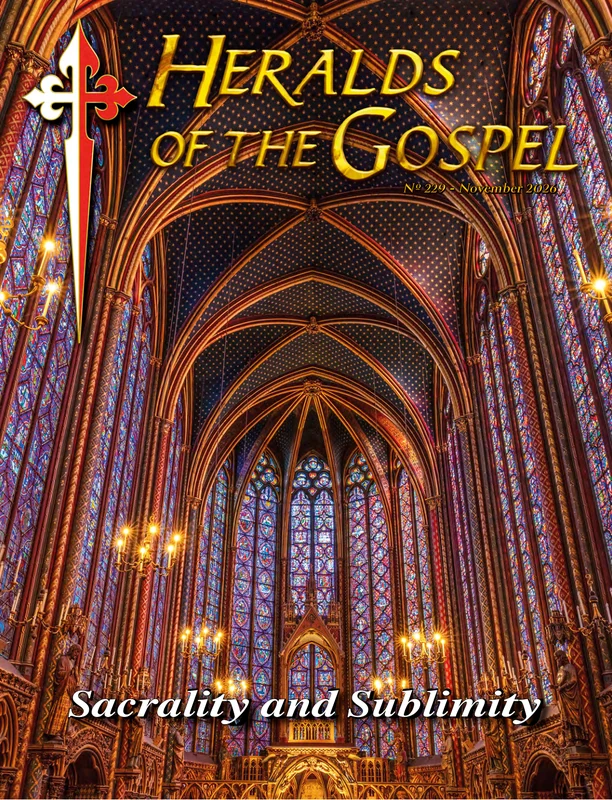
 November 2026, No. 229
 October 2026, No. 228
 September 2026, No. 227
 Who are the Heralds of the Gospel?
 Help of Christians
 Christmas Carols







There are mysterious and surprising relationships between certain colours, shapes, sounds, scents, and flavours on the one hand, and certain states of soul, on the other.
A person, for instance, confined in a room with exaggerated shades of red will find his mood affected by some level of feverish agitation.
Smelling the scent of incense or inhaling noxious fumes has effects not only on the lungs but even one’s frame of mind. The frenetic noise of megacities stands in stark contrast to the soothing silence of cloisters.
The principle that physical factors influence the spirit – the very basis of what we call marketing – leads to two possible stances: a defensive one, aiming to avoid manipulation; and an offensive one, focused on leveraging this reality in the individual and collective pursuit of holiness.
For, as the reader will discover in the following pages, it is possible to use forms, colours, fragrances, and the like to create environments that prepare the way for love of God.
Indeed, this is the highest and most fundamental mission of temporal society: to organize the earth to reflect our Heavenly Homeland. Such a vision may well clash with a materialistic conception of reality.
Yet, to ask whether the temporal order plays a role on the journey to eternity is tantamount to asking whether God’s six-day work of creation matters for salvation…
St. Thomas Aquinas (cf. Summa Theologiæ, I, q. 2, a. 3) – recognizing that material creation must indeed serve as a path to the Kingdom of Heaven – charted this route when describing the fourth way of proving God’s existence.
When we state that something is more beautiful or less so, we are establishing a gradation of beauty. Now, this gradation is established only in relation to a maximum – a Supreme Beauty – which serves as a benchmark and is the cause of all that is beautiful.
Therefore, the entire hierarchy of beauties forms, in effect, a ladder that leads to Beauty in its essence: God Himself.
Now, if the Church presents herself as the way to salvation – for she was constituted as such by the One who is the Saviour and the Way (cf. Jn 14:6) – it nevertheless falls to the secular order to pave the road that culminates in the Most High. The Church is Jacob’s ladder leading to the Throne of the Lord (cf. Gn 28:12).
Temporal society, in turn, serves as its handrail – a golden, noble, and strong handrail designed not only to prevent a fall but to draw pilgrims upward.
On the highest rungs of this ladder of beauty, we find the sublime – that ultimate level of the pulchrum that already touches upon God. And when this sublime quality fulfils a sacred function or speaks explicitly of the Creator, it is refined into the sacral – the very pinnacle of the sublime. It is, therefore, the task of temporal society to make the invisible Beauty visible through the sublime and the sacral.
God has entrusted man with the task of completing the work of creation, and a privileged means of doing so lies in making St. Thomas’s “Fourth Way” increasingly “traversable.” It is our mission to repave it and to reattach the golden handrail of this ladder to Paradise.
If, in our times, it is becoming increasingly difficult to persuade by means of the truth – so often reviled – and if it is so challenging to move hearts through the good – so often relativized – then we must raise man towards the Most High through beauty, the unfailing wing of the human spirit.