 Heralds of the Gospel Magazine, Vol. 20, nº 228, October 2026
 Heralds of the Gospel Magazine, Vol. 20, nº 227, September 2026
 Heralds of the Gospel Magazine, Vol. 20, nº 226, August 2026
 Who are the Heralds of the Gospel?
 Help of Christians
 Christmas Carols









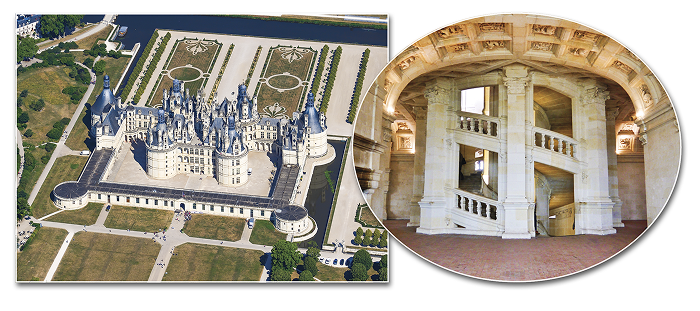
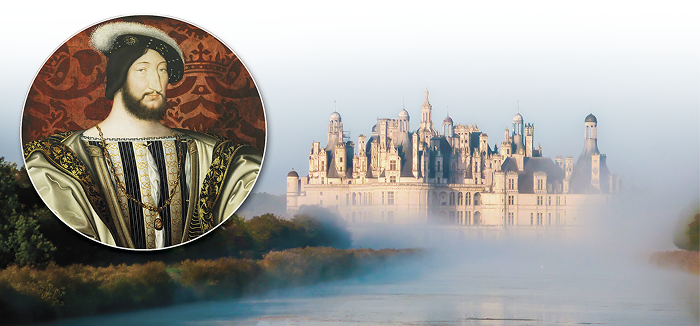
On the banks of the Cosson River in France stands the imposing Château of Chambord. The sprawling plain, the surrounding woods, the reflecting waters – all contribute to create a fitting setting for the palace, which transforms the panorama into a true jewel.
The castle seems like a balm to the human spirit in its search of the marvellous. For this reason, numerous travellers flock there to contemplate it. The diversity of origins of the visitors is accompanied by different states of spirit.
There are those – the majority – who simply wish to satisfy their curiosity. Others, on the contrary, flock there attracted by the historical and architectural enigmas that pervade the building. Finally, there are also souls who see in the castle a relic of Christian Civilization and visit it as if on a pilgrimage. In any case, what they encounter is a mystery.
A dream of extraordinary dimensions, in stone
The castle, in effect, is fascinatingly mysterious. No construction plans remain, nor are the reasons that led Francis I to build this beautiful and sumptuous edifice known. However, thanks to the investigations of researchers, it is possible to unveil part of the secret.1
In the year of Our Lord 1515, the son of Louise of Savoy, Francis I, only twenty years old, ascended to the throne of France, after his cousin Louis XII died without leaving a direct heir. Glory and prestige surrounded him, and his imposing figure personified his power.
Despite the weight of the sceptre, his passion for hunting led him to the deepest woods in the Loire Valley. Among the forests and marshes of the region, Chambord was his favourite place, due to its distance from the world and its cares. The place perfectly fulfilled his aspiration to create, in stone, a work of extraordinary grandeur. Eager to build a hunting castle there, the king ordered the construction to begin in 1519, which would be completed in just thirty years.
If we consider the splendour of the building, its complexity, and its apparent uselessness – after all, it was nothing more than an inn for chases through the forest – the speed of construction is still astonishing and raises certain questions. What is the “prehistory” of the castle? What other motives lay behind those walls? What genius conceived it so readily?
Legacy of a glorious past
Anyone attempting to answer the first of the questions above is immediately faced with a practical difficulty: the main documents about the construction of Chambord disappeared in the 17th century… We are left only with fragments, such as this short mention in a letter from Francis I: “Some time ago – wrote the king – we began the construction of a beautiful and sumptuous building in the place called Chambord, near our city of Blois.” Thus, to decipher some of the initial steps of its history, we are left with only one complete, solid, and enigmatic document: the castle itself!
The first of these lies submerged beneath the waters of the moat. Recent archaeological studies have discovered traces of an earlier construction there. The famous Chambord palace would then have been built upon the foundations of another castle. What would it have been like? In the library of Blois, there are three documents that shed light on the subject: two refer to a building in that area, and the third – a document signed by Louis XII, Francis’ immediate predecessor at the site – indicates that there was a dwelling there worthy of a king of France.
On one of his hunting expeditions, Francis I probably saw the castle, isolated and erected among the marshes, as if to represent the medieval spirit already in advanced extinction. The ancient feats of chivalry, the heroism of yesteryear, the pilgrimages to Jerusalem that had so honoured the name of France: all these glorious memories seemed to perpetuate themselves in the medieval fortress. Driven, then, by nostalgia for that fabulous world, the monarch wanted to materialize this dream in a magnificent building. It is no coincidence that Chambord retains aspects of a feudal castle, complete with towers and a moat. And, while perpetuating the past, the king also aspired to attain even more majestic heights.
We have unveiled at least a part of the mystery. We know it is a child of medieval Christendom and the longing the King of France had for it. Let us continue to “read” the castle, hoping to find a few more pieces of the puzzle.
Harmony and asymmetry
If we enter through the main door, we are immediately surprised by an unprecedented and ingenious architectural feature. The main hall is dominated by a rather conspicuous central staircase. The building revolves around it, with its two independent and intertwined flights of stairs – designed in such a way that those going upstairs do not meet up with those going downstairs. After several investigations, it was concluded that all spaces are symmetrical in relation to this single model, the base of the central staircase. It is the backbone of the colossus.
Despite this principle of cohesion and order, there is a peculiar “incoherence” observed in the castle. All the façades are different. How to explain such asymmetry in a building of such evident harmony?
Initially, it was believed to be nothing more than a mistake during construction. However, upon analysing the plan, it was discovered that the “error” is more serious than it appears at first glance. The castle’s own plan presents seemingly absurd anomalies. Looking at the plan, the four rooms distributed on each floor have the same orientation, except for one. It follows that the number of balconies is different on each façade.
We must therefore assume that there was an initial plan that was not followed. The Chambord we know is not the same as the one that was planned. What should it have been like?
Architects have recently strived to find the formula that would remedy these incongruities. And they found it. It would be enough to make the building’s plan rotate entirely in the same direction, like a large helix, with the staircase as the axis. The rooms would be symmetrically arranged, all the façades would be identical, and everything would become harmonious.
The errors would only be the result of adaptations to facilitate the circulation of visitors. The architect did not have this practical concern. His intentions were much more artistic. And this consideration leads us back to a question already raised above: what genius conceived the castle? Let us go back a few years in history.
And the architect?
Newly crowned, Francis I reconquered the Duchy of Milan. While there, he took the opportunity to admire some Renaissance marvels and personally meet one of the great masters of the time: Leonardo da Vinci. And, shortly afterwards, the plans for the Chambord castle emerged… Curious.
Da Vinci was interested in buildings surrounded by landscape, in centralized plans, in staircases with several revolutions. But in all these preferences, which he left sketched in his notebooks, one perceives the aspiration for an architecture of perfect coherence. It even seems like a pre-description of Chambord, which, moreover, has unmistakably Italian touches.
Considering these coincidences, could Leonardo da Vinci himself have been the architect of the castle? There are strong indications in this regard. Such an original and ingenious building would hardly have emerged without the hand of the famous artist, then residing in France. If he was not the mastermind, it seems at least unlikely that he remained uninvolved in the work, given that the plans were drawn up whilst he was still alive, albeit for only a short time. He died shortly before the start of construction, at the age of sixty-seven, leaving its execution to others.
To whom? Another mystery. We only have one reference: in a financial record of models of the castle, the name of Domenico de Cortone appears, one of the numerous Italian artists of the court. It is therefore assumed that he was responsible for realizing Da Vinci’s dream in stone… and also for introducing the modifications to the original plan and the irregularities already mentioned. Contingencies to be expected when one inherits the work of a genius.
If it is true, however, that the mentor abandoned the idealized work, there is someone who never ceased to follow the realization of the prodigy, and to project his ideals onto it: the king himself. A unique obstinacy led him to continue such a financially burdensome construction, despite the adversities that soon pervaded his reign.
In 1519, Charles V became emperor. Francis I, in addition to not being able to secure the crown of the Holy Roman Empire for himself, would later lose the Duchy of Milan to his Spanish rival. In an attempt to recover this territory, in 1525 the King of France was wounded and captured. The castle’s construction was apprehended with its lord…
Only upon returning from captivity was Francis I able to continue the project, abandoned for fifteen months.
Chambord emerges from the earth, grand and paradoxical.
A paradox, a mystery, a symbol
Paradoxical, yes, and for many reasons. First, because of the palace’s location: the silhouette of this fairy-tale castle is outlined on a swampy terrain. The construction, in turn, is visibly inspired by medieval castles from the late 14th century, while still incorporating certain typically Italian features. Thus, it is a profoundly unique construction, due to its great features that are simultaneously feudal and characteristic of the Renaissance.
But perhaps this is not the main mystery surrounding it. A symbol of the reign of Francis I and his astonishing persistence in completing the greatest architectural work of his life, Chambord presents a huge disproportion between the efforts expended in its construction and the practical outcome resulting from them. It is conjectured that, in total, the king spent only a few weeks of his reign in the castle. The numerous rooms intended to house the court were almost always empty of inhabitants and furniture. Only when the king decided to live there for a few days was a minimum of furniture and artistic treasures brought into the apartments. How, then, to explain the monarch’s insatiable thirst for perfection?
Only one reason explains it: Chambord was not built to provide accommodation, but to serve as a symbol. The King of France wished to erect an emblem.
Thus, we must ask: an emblem of what?
The avenged sunset
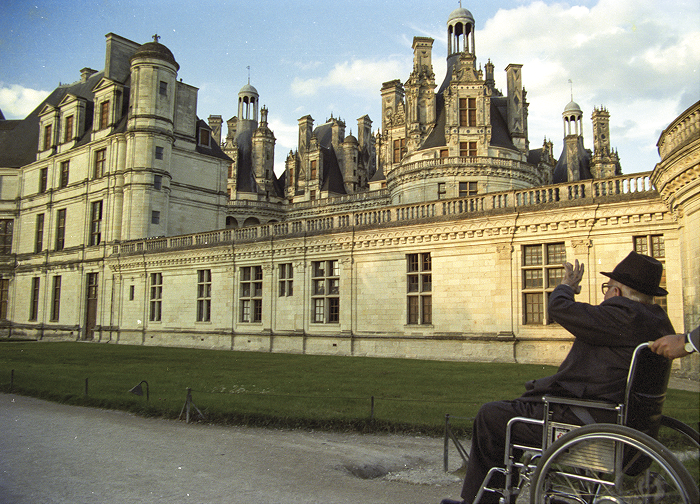
October 14, 1988. Perhaps for the first time, the ancient castle of Francis I received not a visitor, a tourist, or a historian, but a pilgrim. Dr. Plinio Corrêa de Oliveira approached the building, not only for the delight of seeing it, but above all for the love of Christian Civilization, of which the monument was an expression.
Chambord, he commented, is one of the most distinguished castles in the world, of unexpected perfection, in which Heaven dominates the earth, faith dominates concrete life, and spirit dominates matter. In it are condensed the “remnants of the grace that blew over Europe and gave rise to the Middle Ages, setting centuries later, slowly, like a splendorous sun,”2 as “one of the radiations of that sunset of medieval Civilization, a magnificent sunset, as magnificent as Christendom.”3 Dr. Plinio was then able contemplate that marvel closely.
The pilgrim lingered for quite some time near Chambord, at times praising the beauty of the building, or that of the twilight on that cold autumn afternoon. However, at a certain point, those present noticed, from his expression, that something very sublime was occurring. As he contemplated the castle framed by the colours of the sunset, Dr. Plinio seemed to enter a mystery, glimpsing a perfection that transcended the palace itself.
Months later, questioned by his spiritual children, he lifted the veil of this mystery some degree. He confessed that it was, in fact, a mystical experience he had had, in an angelic manner. And, to everyone’s astonishment, he told the words he had heard within him: “This is abandoned, it has been transformed into an empty skeleton without flesh. […] I show myself to you thus. Resurrect me and avenge me!”4 Who could the illustrious visitor who instilled in him such inspirations be? An Angel? The enigma of Chambord remained undecipherable…
He would later utter these inscrutable words, just a year before his passing:
“Nothing interests me as much as a certain spirit that emanates from the Château of Chambord; it is more beautiful than the château itself and could be an Angel. Although the castle was not made by God directly – He is only the first cause – God may have inspired, aroused in men the desire to build Chambord, corresponding to an Angel of Chambord that He has and sends there.”5
Everything leads one to believe that, for the first time in history, a man had unveiled, at least in part, the mysteries surrounding the emblematic castle: its unusual location, the insistence of the knight-king on completing a masterpiece almost devoid of practical purpose, the anonymity of its architect, the perfection of its proportions, its immeasurable beauty. Where neither historians nor scientific research could attain, inspiration came when it pleased God that a dialogue should begin between a man of faith and the “spiritual architect” of one of the most beautiful castles in the world.
From then on, Chambord ceased to be a mystery in the eyes of men. It became a plan. Yes, a divine and providential design; fulfilled when a respectable man, advanced in years, was able to read something that documents do not convey and discern supernatural values that transcend the stones of a building.
Notes:
 Jerome Lourdes Sequeira