 Heralds of the Gospel Magazine, Vol. 20, nº 228, October 2026
 Heralds of the Gospel Magazine, Vol. 20, nº 227, September 2026
 Heralds of the Gospel Magazine, Vol. 20, nº 226, August 2026
 Who are the Heralds of the Gospel?
 Help of Christians
 Christmas Carols









We are in the heart of the South American jungle in the 17th century. Through the thick undergrowth, we can hear a frenetic clamour of chanting voices, harsh trumpets, and noisy drums. The most typical of scenes unfolds: a prisoner, taken in combat and now surrounded by celebrating Guarani, awaits the final blow.
A similar end inevitably awaits those who fall under the power of the Guarani. Captured, the man is fattened and then slaughtered. His flesh will feed everyone from the elderly to the children. His tibias will become trumpets. His skull will serve as a cup.
These are the Guarani customs in 17th-century Paraguay.
* * *
Without leaving the place, let us move on to the 18th century. About a hundred years have passed, and everything has changed.
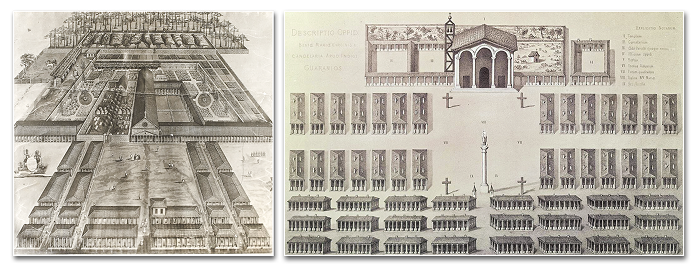
A true Guarani city rises. Wide, paved streets connect extensive plantations to strong, large stone buildings. Let us enter one of them: the church.
There, Holy Mass is celebrated. Religious music resounds. A large choir of mixed voices is accompanied by a full orchestra: pipe organ, harps, trumpets, trombones, flutes, clarinets, and bassoons. The chalices, the vestments, and the temple itself were produced by the baptized hands of the Guarani people.
This is the life in a Jesuit reduction in 18th-century Paraguay.1
The reductions
The history of the reductions – a name originating from the Latin expression reductio ad unum, to indicate the gathering of indigenous people in a single location – began in 1587, when Dom Francisco de Vitoria, OP, the Portuguese Bishop of Tucumán – a region encompassing present-day Paraguay and part of Argentina – requested assistance from the Jesuit missionaries in Brazil. He needed help in his diocese, where the most common language, Guarani, was similar to the Tupi used in Brazilian lands.
The request was accepted, and no effort was spared. Every day the sick were visited, Mass was celebrated, and a sermon was delivered. After this apostolate, always around the altar, the number of indigenous people baptized reached, on average, three hundred per day.
But preaching was not enough. Had not the Divine Master taught that the seed of the word only grows in fertile ground (cf. Mt 13:18-23)? Well, the missionaries decided to civilize by evangelizing and to evangelize by civilizing. To that end, they created the aforementioned reductions. These communities, supervised by Jesuit priests – generally no more than two – lived under the rule of political and religious laws, allowing them to abandon their previous, erratic, semi-nomadic lives. On average, three thousand five hundred people inhabited each settlement, and up to six thousand in some.
The first such experience, the St. Ignatius Guazú Reduction, was established twenty-five leagues from Asunción in 1609. In the same year, one hundred and sixty leagues east of the same capital, the Our Lady of Loreto Reduction was born. And the number of new societies grew with extraordinary speed.
The city of God
The monarchical point of each reduction was the church. There beat the heart of the community. The crowded daily Mass was celebrated, catechism was administered, numerous Confessions were heard, and marriages were celebrated. From there also flowed all spiritual blossoming. Vices, once so deeply rooted, were trampled by virtuous life, asceticism, and prayer.
Flanking the temple stood the hospital, the cemetery, and the administrative centres such as the municipal council, and the school. The main avenues had permanent shade due to the awnings over them. The buildings were generally made with thick masonry blocks, more than a metre thick, and the roof framing had enormous beams. Thus, the buildings maintained a cool temperature and lasted for centuries to come.
Schools for all ages and conditions
The sons of St. Ignatius established a legislative council in the reductions, formed by the Guarani themselves. Each community thus became a small autonomous republic, similar to the ancient and famous Greek city-states.
There was also a cavalry corps and an infantry squadron that used both the traditional weapons of the indigenous peoples – the macaná, bow and sling – as well as swords and rifles.
Agriculture began to provide sustenance for the Guarani, who previously depended on hunting and fishing. In each city there were about seven large gardens and orchards, abundant in fruit, vegetables and medicinal plants.
Industry also developed. Using modern brick kilns and forges, the Guaraní built mills, sawmills and tanneries, as well as sugar and olive oil mills, and even clock-making workshops.
The arts flourished. The first printing press in the Rio de la Plata region, for example, was established in a reduction. Sculptures, paintings, carpets, musical instruments, liturgical vessels and linens – with lace, jewels, and precious metals – everything was crafted by the natives according to the most refined taste of the Old Continent.
Among the gifts that the newly baptized manifested with the greatest brilliance was music. French, German, and Italian compositions were played with the corresponding expression to such a degree that it was enough to hide the instrumentalists from the public’s view, in order for them to believe they were listening to orchestras from the other side of the Atlantic.
Attacks and defence
Thus, over the decades, missionaries founded numerous centres of civilization that, in the 18th century, would extend for six hundred and fifty kilometres from north to south, and about six hundred kilometres from east to west, in what is now Paraguay, Uruguay, northeastern Argentina, southern Brazil, and Bolivia.
As could not be otherwise, envy emerged in this context of prosperity. Some reductions were undone by those who should have been most interested in them: the Bishops and the civil governors. Others succumbed to the bandeirantes2. An inhuman hatred led them to exterminate both the buildings and the Guarani who inhabited them, “robbing, plundering churches, tying up natives, killing and slaughtering children.”3 Such was the massacre and enslavement that, by around 1630, the number of captive indigenous people exceeded three hundred thousand.4
But the indigenous people, upon receiving the faith, had not lost their belligerence. In 1641, on the banks of the Uruguay River, the Battle of Mbororé took place. Eight hundred bandeirantes, armed with rifles, allied with six thousand Tupi, were defeated by four thousand Guarani, armed only with three hundred rifles, arrows, spears, and slings. And through war, peace was made… for a time.
After 1750, when the reductions reached their peak, the Spanish and Portuguese crowns, under territorial or economic pretexts, expelled the Jesuits from the entire so-called “Guarani Republic.”
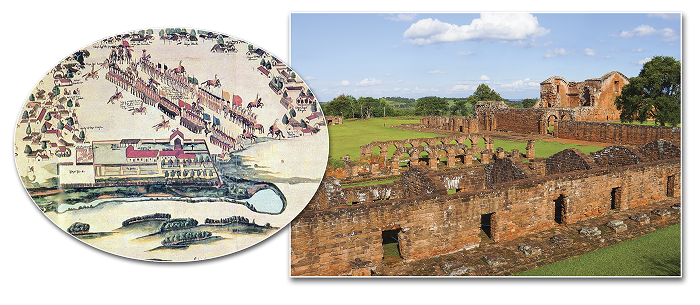
In a short time, the strength of the reductions, under the charge of civil governors, became just a memory. Then they were abandoned. Finally, destroyed. Today, only ruins remain.
The realized dreams of a people
Before the Catholic Faith arrived in South America, the Guarani lived on a hope. They descended valleys, crossed rivers, tore through forests, and climbed mountains, “driven by an inner fever that made them forget fatigue and hunger.”5 It was the dream of finding what they called Yvy Mará He’y – the “land without evil,” where the god-men, immortality, and endless happiness dwelled.
This was age-long pilgrimage of these nomads, until priests from a distant world brought them Baptism – making them children of God, immortal “godmen” fit for the eternal dwellings – and helped them build a society free of primitivism, where the striving for sanctity left no room for evil and sin: a true “land without evil.”
Notes:

 Sr. Allana Neves