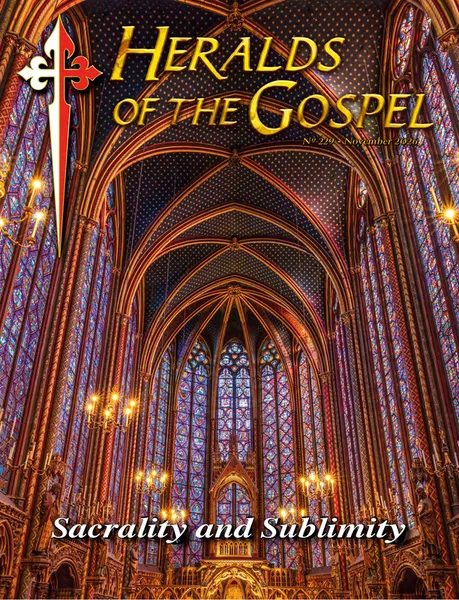
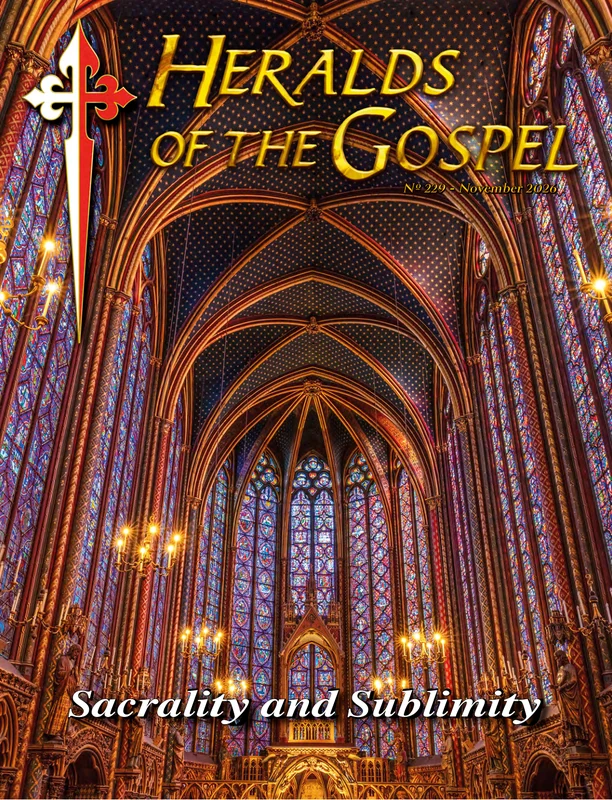
 November 2026, No. 229
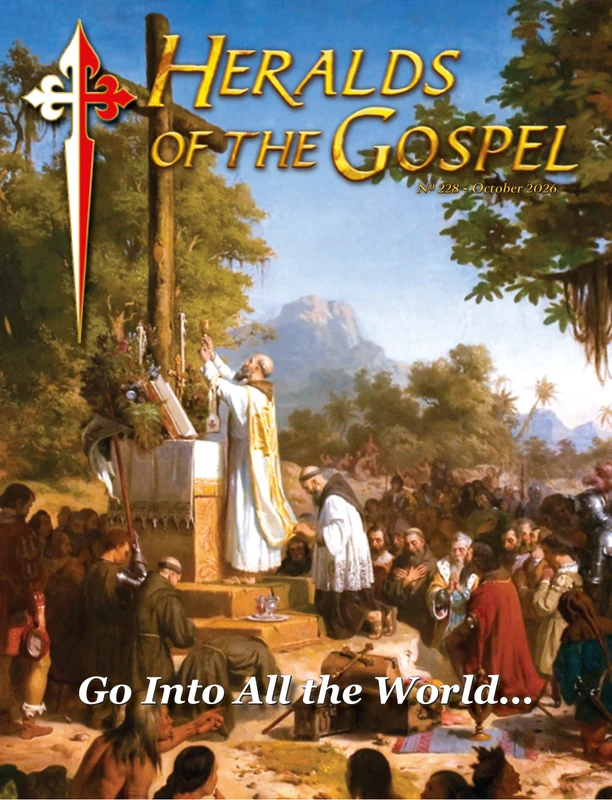 October 2026, No. 228
 September 2026, No. 227
 Who are the Heralds of the Gospel?
 Help of Christians
 Christmas Carols







It is one thing to speak the truth; it is another to proclaim it with eloquence. It is one thing to perform a good deed; it is another to carry it out with dedication. In such cases, elegance and dedication constitute distinctive marks of the beautiful – pulchrum – for when truth and goodness unite with a certain splendour, beauty shines forth.
It is no coincidence that the Thomistic tradition enshrined the expression: the beautiful is the splendour of the good and the splendour of the true – splendor boni, splendor veri.
Indeed, the true, the good, and the beautiful are intimately related. The good is beautiful and true, and leads to the Supreme Good; the true is good and beautiful, and leads to the Supreme Truth; the beautiful is true and good, and leads to Supreme Beauty.
Goodness, Truth, Beauty: God, Being by essence, from whom flow – by participation – all goodness, all truth, and all beauty.
But what makes the true, the good, and the beautiful so special? They are “modes of being” (De veritate, q. 1, a. 1), or transcendentals of being. And what does this mean?
According to perennial Philosophy, a transcendental is a fundamental property of being that accompanies it by the mere fact of its existence. It belongs, therefore, to all beings – angels, humans, animals, etc. – and not merely to a particular category among them.
Aristotle was the first to address these notions; they were later articulated by Philip the Chancellor (c. 1160–1236) and elevated to new heights by St. Thomas Aquinas.
Building upon the postulates of Aristotle the Stagirite, the Angelic Doctor’s profound metaphysics gave these properties of being a unique formulation.
With this, it became clearer that the One, the True, and the Good are, first and foremost, attributes of the Being subsisting in itself – God – the measure of all that possesses unity, truth, and goodness by participation in Him (cf. De veritate, q. 1, a. 1; q. 21, a. 1; 3; De potentia Dei, q. 7, a. 2, ad 9; q. 9, a. 7, ad 6).
Aquinas does not explicitly include pulchrum among the transcendentals of being. Nor did he leave us a specific treatise on beauty, nor did he devote the same attention to this theme as he did to the true and the good.
Nevertheless, based on scattered passages in his work, it is possible to reconstruct a genuine theory of beauty, through which one can affirm that the pulchrum is a transcendental property of being, distinct from the others.
St. Thomas states that those things are beautiful which please when seen (cf. Summa Theologiæ I, q. 5, a. 4, ad 1). According to some, he shows a certain tendency to regard beauty as a physical property: the splendour of form that affects the senses (cf. ibid., I-II, q. 27, a. 1, ad 3).
This interpretation, however, is insufficient, for the Angelic Doctor explicitly affirms the existence of a spiritual beauty, in which a person’s conduct and actions are well balanced by the spiritual splendour of reason (cf. ibid., II-II, q. 145, a. 2).
Thus, God can be called “pulchrifying” – that which produces beauty – because He is the cause of beauty in all things, imparting light and splendour to them (cf. Super De divinis nominibus, c. IV, lect. 5, n. 340).
Indeed, all beauty that may exist in creatures is a participation in Absolute Beauty (cf. ibid., n. 346).