 November 2026, No. 229
 October 2026, No. 228
 September 2026, No. 227
 Who are the Heralds of the Gospel?
 Help of Christians
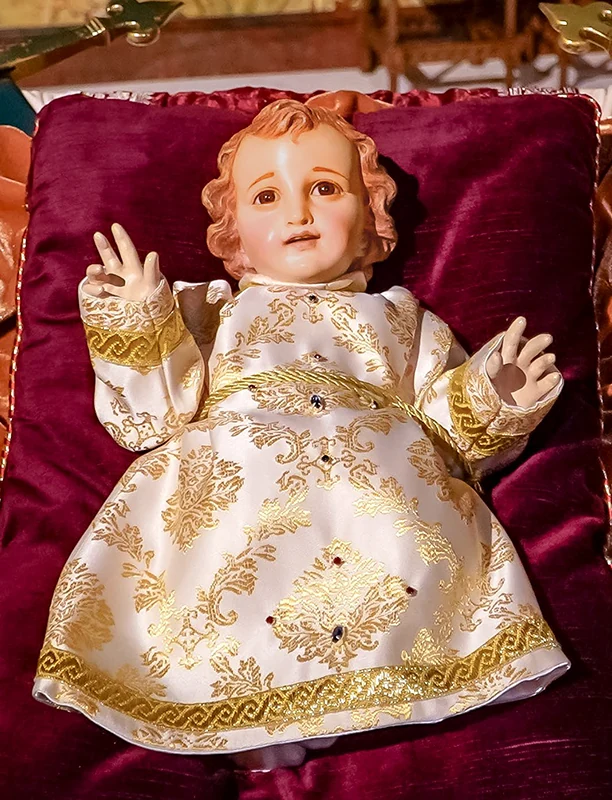 Christmas Carols







“I was glad when they said to me, ‘Let us go to the house of the Lord!’” (Ps 122:1). These words, spoken by the psalmist in reference to Jerusalem – the seat of religious worship in the Old Testament – apply to one of Christianity’s most traditional customs: the pilgrimage.
Born of the faithful’s devotion to shrines and sacred sites, the pilgrimage is a time-honoured act of piety, sometimes undertaken to atone for a fault, to implore special graces, or to fulfil a vow.
The earliest pilgrimages were generally directed toward the Holy Land, where Our Lord Jesus Christ lived, died, and rose again for our salvation.
With the spread of the Faith and the construction of churches throughout the world, other locations began to receive such visits; prominent among them was the Roman capital – city of the Successor of Peter and repository of the Apostles’ relics – which became one of the most sought-after destinations, yielding great spiritual fruit for the entire Mystical Body of Christ.1
The long and fervent tradition of pilgrimages to the Eternal City – which in Portuguese, eventually earned for the pilgrim the synonymous title romeiro 2 – was enriched in the 16th century through the efforts of St. Philip Neri, renowned among his contemporaries for his contagious joy in the service of God and souls.
This holy man initiated an itinerary known as the Visit to the Seven Churches, a long walk which takes in Rome’s most important basilicas, interspersed with meditations on the Passion of Christ and pleasant refreshments.
Would you, dear reader, like to learn a little about these historic and blessed Roman churches and share, in some way, in the graces proper to a pilgrimage?
Through these lines, I invite you to embark on a journey to the land of the martyrs. Since the spirit is free from the limitations of distance and time, to fly wherever it wishes, let us together follow the itinerary popularized by St. Philip Neri.
Dazzling and inviting beauty
To begin with, let us walk to St. Peter’s Basilica, built on the very spot where, in the year 64 AD, the first Pope was crucified upside down, as he did not consider himself worthy of dying like Our Lord.
It is said that, around the year 80, Pope Anacletus built a small chapel over the tomb of the Prince of the Apostles, which was replaced in the 4th century by a large basilica erected by Emperor Constantine and his mother, St. Helena.
Between the 15th and 17th centuries, this second early Christian building gave way to the Renaissance church we see today, the fourth centenary of whose consecration is celebrated on November 18 this year. It is currently the Catholic church with the largest internal floor area: 15,160 square metres.
Let us cross the vast square, dominated by the obelisk – a red granite monolith over twenty-five metres high, brought from Egypt, which serves as a sundial – and surrounded by Bernini’s colonnade, which evokes the keys to Heaven and earth entrusted by the Divine Redeemer to the Head of the Church (cf. Mt 16:18–19).
Entering the sanctuary, we are struck by the magnificence of the Mystical Bride of Christ reflected in its proportions and in its mosaics, images, tapestries and stones…
High on the walls, a golden band can be noticed running the entire length of the basilica’s perimeter, bearing passages from Scripture relating to the Apostle Peter, written in Latin and Greek.
As we stand before the Altar of the Confession, highlighted by the magnificent central baldachin, let us pause for a few mom ents of prayer.
The most precious relics in this basilica are housed in the four niches in the walls surrounding it. Among them are a fragment of the Holy Cross, found by St. Helena, the Veil of Veronica and the spear of St. Longinus.
Beneath the papal altar, in the Vatican Necropolis, we may venerate the relics of St. Peter, paying them a profound act of devotion before moving on.
Back at the upper level, looking up we can see, in the background, the stained-glass window depicting the Divine Paraclete and, below it, the authentic chair of the first Pope, supported by four bronze figures representing St. Augustine, St. Ambrose, St. John Chrysostom and St. Athanasius.
A pleasant encounter with the Apostle to the Gentiles
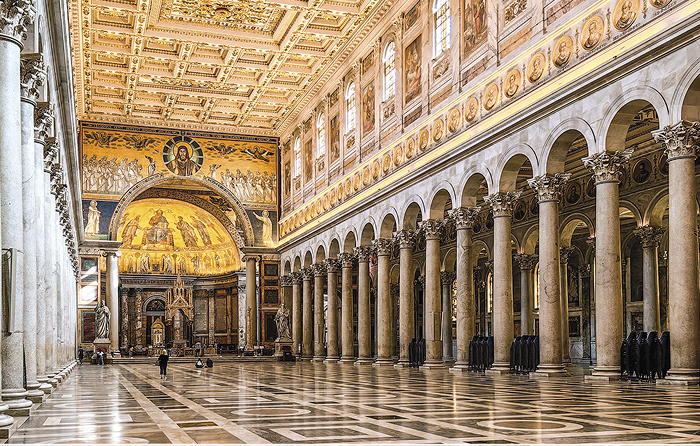
Continuing our pilgrimage, we now head towards the Basilica of St. Paul Outside the Walls.
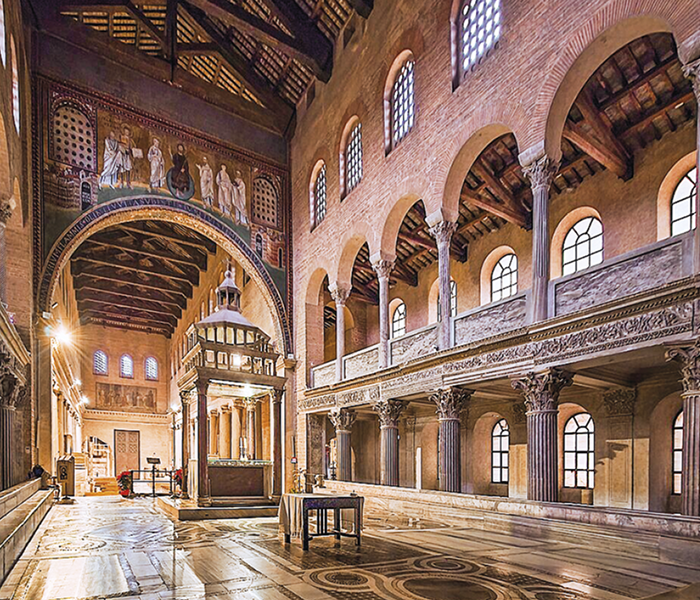
Before entering this second church, let us note that, once again, the building is no longer the original one, also erected on the orders of Constantine and consecrated by Pope St. Sylvester I around the year 330.
Following a devastating fire in 1823, the basilica had to be rebuilt. The new edifice, nevertheless, still houses the intact remains of the Apostle to the Gentiles, enchanting visitors from all over the world with its gentle and majestic charm, and it will certainly convey to us something of the spirit of this ardent herald of Christ.
Proceeding through the atrium leading to the entrance, we see a statue of St. Paul standing at its centre. With a majestic bearing, a contemplative gaze and sword in hand, his figure conveys at once piety and combativeness, gentleness and boldness, chastity and uncompromising resolve – harmonious virtues that every baptized soul ought to admire.
This impression, moreover, is heightened when, upon entering the sanctuary, the pilgrim approaches the Gothic-style baldachin covering the high altar. This marks the holiest place in the basilica: the tomb of the Apostle to the Nations.
At this point in our pilgrimage, St. Paul is waiting attentively to hear all our prayers. Let us offer them with confidence.
Venerating the relics of a soldier of Christ
As we resume our journey, the route takes us a short distance along the Via Appia, one of the main roads leading to the capital of the ancient Roman Empire.
We are retracing Peter’s steps when, seized with fear, he decided to flee the Eternal City to escape death. Halfway there, the Divine Master appeared to him and, asked by the Apostle where He was going, replied: “I am going to Rome, to be crucified once more.”
Strengthened by this vision, the Pontiff repented and returned to the City, ready to lay down his life for the Redeemer.
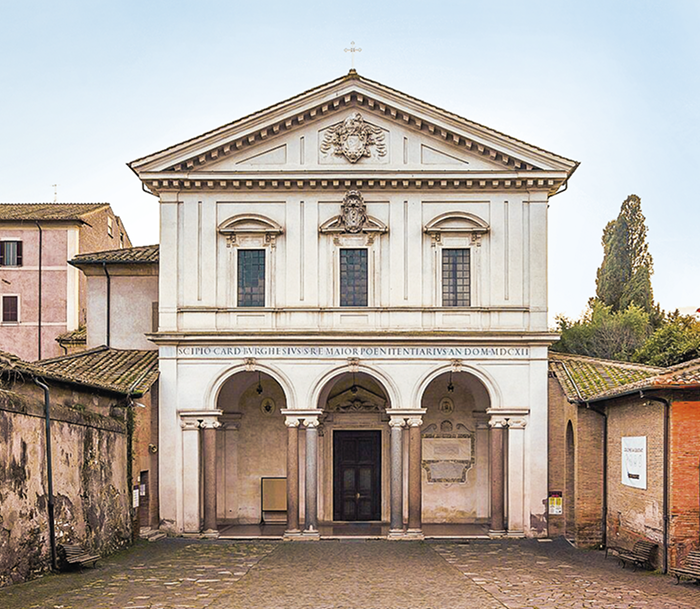
Further along the road lies the catacomb of St. Sebastian, a Christian Roman soldier martyred by Emperor Diocletian at the end of the 3rd century.
Above this underground cemetery, which received the mortal remains of the holy martyr, stands the basilica dedicated to him, where we venerate some of the instruments used in his martyrdom: an arrow that pierced his body and a section of the pillar to which he was bound.
Mother of all churches
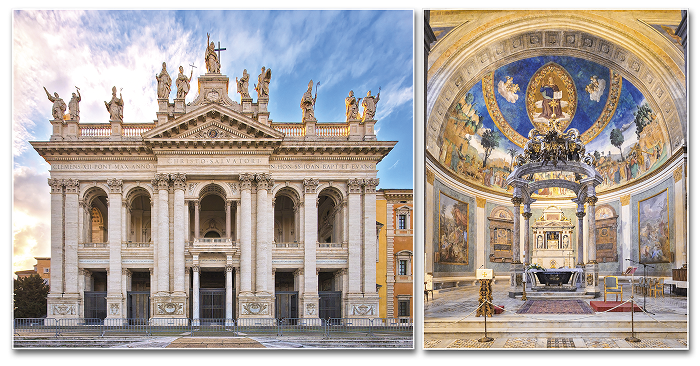
Our next destination is the Basilica of St. John Lateran, the oldest Catholic church in Rome, and therefore regarded as the mother of all churches.
Built on land that once belonged to the Laterani family – from whom the name Lateran derives – the cathedral in Rome that we are now visiting, together with the buildings surrounding it, was once the residence of the Pope and the Curia, as well as the venue for five ecumenical councils.
This precious sanctuary treasures the skulls of St. Peter and St. Paul, as well as a wooden altar, kept within the main altar, upon which these two great Apostles celebrated the Holy Sacrifice, according to tradition.
Therefore, dear pilgrim, this is a basilica well-suited for us to ask for an increase in faith and Eucharistic devotion. Kneeling before these treasures of Christendom, let us raise our prayers to Heaven.
Sanctuary of the Cross
Going on a little further, let us visit the Basilica of the Holy Cross in Jerusalem, which conserves various relics of the Saviour’s Passion, such as fragments of the Holy Cross, one of the nails that pierced Jesus’ limbs, the sacred sponge with which He was offered vinegar, and part of the titulus crucis, the sign affixed to the cross bearing the inscription INRI – Iesus Nazarenus Rex Iudæorum.
All these relics are housed in a chapel at the rear of this basilica, known as the Sanctuary of the Cross. At its entrance, before we adore the instruments of the Passion, let us also venerate a fragment of the cross of St. Dismas, the good thief, an excellent intercessor who can obtain for us from the Divine Lamb complete repentance for our sins and the supreme gift of eternal salvation.
Before taking our leave, we will walk through the rest of the church and follow, in the paintings that adorn it, the story of the discovery of the Holy Cross by St. Helena.
Painted in the 15th century, these works of art depict scenes such as the discovery of the sacred relic amongst the excavations and the resurrection of a young man whose body had been laid upon it.
Basilica of a hero of the Faith
As we draw near to the end of our journey, let us pause before a column topped by a statue of St. Lawrence. It marks our arrival at the Patriarchal Basilica of St. Lawrence Outside the Walls, which houses the relics of the holy deacon, who was cruelly martyred on a gridiron on August 10, 258.
Tradition tells us that, at a certain point during his torment, Lawrence said to his executioner: “I am already well roasted on this side. Turn me over.”3 A heroic cry, without doubt, from a soul who carried his love for Jesus Christ to its final consequences!
May this hero of the Faith obtain for us from God the grace to imitate his virtues in the service of the Holy Church.
With Mary and the Infant Jesus
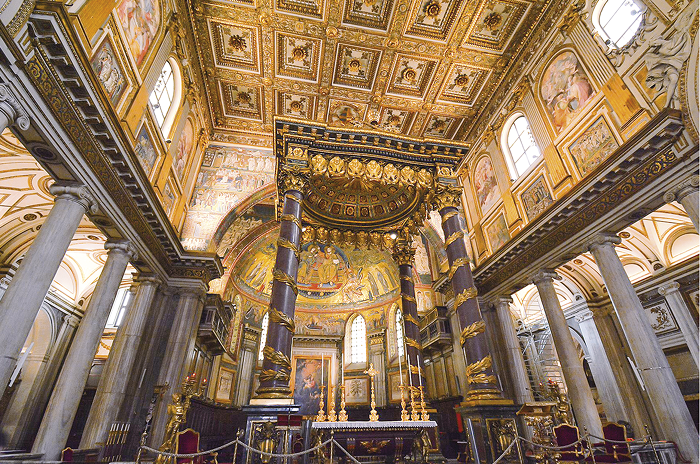
Our pilgrimage finally culminates at the Basilica of St. Mary Major, the first Marian church of Christendom.
Built on the site chosen by the Mother of God herself – revealed in a dream to Pope Liberius and a wealthy senator named John, one August night in the 4th century – this basilica holds a special grace.
Our Lady asked these two men to build a temple in her honour on the place where it would snow that night, in the height of the Roman summer…
The following day, the spot chosen by the Virgin was completely covered in snow. This miracle, incidentally, is depicted in the exquisite mosaics which we can admire through the arches of the gallery.
Let us descend the staircase next to the high altar, to the Crypt of the Holy Manger. Here, in the heart of the basilica, we are able to venerate the boards of the manger of Jesus and to savour something of the Divine Infant’s presence and sweetness, imploring Him to bless us at the end of this blessed pilgrimage.
Before withdrawing, however, let us visit the Pauline Chapel in the left-hand aisle, where there is a precious icon of the Blessed Virgin, attributed to St. Luke the Evangelist: Salus Populi Romani, the gate of salvation not only for the Roman people, but for the whole world.
In the diversity of the churches, one spirit
As our spirit reluctantly returns to the tasks of everyday life, let us reflect one last time on all that we have considered in the course of these lines.
The Holy Roman Catholic and Apostolic Church is, as Dr. Plinio Corrêa de Oliveira observes, “an immense soul, which portrays itself through a thousand things, possessing movements, grandeur, holiness and perfection, as if it were a single soul expressed through all the Catholic churches of the world.”4
And, on our pilgrimage, we have contemplated, as it were, a photo album that has brought into sharper focus before our eyes the holiness, grandeur and magnificence of the Mystical Bride of Christ, whose children we are.
Now, if we are children of the Church, we must always be imbued with her spirit, which translates especially into a serious attitude towards the struggles of earthly life, a constant elevation of thought, the practice of justice – which consists in giving everyone their due value – and into wisdom, which leads us to consider everything through the prism of the divine will.
May we, through the prayers of the Blessed Virgin Mary, so assimilate this spirit that, at the end of our pilgrimage in this world, we may exclaim, paraphrasing St. Paul: “it is no longer I who live, but the Mystical Body of Christ that lives in me!” (cf. Gal 2:20).