 Heralds of the Gospel Magazine, Vol. 20, nº 227, September 2026
 Heralds of the Gospel Magazine, Vol. 20, nº 226, August 2026
 Heralds of the Gospel Magazine, Vol. 20, nº 225, July 2026
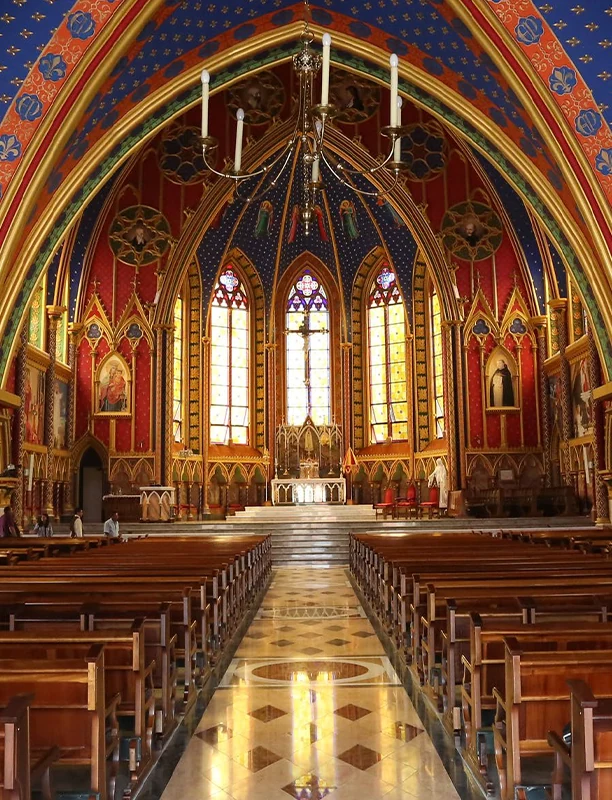 Who are the Heralds of the Gospel?
 Help of Christians
 Christmas Carols







The origin of his vocation
Francisco was born on October 7, 1847, to a very Catholic family in the Valencian town of Godelleta, Spain. The ninth of eleven children, he was frail in health but had a cheerful disposition and was always ready to serve selflessly. Endowed with privileged intelligence and an assertive personality, he soon became the leader of his companions. At the age of eighteen, while praying at the feet of the Virgin of the Pillar in Zaragoza, he received the grace that marked him forever. He described it thus, several decades later: “I joined the queue, as my father bid me. When, on my knees, I kissed the holy pillar, I felt an inner warmth that still has not dissipated.”1 He made a good Confession, received Communion and changed his life. On another occasion, he confided that this was the origin of his vocation. He was already twenty-five when, after completing his law degree in Valencia, he decided on his future: to become a priest in the Society of Jesus. Consecrated life was a great joy for him, and he soon stood out as an exemplary religious for his extraordinary humility, piety and charity; always fervent and punctual, he willingly took on the most arduous manual labour. He acquired and maintained until the end of his days the habit of sleeping only two or three hours a night – seated in a chair, never in bed – his head supported on the backrest.His great missionary labour begins
This generosity and enthusiasm would be the norm for all his activities and the reason for the good results of his apostolic endeavours. In 1879, he was transferred from the French seminary in Poyanne to the Maximus College of Oña in Burgos, where he studied theology. This small town did not enjoy a good reputation among the neighbouring villages. Francisco and one of his colleagues, John Conde, turned this situation around by creating an evening academy for young men, who were given their first lessons in literature, science and, of course, catechism. It was soon attended by almost all the local youths, who were thus freed from the vice of blasphemy and other bad habits. They, in turn, spread this influence to their families, so that within a few months a large part of the population was taking part in various devotions, such as the Dawn Rosary procession. His ordination to the priesthood took place in 1883, and the following year he was assigned to the Jesuit college in Cádiz. There, by God’s design, he received one of those blessed sources of suffering from which the success of his missions would spring: a wound on his right leg that never healed and from which he had to scrape remnants of hideous rotting flesh. As he himself once said, it was a permanent sackcloth that would cause him enormous suffering. He was later transferred to Talavera de la Reina, a small town in the province of Toledo, where he began his missionary forays into the countryside. Over the next few years, he would visit more than four hundred villages in Spain, travelling almost two hundred thousand kilometres using the taxing means of transportation of the time.Lenten Catechism
In his popular missions, Fr. Tarín implemented a new method of evangelization which became known as the Lenten Catechism for adults. It consisted of a dialogue, a sermon and a Way of the Cross. Fr. Francisco Tarín in the early years of his priesthood, with a missionary cross hanging at his neck
Tireless zeal for the salvation of souls
One of his companions attested: “He does not stop day or night; he walks from one village to another surrounded by a troop of children, preaches several sermons a day, attends Confessions for hours on end and, finally, spends the night kneeling at the foot of the altar. […] He celebrates Mass at the crack of dawn, and the first rays of the sun find him on his way to the next village.”2 On one occasion, as he had preached himself hoarse, his superiors ordered him to stop where he was for a few days. But his tireless apostolic zeal led him to take advantage of this period of rest to visit a prison nicknamed the “Hell of Cartagena.” Perplexed, the prison warden wondered if the priest was mad. However, a few hours later, he and the jailers were stunned to hear the prisoners singing in unison the hymn Forgive me, O my God, followed by Save me, Virgin Mary. The next day, starting in the early hours of the morning, he attended several of them in Confession. He even formed a choir for the Apostolate of Prayer. When he was departing, the warden advised him to be careful, for he feared that the inmates would not let him leave…Recruiting from the enemy ranks
On one occasion, on the eve of the start of a mission, his enemies hired a group of youths to disrupt his night with whistles, horns and tin drums. Father Tarín went out to meet them and spoke to them in such a fatherly way that the boys acknowledged that they had been paid to do it, and asked his pardon. Without any delay, he invited them to take part in the Dawn Rosary, which would begin in a few hours’ time. In the meantime, he brought them into the church, where several took the opportunity to go to Confession. That day, the Church’s enemies provided the musical accompaniment for the procession… In the city of Cáceres, he brought back to the fold of Christ a well-known and fiercely anti-clerical intellectual named Eduardo Sánchez Garrido. In nocturnal gatherings, he spread rancour against priests and nuns, making an impact by reading passages from an imaginative book he intended to publish entitled The Devils of the Vatican. Before long, Fr. Tarín persuaded him to reconcile with God, burn his project and put his literary skills at the service of the Church.Persecuted from outside and inside
His detractors thought they could defeat him through mockery, provocation and even physical aggression, but they never managed to frighten him. Fr. Francisco Tarín in 1909, during a mission in the region of Paradas
Fearlessness in the face of hostilities
He was also victim of the wave of anti-clericalism and social unrest that raged in Spain at the time. However, thanks to his trust in the Lord, nothing daunted him. On the contrary, he intrepidly defended his position as a priest of Jesus Christ. One day, as he passed a tavern, he noticed that two men inside were mocking him. So he went in and said to them: “It seems you were trying to call my attention because you want to kiss the crucifix. Well, here it is.” Dumb-struck, the two men took off their hats, kissed the crucifix and knelt down to receive a blessing. On another occasion, he was returning at night from a mission in the neighbourhoods of Seville and, as he approached the Jesuit residence of the city, he saw a mob of rowdy rioters who were breaking the windows of the building. He continued without hesitation. When the carriage stopped, someone realized there was a priest inside and started shouting: “A priest! A priest! There’s a Jesuit in here!” The rioters crowded around the vehicle, and not with good intentions… But when they saw Fr. Tarín, they fell silent, and one of them opened the door. They then formed a corridor to the entrance of the house and everyone doffed their hats as he passed. After the incident, they quietly dispersed.Unassuming wonderworker
There are countless testimonies to his gifts as a wonderworker. A pilgrimage in the region of Murcia had drawn around thirty thousand pilgrims on a clear, hot summer’s day. Seeing the crowd suffering terribly from the inclemency of the sun, Fr. Tarín began his sermon by addressing the following plea to the Blessed Virgin: “These faithful have come from afar to praise You, and they are suffering so much heat! Please, my Lady, close the curtains a little.”3 Immediately, a cloud appeared in the east, bringing a cool breeze with it. It grew to cover the entire sky and remained throughout the day. In the house where he stayed in Cartagena, he prayed all night without extinguishing the lamp. In the morning, a servant went to refill it with oil and saw that it was still full! What is more, the room was filled with a jasmine-like fragrance. A train carrying emaciated and hungry soldiers, fresh from the war in Cuba, once stopped at Utrera railway station. Standing on the platform, Fr. Tarín watched as through the carriage windows they asked for something to eat. Moved, he ran to the station canteen, gathered up what little bread there was and began to distribute it equally from wagon to wagon. Each soldier took his share and, to everyone’s amazement, there was still bread left over! “Miracle! Miracle! Long live Fr. Tarín!” everyone shouted, full of emotion. But he had already disappeared.The angel of Seville
At the end of 1898, he was appointed superior of the house of the Society of Jesus in Seville and held this position until 1904, when he fell seriously ill and was transferred to Madrid. During this time, he breathed new life into a decimated and ageing community, while winning the affection of the population with his continuous popular missions. His main concern, however, was the formation of the youth. He did not just want the boys to be educated; he wanted them to receive carefully prepared teachings and principles at school. To this end, he founded the St. Cassian Association of Primary School Teachers, which brought together Catholic teachers with the aim of confronting the secular teaching that was undermining Christian homes. He prophetically perceived that the liberal ferment was on the rise in Spain and that, if it continued, it would culminate in a bloody conflict. This is what happened decades later.His “dark night”
Having recovered from his serious illness in the Spanish capital, in 1909 he returned to the Jesuits’ residence in Seville. But the hour of his calvary was tolling. A new illness struck him, which left him bedridden until the hour of his death. He was no longer able to preach or carry out missions. Fr. Francisco Tarín just weeks before his death
Notes
1 JAVIERRE, José María. El León de Cristo. Biografía del Venerable Francisco Tarín. 2.ed. Madrid: BAC, 1988, p.37.
2 Idem, p.169.
3 Idem, p.172.