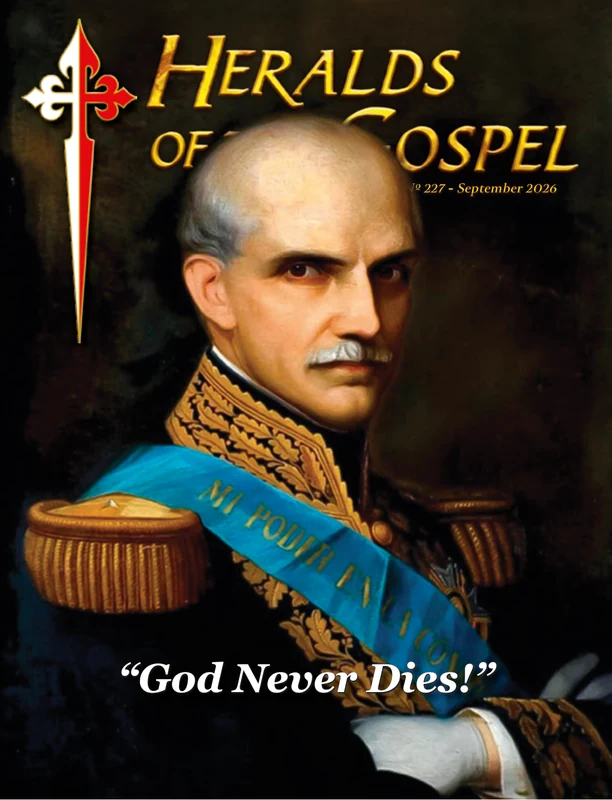
 Heralds of the Gospel Magazine, Vol. 20, nº 227, September 2026
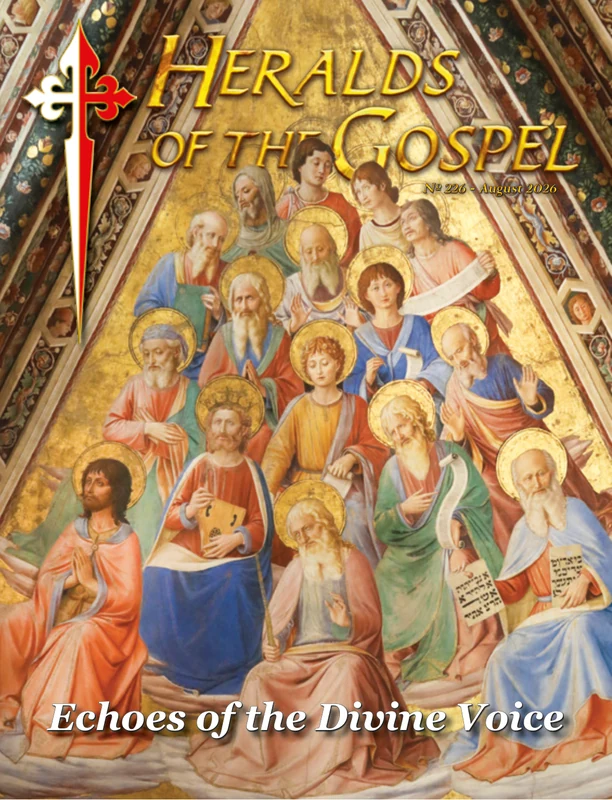 Heralds of the Gospel Magazine, Vol. 20, nº 226, August 2026
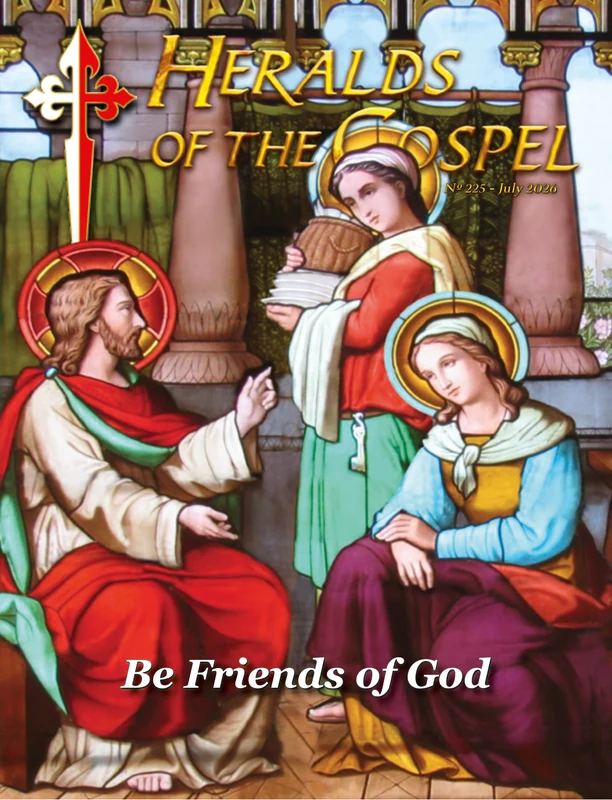 Heralds of the Gospel Magazine, Vol. 20, nº 225, July 2026
 Who are the Heralds of the Gospel?
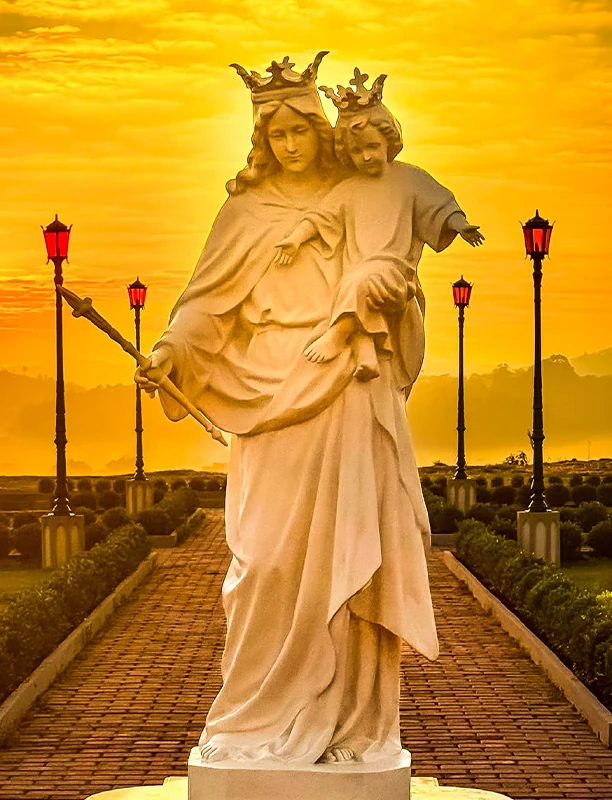 Help of Christians
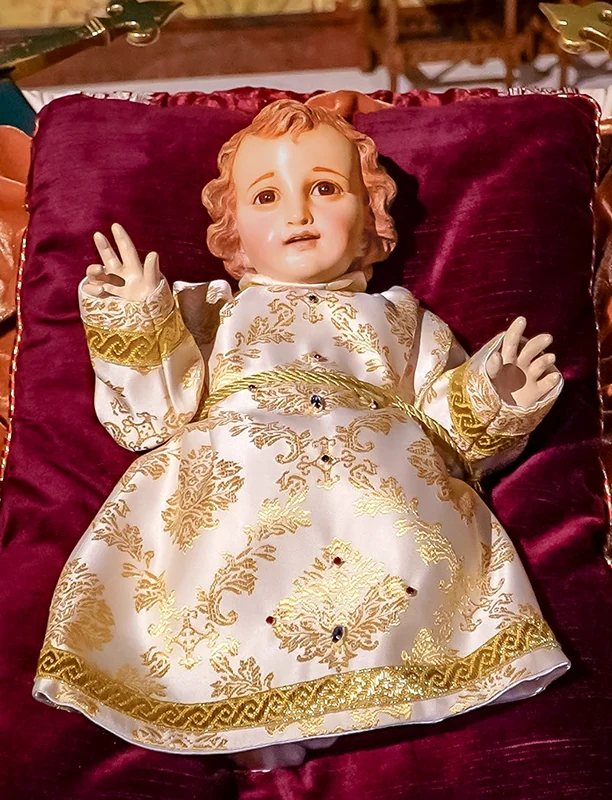 Christmas Carols







Gospel of the Palm Sunday of the Lord’s Passion
Gospel of the Procession
1 When Jesus and the disciples drew near Jerusalem and came to Bethpage on the Mount of Olives, Jesus sent two disciples, 2 saying to them, “Go into the village opposite you, and immediately you will find an ass tethered, and a colt with her. Untie them and bring them here to Me. 3 And if anyone should say anything to you, reply, ‘The Master has need of them.’ Then he will send them at once.”
4 This happened so that what had been spoken through the prophet might be fulfilled: 5 Say to daughter Zion, “Behold, your King comes to you, meek and riding on an ass, and on a colt, the foal of a beast of burden.”
6 The disciples went and did as Jesus had ordered them. 7 They brought the ass and the colt and laid their cloaks over them, and He sat upon them. 8 The very large crowd spread their cloaks on the road, while others cut branches from the trees and strewed them on the way. 9 The crowds preceding Him and those following kept crying out and saying: “Hosanna to the Son of David; blessed is He who comes in the name of the Lord; hosanna in the highest.”
10 And when He entered Jerusalem the whole city was shaken and asked, “Who is this?” 11 And the crowds replied, “This is Jesus the prophet, from Nazareth in Galilee” (Mt 21:1-11).
I – Triumphant Anticipation of the Glory of the Resurrection
In considering the triumphal entry of Our Lord Jesus Christ into Jerusalem on Palm Sunday, we should bear in mind that the Liturgy is not only a commemoration of historical facts, but, above all, an occasion for receiving the same graces created by God at that moment to distribute to the Jewish people there present. The Catholic Church, therefore, encourages the faithful to repeat this ceremony symbolically, in order to begin Holy Week with well-prepared souls. In Antiquity, military heroes and athletic champions were saluted with palms for their achievements. Therefore, Jesus wanted His Passion − which reached its apex on Calvary − to be marked with triumph from the very outset, in anticipation of the glory of the Resurrection that would follow. Resurrection of the son of the widow of Nain - Cathedral of Our Lady of the Assumption, Clermont-Ferrand (France)
 The cure of the lepers - Cathedral of Our Lady of the Assumption, Clermont-Ferrand (France)
An angle for considering the Lord’s Passion
Let us contemplate today’s Liturgy from this perspective, reliving those bright moments in which Jesus entered the Holy City, knowing that afterwards He would undergo the anguish of the Passion and the joy of the Resurrection. May the graces that were shed upon all the participants of this first procession, in which the Redeemer was present, descend upon us and fill our souls, helping us to clearly understand the role of suffering in our life as Roman and Apostolic Catholics, as a necessary means for attaining final and definitive glory. Pain and triumph are magnificently intertwined here. “Per crucem ad lucem! − By the Cross to the light!” Since space does not permit a detailed commentary on each Gospel passage that the Church has selected for this day, we will make a reflection based on both texts.Gospel of the Holy Mass
Passion of Our Lord Jesus Christ, according to St. Matthew (brief version).
11 Jesus stood before the governor, Pontius Pilate, who questioned Him, “Are You the King of the Jews?” Jesus said, “You say so.” 12 And when He was accused by the chief priests and elders, He made no answer. 13 Then Pilate said to Him, “Do You not hear how many things they are testifying against You?” 14 But He did not answer him one word, so that the governor was greatly amazed.
15 Now on the occasion of the feast the governor was accustomed to release to the crowd one prisoner whom they wished. 16 And at that time they had a notorious prisoner called Barabbas. So when they had assembled, 17 Pilate said to them, “Which one do you want me to release to you, Barabbas, or Jesus called Christ?” 18 For he knew that it was out of envy that they had handed Him over. 19 While he was still seated on the bench, his wife sent him a message. “Have nothing to do with that righteous Man. I suffered much in a dream today because of Him.”
20 The chief priests and the elders persuaded the crowds to ask for Barabbas but to destroy Jesus. 21 The governor said to them in reply, “Which of the two do you want me to release to you?” They answered, “Barabbas!” 22 Pilate said to them, “Then what shall I do with Jesus called Christ?” They all said, “Let Him be crucified!” 23 But he said, “Why? What evil has He done?” They only shouted the louder, “Let Him be crucified!”
24 When Pilate saw that he was not succeeding at all, but that a riot was breaking out instead, he took water and washed his hands in the sight of the crowd, saying, “I am innocent of this Man’s Blood. Look to it yourselves.” 25 And the whole people said in reply, “His Blood be upon us and upon our children.” 26 Then he released Barabbas to them, but after he had Jesus scourged, he handed Him over to be crucified. 27 Then the soldiers of the governor took Jesus inside the praetorium and gathered the whole cohort around Him. 28 They stripped off His clothes and threw a scarlet military cloak about Him. 29 Weaving a crown out of thorns, they placed it on His head, and a reed in His right hand. And kneeling before Him, they mocked Him, saying, “Hail, King of the Jews!” 30 They spat upon Him and took the reed and kept striking Him on the head. 31 And when they had mocked Him, they stripped Him of the cloak, dressed Him in His own clothes, and led Him off to crucify Him. 32 As they were going out, they met a Cyrenian named Simon; this man they pressed into service to carry His Cross.
33 And when they came to a place called Golgotha − which means Place of the Skull −, 34 they gave Jesus wine to drink mixed with gall. But when He had tasted it, He refused to drink. 35 After they had crucified Him, they divided His garments by casting lots; 36 then they sat down and kept watch over Him there. 37 And they placed over His head the written charge against Him: “This is Jesus, the King of the Jews.”
38 Two revolutionaries were crucified with Him, one on His right and the other on His left. 39 Those passing by reviled Him, shaking their heads and saying, 40 “You who would destroy the Temple and rebuild it in three days, save Yourself, if You are the Son of God, and come down from the Cross!” 41 Likewise the chief priests with the scribes and elders mocked Him and said, 42 “He saved others; He cannot save Himself. So He is the King of Israel! Let him come down from the Cross now, and we will believe in Him. 43 He trusted in God; let Him deliver Him now if He wants Him. For He said, ‘I am the Son of God.’”
44 The revolutionaries who were crucified with Him also kept abusing Him in the same way. 45 From noon onward, darkness came over the whole land until three in the afternoon. 46 And about three o’clock Jesus cried out in a loud voice, “Eli, Eli, lema sabachthani?” which means, “My God, My God, why have You forsaken Me?” 47 Some of the bystanders who heard it said, “This one is calling for Elijah.” 48 Immediately one of them ran to get a sponge; he soaked it in wine, and putting it on a reed, gave it to Him to drink. 49 But the rest said, ‘Wait, let us see if Elijah comes to save Him.” 50 But Jesus cried out again in a loud voice, and gave up His spirit.
51 And behold, the veil of the sanctuary was torn in two from top to bottom. The earth quaked, rocks were split, 52 tombs were opened, and the bodies of many Saints who had fallen asleep were raised. 53 And coming forth from their tombs after His Resurrection, they entered the Holy City and appeared to many. 54 The centurion and the men with him who were keeping watch over Jesus feared greatly when they saw the earthquake and all that was happening, and they said, “Truly, this was the Son of God!” (Mt 27:11-54).
II – The Contrast Between Uncreated Goodness and Human Malice
Our Lord Jesus Christ could have, in perfect justice, exalted Himself, without incurring the least sin − on the contrary, it would have been a great act of virtue, for He is worthy of all praise. But He renounced this to give us an example. And while these acclamations that He permitted (cf. Lk 19:39-40) from His disciples and from the people on Palm Sunday may be considered an exception to this rule... how meagre they were, compared to what He truly merits! The crowing with thorns, by Gaspar Insemann, Unterlinden Museum, Colmar (France)
Divine goodness manifested in the Passion
To save humanity, the Second Person of the Blessed Trinity desired to become flesh, making Himself equal to us in all things, except sin (cf. Heb 4:15). And even though a tear, a gesture, or even a desire of the God-Man would have been sufficient to redeem an unlimited number of creatures, He humiliated Himself, making Himself obedient even unto death on the Cross, as St. Paul affirms in this Sunday’s second reading (cf. Phil 2:6-11). He, who with a simple act of the will, could have impeded the action of those who sought His death − for example, by simply ceasing to sustain their being, making them return to nothing − accepted all the insults described by St. Matthew in the Gospel of the Mass. Here we savour God’s mercy, so infinitely solicitous in pardoning us. If only one of us had committed a fault and the rest of humanity were innocent, He would have suffered the same martyrdom to redeem this sole culprit! As Fr. Garrigou-Lagrange explains, in the mystery of the Redemption, “the demands of justice ultimately converge with those of love, and mercy triumphs, for it is the most immediate and profound expression of God’s love for sinners.” 4Human malice takes revenge for goodness received
Witnessing this benevolence, we see the people rejoice and earnestly acknowledge that they are truly in the presence of the Messiah. But their attitude was not profound. It was superficial; it lacked roots... If Jesus were to be received with honours today − “Hosanna to the Son of David; blessed is He who comes in the name of the Lord; hosanna in the highest!” −, within a few days the same multitude would be in the square before the praetorium, vying to save Barabbas instead of Him whom they had previously acclaimed, and shouting “let Him be crucified!”, as we read in the Passion text. Jesus carries the Cross, by Simone Martini - Louvre Museum, Paris
We should not pin our hopes on the world
With this, the Passion of our Divine Redeemer offers a lesson: those who, for worldly principles, embrace the ideal of seeking applause, pinning their hope on human approval, are sadly mistaken. They commit the folly of choosing a volatile situation for themselves, for where the practice of virtue is lacking, acclamations easily turn into hatred. The Lord’s Passion eloquently shows us the need to focus our efforts on serving Him, without a care as to whether we are attacked or praised, accepted or rejected, but only striving to ensure that our conduct is pleasing to Him. When we were baptized we made the commitment − either on our own or through the voice of our godparents − to renounce the devil, the world and the flesh, and we are forever marked by the sign of combat. At no time did we pledge to lean on the applause of others. In the celebration of Palm Sunday, then, we should recall our promises to fight, which demand from us the determination to face all of the conflicts that these enemies we rejected in Baptism will present to us. And this means imitating Jesus and carrying the cross that Providence lays upon our shoulders.The Cross: sign of ignominy and symbol of glory
The Holy Cross of Our Lord Jesus Christ! When those wicked and merciless men came before Him as He was being crucified, they looked at Him and said: “If He is the Son of God, let Him come down from the Cross!” “O venomous tongue, malicious word, perverse expression!” − exclaims St. Bernard of Clairvaux − “[...] For what sense does it make for Him to descend, if He is the King of Israel? Is it not more logical for Him to ascend? [...] All the more since He is the King of Israel, who does not abandon the title of the kingdom, the Lord who carries His Empire on His shoulders does not cast aside His sceptre [...]. If, on the contrary, He were to descend from the Cross, He would save no one.” 5 Adoration of the Holy Cross in one of the houses of the Heralds - Good Friday of 2016
III – “Per Crucem ad Lucem!”
Contrary to the chimera suggested by a certain widespread mentality, the cross cannot be abolished from the face of the earth, for in general, every human being suffers. Only in films and other fantasies of the kind − crowned with the invariable “happy ending” − do we find unreal people immune to physical or moral discomfort, successful in all their undertakings, with no interpersonal difficulties, and even raised above all the petty annoyances and disappointments of daily life. No matter how many hospitals are founded, childcare centres are opened or residences for the elderly are built, suffering is still our companion and will only cease in heavenly Paradise. It is therefore of utmost importance for man to grasp the true value of suffering, for a mistaken notion in this regard leads some people to despondency and others to revolt against Providence. Others − perhaps the majority − wish to shirk their own cross, an attempt which, beyond being futile, only makes it heavier by adding to it the burden of inconformity to God’s will, for God knows and permits each one of our afflictions.The value of the fight
Let us convince ourselves that suffering brings countless benefits for our salvation. First, it is a powerful means for drawing closer to God. Indeed, both Angels and men, having been created in a state of trial, had, from before the fall, the tendency to close in on themselves when they should have been constantly open to God. Therein lay the trial. With sin, this inclination became accentuated, and, in man, each actual fault increases its virulence. Our Lady of Sorrows, National Art Museum of Catalonia, Barcelona (Spain)
Glory acquired through suffering
By taking on flesh, the omnipotent Word, Only-begotten of the Father, wanted to experience the vicissitudes of the human state to give us an example of patience. 9 His most holy Soul, created in the beatific vision from the moment of conception, already possessed all glory, which naturally should have been reflected in His Flesh. However, in Him, the natural relationship between soul and body was subject to His divine will, which wished to suspend this law, 10 performing a miracle to His own detriment, for He preferred to take on a mortal body “that He might procure His bodily glory with greater honour, when He had merited it by His Passion.” 11 Consequently, He assumed those corporeal deficiencies stemming from original sin that are not incompatible with the perfection of knowledge and grace, such as fatigue, hunger, thirst, and death. 12 He chose to be born in a stable, where he endured the cold of the night and other hardships; He wanted to afterward live a hidden life, as a carpenter’s son, without revealing His eternal origin; and, finally, He wanted to suffer a violent death to redeem us. Subjecting Himself to all types of human suffering inflicted from without, 13 Jesus also wished to uphold the combat of the cross as the cause of the elevation of all baptized souls, heirs of God and co-heirs with Christ (cf. Rom 8:17). The first reading shows us this (Is 50:4-7), in the attitude of Isaiah − prefigure of the Redeemer − who confronted all insults for love of God and neighbour, certain that he would be neither disgraced nor thwarted, for the Lord would come to his aid and grant him the victory. Entrance of Jesus into Jerusalem - Monastery of St. Benedict, Subiaco (Italy)
IV – The Combat of a Catholic is His Glory
The lesson of the Liturgy for the beginning of Holy Week should remain etched on our memory until our last breath: we are combatants! We were not made to support those who put their hope in the world, but to defend Our Lord Jesus Christ. The world only interests us as an object of conquest for the Kingdom of God, for we want to be Apostles so that all men might share the joy we have as Christians. This joy stems from the certainty, instilled in the soul by faith, of one day recovering our body in a glorious state and experiencing a blissful eternity in the company of God, the Blessed, the Angels and the saints. Although the portal to eternal happiness is death – the natural destiny of every human being – the conviction that the cross leads to light, namely, to victory and the final triumph, balances the soul, making it calm and serene, and imparts strength to confidently face death, knowing that He who died for us on the Cross is on the other side to receive us. During this Holy Week, let us unite ourselves to Our Lord Jesus Christ and keep Our Lady company during the sorrows that will unfold before us in the following days, certain of the glory that lies just beyond them, waiting to be revealed. ◊Notes
1 EASTER VIGIL. Easter Proclamation. In: THE ROMAN MISSAL. English translation according to the Third Typical Edition approved by the United States Conference of Catholic Bishops and confirmed by the Apostolic See. Chicago: Liturgy Training Publications, 2011, p.354-355.
2 MASS FOR EASTER DAY. Sequence. Excerpt from the Lectionary for Mass for Use in the Dioceses of the United States of America, second typical edition 2001, 1998, 1997, 1986, 1970. Confraternity of Christian Doctrine, Inc., Washington, DC.
3 Cf. CLÁ DIAS, EP, João Scognamiglio. Uma mulher precedeu os evangelistas [A Woman Preceded the Evangelists]. In: Arautos do Evangelho. São Paulo. N.75 (Mar. 2008); p.10-17; Gospel Commentary for Easter Sunday of the Resurrection of the Lord – Year A, in the collection New Insights on the Gospels.
4 GARRIGOU-LAGRANGE, OP, Réginald. El Salvador y su amor por nosotros. Madrid: Rialp, 1977, p.312.
5 ST. BERNARD. Sermones de Tempore: In die sancto Paschæ, n.1-2. In: Obras completas, vol. I. Madrid: BAC, 1953, p.497-498.
6 Idem, n.5-6; p.500-501.
7 Cf. FILLION, Louis-Claude. Vida de Nuestro Señor Jesucristo, vol. III: Pasión, Muerte y Resurrección. Madrid: Rialp, 2000, p.212.
8 ST. ANTHONY MARY CLARET. Sermones de Misión, vol. III. Barcelona: L. Religiosa, 1865, p.197.
9 Cf. ST. THOMAS AQUINAS. Summa Theologiæ, III, q.14, a.1.
10 Cf. Idem, ad 2.
11 Idem, q.49, a.6, ad 3.
12 Cf. Idem, q.14, a.4.
13 Cf. Idem, q.46, a.5.
14 GARRIGOU-LAGRANGE, op. cit., p.309.
15 ST. THOMAS AQUINAS, op. cit., q.49, a.6.