 Heralds of the Gospel Magazine, Vol. 20, nº 227, September 2026
 Heralds of the Gospel Magazine, Vol. 20, nº 226, August 2026
 Heralds of the Gospel Magazine, Vol. 20, nº 225, July 2026
 Who are the Heralds of the Gospel?
 Help of Christians
 Christmas Carols








An apparent contradiction
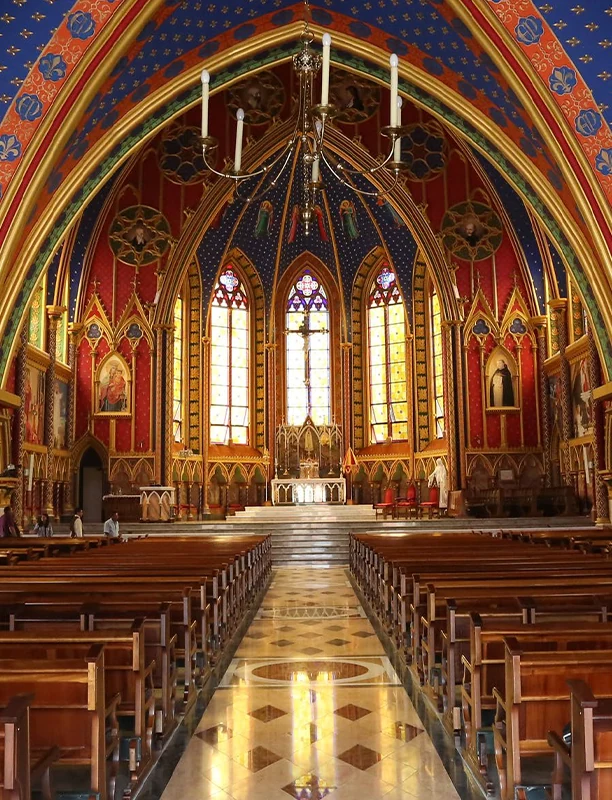
Whenever I see Gothic monuments, and Cologne Cathedral in particular, I am struck by two contradictory impressions in the depths of my soul. On the one hand, it is something so beautiful that if I did not know it, I would not be able to imagine it. It therefore surpasses any dream I could have. But on the other hand, looking at it, something inside me says: “This should exist! This façade, while being unimaginable to me, is, at the same time and paradoxically, an old acquaintance, as if I had dreamt of it all my life!” The unimaginable and the dream meet in an apparent contradiction, and there is something about this encounter that deeply satisfies my soul. I have an internal impression of orderliness, elevation, appeasement and strength, an invitation – I have just said appeasement – to combativeness, which is good for me even at my age.1Ultimately, there is something in us that wants something we cannot imagine. But that part of our spirit, which is made for certain things, desires them and knows them so well that, when it sees them, it has the impression of meeting an old acquaintance. And on the other hand, it is surprised to find the unimaginable. So there is something in the depths of us that, without our realizing it, outlines a figure of wonders – which I would not say were dreamt of, but longed for, sketched out – born of the needs of our soul.There is something in the deepest part of us which, without our perceiving it, outlines a figure of wonders, born of the needs of our soul
Something mysterious that demands dedication and enthusiasm
When we find this marvel, we say to ourselves: “Ah, here is the awaited façade! I could not die without having seen it. My life would not be complete; I would not be entirely myself if I had not contemplated it. O blessed façade, blessed style, which brings out something from deep within my soul and, in a way, makes me know myself, and comprehend what I was created for. “It is something mysterious that demands all my dedication, all my enthusiasm, and calls for my soul to be entirely like that. Arising from it is a school of thought, of sensibility, a style of will, and a way of being, for which I feel I was born. It is something much greater than myself. “Those men who preceded me also had this desire in the depths of their souls. They even conceived what I did not conceive and did what I did not do. They had a desire so high and so universal, corresponding to the deep yearnings of so many men, that the monument they produced remained forevermore: Cologne Cathedral!”
The “lumen” of our souls: more beautiful than stained-glass windows
There is a concept of light that is born in my spirit, which is not, of course, electric light or even a beautiful light filtered through stained-glass windows, but much more than that: a light that is in the human soul, looking for what is luminous outside, for the feast of encounter and participation. The light within meets the light without. More beautiful than all the stained-glass windows in Cologne Cathedral is the lumen that resides deep inside our souls, and by which we are enraptured when we see this cathedral. It is a luminosity that exists within us, a movement of soul, a desire which is more beautiful than that which we desire. Let us imagine that someone were to offer Our Lady a flower. She would look at the rose and give a charming smile. In the encounter with the rose, what was deep inside her shone forth. However… how much more beautiful than the rose is the Blessed Virgin’s smile! So what is deep inside her soul is worth more than what made her smile! We can say something similar about the souls who love Cologne Cathedral. Every time a person passes by and, in a spirit of faith, looks at it and becomes enthusiastic – admires a stained-glass window, an ogive, a sculpture, the towers, that little spire between the two towers – the cathedral that they have deep inside their soul, the wonders that it has in a germinal state, smile. And this pleases Our Lord in the tabernacle and Our Lady in Heaven more than the cathedral itself. When we see the splendours of the stone cathedral, the people coming and going, we say: “How men love this!” And we can also say: “God, in the highest Heaven, how He loves this!” Indeed, more beautiful than the cathedral is man’s love of it. Because man is God’s masterpiece in the visible universe. And all our movements of soul, which lead us to love what God has made or what the Holy Spirit has inspired for God’s glory, are more beautiful than the material things man has made. We smile at the cathedral; the Creator and Mary Most Holy smile at us. Just as in the case of the rose. The giver of this flower would smile, seeing Our Lady smiling at the rose. And he would say: “This smile is more beautiful than the rose. The soul beholding the rose has more pulchritude than the rose it beholds.” Such is the pulchrum that lies deep within the innocent soul. It is a form of light, which consists of the longing, the desire, the will to find something we know not what, but when we find it, we realize that we were looking for it. And therein lies the enigmatic nature of this phenomenon.Finer than all the stained-glass of Cologne Cathedral is the “lumen” residing deep inside our souls, by which we are enraptured when we see this cathedral
The great encounters of our lives
There is a very true French saying that I repeat from time to time in these talks: “Those who do not know what they are seeking do not know what they find.” But it has its limitations. Sometimes the great encounters of our lives are with things we were looking for without knowing it, because they are ineffable; that is, there are no words capable of expressing them adequately.The best of our soul is in what we are looking for, without having the words to express it; and when we find it, we do not have the words to praise it sufficiently. And in this encounter between the inexpressible and what is above all praise, an arc is formed that brings joy to our soul. Therein lies the meaning of our life. A man who throughout his life found what he ought to have looked for can say: “I have lived!” If he has not, at the time of his death he can say: “I went through life like a dog without a master. I have eaten from the rubbish bins, drunk from the gutters, slept in the drizzle, the mud, the rain or the sun, but I have not lived. Because I did not find a kind hand to caress me, a good owner to care for me. I was made for fidelity, to serve, but I did not find anyone to serve. I have lived an empty life and I die haphazardly.” When the child becomes a young man, then a man, and so on, this search is satisfied by the circumstances of life, because he finds wisdom from the very first glimpses – if he is indeed looking for it. Scripture says that wisdom is like a woman who comes begging at the door of our souls from dawn, waiting for us to open and receive her (cf. Wis 6:13-14). In reality, she has the splendour of a queen, who with her motherly affection and her incomparable radiance invites innocence to follow her. And the innocence that follows the path of wisdom is the stem, the root of holiness. So, this innocence that allows itself to be guided by wisdom means that man encounters the Holy Roman Catholic Church at an early age and says: “There is a mystery here. This is the wonder of wonders! I give myself to it, and once and for all! Through the Church, how many other wonders there are to behold! In Christian civilization, how many beauties of the past!”The best of our soul is in what we seek, without having the words to express it; and when we find it, we do not have the words to praise it
The inner light of the innocent soul
And each of us goes about building a kind of interior museum, more beautiful than any adorned room, where we keep the “objects” we possess. They are the memories of what touched our soul, of those moments when we felt such enthusiasm, contentment and equilibrium that we were left breathless, as it were, and at a loss for words.
Quintessential and superior beauty
You are all are perceiving that this is a way of saying: Credo in unum Deum, Patrem omnipotentem, creatorem cæli et terræ, visibilium omnium et invisibilium – I believe in one God, the Father almighty, maker of Heaven and earth, of all things visible and invisible. Why God? Because man knows perfectly well that a piece of glass is a piece of glass, and the sun is nothing but the sun. And that all this would be an illusion if it were not the expression of an infinitely greater Being, who hides Himself from our senses, but shows Himself through these symbols. All this would be absurd if this Being did not exist. Now, since it is impossible for so much order and beauty to be absurd, the conclusion follows: He does!
“My child, I am your cathedral! The cathedral exceedingly great! The cathedral exceedingly beautiful! The cathedral that made a smile bloom on the Virgin’s lips like no jewel, no rose, none of the mere creatures She knew, could make bloom.” This cathedral is Our Lord Jesus Christ. It is the Heart of Jesus, who deposited ineffable harmonies in the Heart of Mary. There we will meet Him. When we see monuments like Cologne Cathedral, we have a certain feeling of the exceedingly great, the exceedingly delightful, which is out of all proportion to us, but towards which we fly; it is the hope of Heaven. ◊In loving these wonders, we are actually loving the most pure Spirit who created all of this, so as to say to us: “My child, I am your cathedral!”
Taken, with adaptions, from: Dr. Plinio. São Paulo. Year XIII. N.152 (Nov., 2010); p.30-35
Notes
1 Dr. Plinio was seventy years old when he gave this conference.